
Key Points
- Undergraduates, graduate students and faculty co-authored the 2026 Great Salt Lake report.
- Utah's 2034 Winter Olympics give lake policy research a hard deadline.
- Northwestern's study of 528 education grants supports planning multi-year policy timelines.
Introduction: Why Regional Reports Need a Social Science Chapter
When a lake shrinks, an aquifer drops, or a coastline erodes, a report team usually forms within months. It tends to be staffed with hydrologists, ecologists and engineers, and a social scientist is often added late or not at all. That gap matters because the questions legislators ask next are about residents, costs and behavior.
The 2026 Report on the State of Great Salt Lake Social Science, released in September 2026 by a multi-university network based at Utah State University and covered by USU Today on October 27, 2026, serves as the running case here.
Agencies increasingly treat social evidence as a required input, but the invitation still tends to go to researchers they already know.
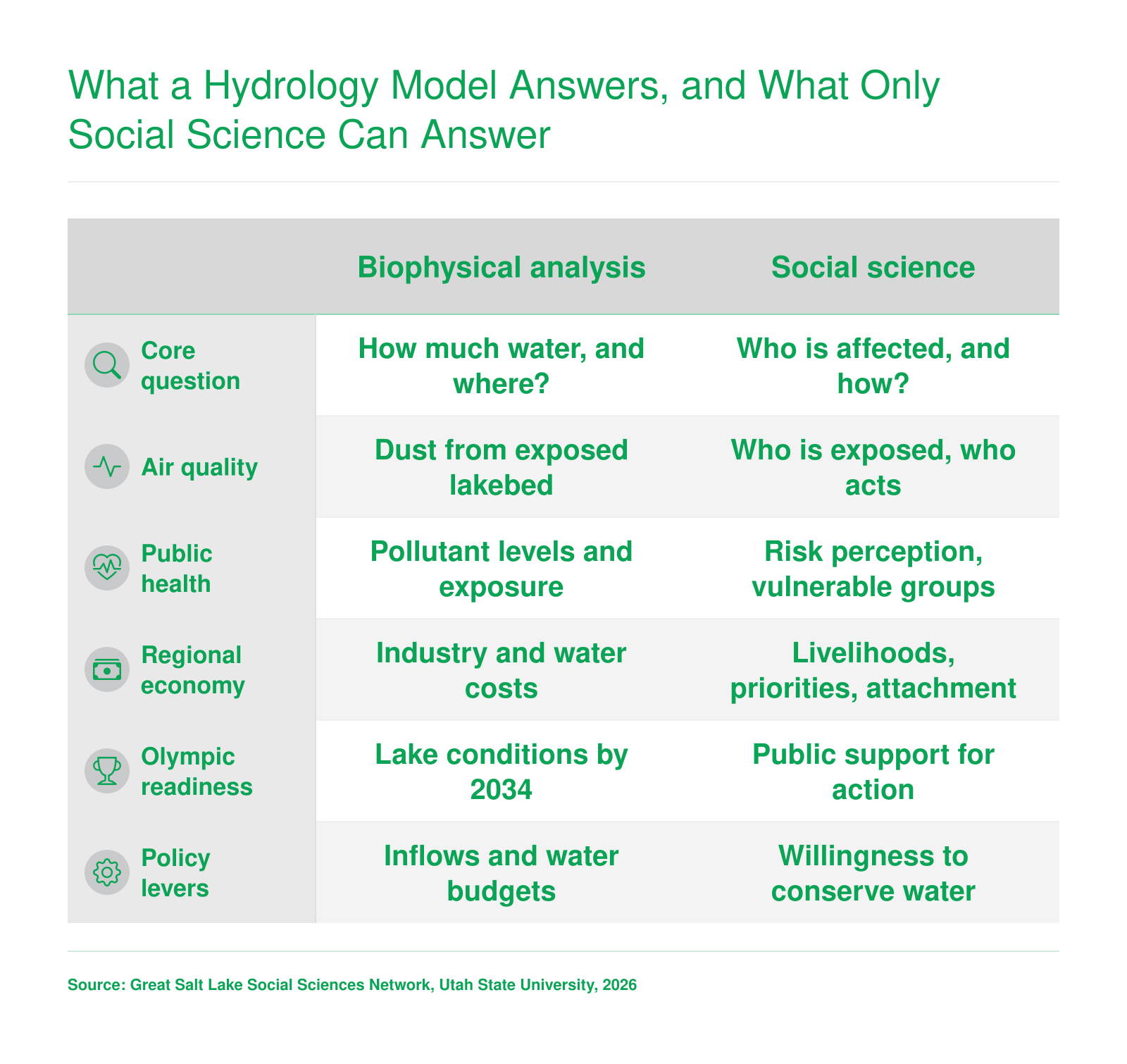
What a Hydrology Model Answers — And What Only Social Science Can Answer
The 2026 Report on the State of Great Salt Lake Social Science flags growing risks from the shrinking lake to air quality, public health, the regional economy and conditions for the 2034 Winter Olympic Games. Each of those risks has a physical side and a human side, and the two kinds of analysis are complementary: social science does not replace the water model, it explains who is affected, what they will support and how policy can respond.
Four Kinds of Policy Reports — And What Quality Control Looks Like in Each
Not every policy report is held to the same standard, and social scientists should know which kind they are writing before they agree to contribute. The 2026 Report on the State of Great Salt Lake Social Science, produced by a multi-university network based at Utah State University, is an example of the first type below. It is a synthesis of existing research meant to inform policy, research and action. The other formats move faster or answer narrower questions, and each relies on a different kind of review.
| Report Type | Who Commissions and Produces It | Review and Quality Control | Typical Turnaround | Best Used For |
|---|---|---|---|---|
| State-of-the-research synthesis | Research networks or university consortia, often with faculty, graduate students and undergraduates as co-authors | Review across co-authors and partner institutions, plus documentation of which studies were included and why | Months, and longer when many institutions coordinate | Establishing what is known about an issue, flagging research gaps, and showing public value to funders and legislators |
| Agency-commissioned technical assessment | State or federal agencies and legislatures, produced by university institutes, consultants or agency staff | Scope fixed by contract or statement of work, with agency technical review and sometimes external peer review or public comment | Set by contract terms or legislative deadlines | Informing a specific regulatory, budget or resource-management decision |
| Policy brief | University institutes, research teams, think tanks and nonprofits | Mostly editorial and internal review, so credibility depends on how clearly claims trace back to underlying studies | Weeks | Putting key findings in front of legislators and staff during sessions, hearings or public debates |
| Community or regional needs assessment | Local governments, foundations, regional coalitions and nonprofits, often produced with community partners | Stakeholder validation, community advisory input and documented sampling and consultation methods | Often months, because consultation takes time | Setting local priorities, supporting grant applications and guiding regional planning |
How to Tell Whether a Policy Report Is Credible
How can you judge whether a policy report deserves trust when you only have five minutes? Ask four questions, then weigh the answers against the kind of report you are holding.
Four Screening Questions
- Who commissioned and funded it? A credible report names every funder, sponsor and commissioning body, and says what role each played, from setting the question through publication.2
- What does the methods appendix say? Look for scope, assumptions, sampling, data sources and limitations.1 An experienced reviewer with no prior connection to the work should be able to follow what was done, when, and how the results were reached.3
- Do the conclusions match the evidence? Findings and recommendations should trace back to material actually presented. Where evidence conflicts, the report should say how it was weighed and what uncertainty remains.
- Did outsiders review it? National Academies reports go through independent expert review, with reviewers anonymous to the committee.1 Ask whether any comparable check happened.
Match the Standard to the Genre
The bar is not identical across report types. A peer-reviewed academic chapter should show blind review and a full methods trail. A government report should show formal review, and often public comment. GAO audit work, for example, falls under standards revised in 2024 that make quality management and peer review a dedicated area. A think-tank report may be perfectly usable if funders are disclosed and methods are open. An advocacy report argues a position, so read it as a case for that position and check its sources yourself.
Red Flags
- No methods section at all.
- Sample sizes left unstated.
- Citations that point to press releases instead of studies.
- Funders or conflicts of interest left undisclosed.
- Recommendations that outrun the data presented.
Building Credibility into Your Own Chapter
If you are a contributor, you control more of this than you might think. Document your methods well enough that a stranger could follow them. Archive your instruments, protocols and data dictionaries, and share datasets or code where privacy, confidentiality and legal limits allow.1 No single rule requires every policy report to release all underlying data, but you should be able to explain what is and is not available, and why.
State limitations plainly instead of burying them. Disclose your funding inside the chapter itself, along with any financial, professional or institutional interests a reader might reasonably want to know about.2 If an error surfaces later, label the correction clearly.1 Those habits are what turn a chapter into evidence that agencies and other researchers can cite with confidence.
- Principles and Practices That Guide Our Work, National Academies
- GAO-24-106786 Report, U.S. Government Accountability Office
- GAO Documentation Standards, U.S. Government Accountability Office
Community Participation and Stakeholder Consultation: Turning Voices into Evidence
Deep community input takes time and money, while a deadline-driven report rewards speed. Teams that want consultation to count as evidence have to choose methods deliberately and pay for them early.
The Methods Menu and Its Trade-Offs
No federal template requires a particular combination of methods, so the choice is yours. Each one buys something different.
- Stakeholder advisory committees: Appointed, representative members give continuity from planning through review.1 The cost is that a small committee can speak for a community it only partly reflects.
- Deliberative workshops: Presentations, deliberation and prioritization at scoping, alternatives, impact and draft stages show how people reason about trade-offs.2 Keep staff information separate from participants' own views.
- Participatory mapping: Local knowledge captured on paper, in GIS, through photos or on mobile devices adds place-based detail.3 Participation is often uneven, and some Indigenous or culturally sensitive knowledge should not be published.
- Survey panels: Probability-based designs support population-level estimates.2 Targeted surveys or interviews can reach groups a panel misses.
Document Consultation as Data
Record who was consulted, how they were chosen, what they said, and what changed in the report as a result. A comment-response matrix for the draft review, the concern, the section affected, the response, the reason when nothing was revised, lets a reader audit consultation instead of taking it on faith.4
Avoid Extractive Consultation
Report findings back to participants, in plain-language summaries and accessible formats.5 Name contributing organizations. Technical or financial assistance may be needed for some groups to take part meaningfully, so put that time and money in the budget before the grant is submitted, not after the interviews are done.4
Consultation Versus Evidence
Three listening sessions are context. They can shape questions and flag blind spots, but they prove nothing about how common a view is. Evidence comes from survey or qualitative data with a stated method: sampling frame, recruitment, dates, sample size, response rate, weighting, question wording and languages, and how nonresponse limits the findings. Interviews and focus groups should be adapted for language, literacy, access and privacy.
Name Who Was Not in the Room
Close the consultation section by saying who was not reached: renters, shift workers, non-English speakers, Tribal members, or anyone else your methods missed. Explain why and what that does to the conclusions. That limitation paragraph is what separates a credible assessment from a press release.
A regional report becomes usable policy evidence only when social science explains who is affected, what they value, and which solutions they will support, and that is the chapter hydrologists cannot write for you.
How Long Research Takes to Reach Policy — And How to Track What Happened
How Long Research Takes to Reach Policy, and How to Track What Happened
Research-to-policy timelines are now being measured rather than assumed, and the results argue for planning on a multi-year horizon.
A 2026 Northwestern Institute for Policy Research working paper followed 528 Institute of Education Sciences grants funded between 2002 and 2022 and found that 70 percent eventually reached government policy.1 Among those, the average gap from funding to a first citation in a government policy document was 8.2 years, with each grant cited in about six documents.1 Read that carefully: the measure is documentary uptake, not enactment, rulemaking, or confirmed implementation, and the study does not claim that citations caused policy change. Treat it as an order of magnitude, not a deadline. A 2020 systematic review made the mismatch plain in a different way: research unfolds over years, while policymakers' windows for action often last weeks or months.
A Fast Loop Is Possible
The Great Salt Lake case shows the other tail of the distribution. Utah's legislature made policy changes and financial contributions benefiting the lake during the same period in which the 2026 Report on the State of Great Salt Lake Social Science reached the public, and the network behind it is built to refresh its synthesis annually. An annual review paired with a live policy debate is what shortens the apparent lag.
Instruments That Show What Happened
- Bill tracking: follow the specific bills that touch your recommendations, including committee substitutes.
- Rulemaking dockets: the agency rule implementing a statute often matters more than the statute.
- Hearing records: testimony and questions reveal whether a chapter entered the argument.
- A follow-up synthesis: a second "state of the research" report stating which recommendations advanced.
The Government Accountability Office offers a working template: it follows up on recommendations at least annually and classifies each as closed and implemented, open and partially addressed, or open and not addressed. About 70 percent of recommendations made over the previous four years were implemented, though outcomes vary widely.2 As of August 2026, the Department of Veterans Affairs had not fully implemented 14 of 18 recommendations cited in a review.3
Build the Tracker on Day One
Keep a table of recommendations with a named owner and a twelve-month review date. Teams that wait until publication to design follow-up usually never do it.
- Research-to-Policy Timelines Working Paper, Northwestern University Institute for Policy Research
- GAO Annual Report on Recommendations, U.S. Government Accountability Office
- GAO Recommendation Status Updates, U.S. Government Accountability Office
Did You Know?
The deliverable is not a bound PDF. It is a decision-maker who can find your chapter the week a hearing is scheduled, plus a record of what happened after publication. Before you write a single section, name your specific audience and the specific window you are writing for.
From Report Chapter to Journal Article: Career, Funding, and Agency Relationships
Build the Relationship Before You Need It
Agency scientists at state natural resource departments, extension staff, and legislative research aides are repeat collaborators. The invitation to join an assessment team usually follows years of showing up: serving on a technical advisory group, reviewing a draft, answering a data question during a hearing cycle. Do that unpaid, low-stakes work early and the ask arrives when a report is being scoped.
Turn a Chapter into an Article Without Hiding the Report
Reframe the question. A chapter answers what is known about one lake, watershed, or region; a journal article needs a portable question that a reader in another state can use. Add a comparison case, a second time period, or a testable proposition about how publics respond to environmental change. Then disclose the report in the acknowledgments and the cover letter as prior dissemination. Editors generally treat a synthesis written for a commission differently from a duplicate submission, but they need you to say so plainly rather than let a reviewer discover it.
Put Reports in Their Own CV Line
Several U.S. universities now give commissioned and agency reports a category of their own. Rhode Island's annual review guidelines list reports alongside peer-reviewed and non-peer-reviewed articles1; UNC Greensboro names project reports and assessment protocols among non-peer-reviewed work2; Houston counts technical reports among indicators of scholarly work.3 Use that space well: name the commissioner or convening body, state your role (lead author, chapter author, methods contributor), and record documented uptake.
Distinguish dissemination from uptake. "Presented findings to the interim legislative committee" is dissemination. "Cited in testimony" or "adopted as the agency's baseline assumptions" is uptake. Claim causation only when you can point to the record.
Make Uptake the Spine of the Funding Story
Funders ask about reach and significance, and two forms of evidence travel furthest: citation in legislative proceedings and a follow-on agency contract. Both show that someone outside the academy acted. Collect partner letters and impact notes as they happen; reconstructing them at review time rarely works, because the staffer has moved on and the memory of who used what has faded.
Applied report work is still unevenly valued. Some departments file a commissioned report under public service; others will not weigh it near peer-reviewed scholarship, and Penn State's guidelines still tie the formal record to peer review.4 Review by a sponsor or advisory panel is not peer review, so describe the review accurately. Run a peer-reviewed pipeline alongside the applied work and let documented uptake argue that the report side is scholarship, not service alone.
- Annual Review Guidelines, University of Rhode Island
- Best Practices in Tenure, University of North Carolina at Greensboro
- College of Education Non-Tenure Track Promotion Guidelines, University of Houston
- IST AC-18.2023 Promotion and Tenure Guidelines, Penn State
A Checklist for Contributing to Policy-Relevant Assessments
Use this sequence for any community or regional report, from the first invitation through the months after release.
- Settle authorship before you commitAgree in writing on contributor roles and author order, including students. The Great Salt Lake social science report credited undergraduates, graduate students and faculty.
- Name the decision and the audienceIdentify which legislature, agency or nonprofit will use the findings, and what choice they face.
- Fix evidence standards before draftingDefine the review's scope, what counts as eligible research, and how surveys and qualitative work will be weighed.
- Plan stakeholder input earlyDecide how community voices will be gathered, documented and cited as evidence.
- Separate findings from recommendationsLead with what the evidence shows, then mark clearly where interpretation begins.
- Flag what needs further studyName emerging issues, such as a proposed development or an upcoming public event, as open questions instead of settled findings.
- Stay reachable after releaseInvite policymakers and stakeholders to contact the authors with follow-up questions.
- Turn chapters into publicationsBefore submitting a peer-reviewed version, check each journal's prior-publication policy and record where the report was cited or used.