Key Points
- Reweighting and imputation cannot recover categories an instrument never asked about.
- FAIR2 has four steps: frame, articulate, identify bias, report back.
- Data Chats have community members review visual summaries of administrative data.
Introduction: Bias Enters the Data Before the Data Exist
Francisca García-Cobián Richter, a research associate professor at Case Western Reserve University's Mandel School of Applied Social Sciences, put the stakes plainly in an October 2026 university story: "When data is collected in a biased society, data technologies may only serve to perpetuate these biases." Her team's answer is FAIR2, a four-principle framework for participatory data science.
The harder claim follows from it. Bias in social science data is usually settled upstream, in the categories on a form, the proxy variables, the sampling frame, and who sits in the room, not in the post-hoc correction. No weighting scheme repairs a question never asked.
What Community-Engaged Research Is — And How It Differs from CBPR
What Community-Engaged Research Is, and How It Differs from CBPR
Community-engaged research (CEnR) is scholarship done in partnership with the people affected by the question. Community input runs across the research lifecycle, framing the question, instrument design, sampling, analysis, interpretation, dissemination, not only at recruitment, when a study needs participants.
CBPR sits inside that family as the most intensive form. Community-based participatory research is defined by shared decision authority, co-learning, capacity building, and community members serving as co-researchers rather than advisors. The two terms are not synonyms, and hedging about the difference helps no one. What holds across most definitions is durability: partners are engaged before the question is fixed and stay engaged after the findings exist.
A Four-Question Authority Test
Most arguments about whether a study "counts" as CBPR dissolve once you name the specific decisions at stake. Ask who holds real authority over four of them:
- The question: who decides what is worth studying?
- The instrument: who can change wording, categories, or response options?
- The analysis: who interprets what the results mean?
- The byline and the data: who is credited, and who controls access afterward?
If the community holds shared or final authority on most of these, call it CBPR. If community members advise, review, or consult while the research team retains final say, it is community-engaged research of a different type. Both are legitimate. Only one is participatory in the governance sense.
Why the Label Matters
Funders, IRBs, and peer reviewers read these terms differently. A proposal promising CBPR implies a governance structure with partners at the decision table, a budget line for their time, and often a written agreement about data and authorship. Labeling a consultative study as CBPR sets up expectations the project cannot meet, and reviewers who know the literature will notice the gap. The subtler cost lands on partners, who signed on to advise and later learn they were described in the application as co-investigators without authority.
Where the Levels Sit
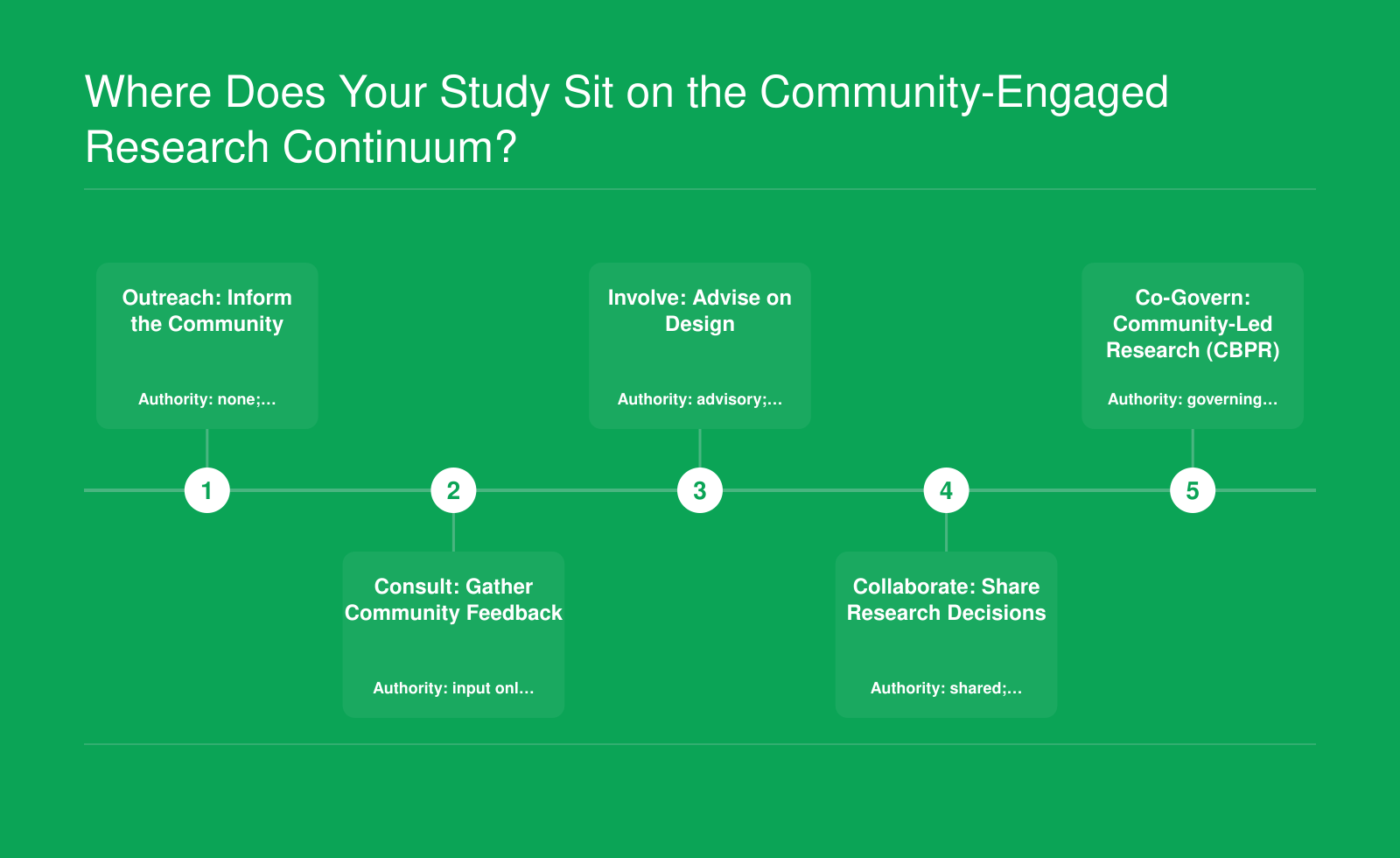
The distinction is easier to hold as a continuum than as a binary, with outreach at one end and co-governance at the other. The next section maps that range.
The Community-Engaged Research Continuum: From Outreach to Co-Governance
Community engagement is a ladder of decision authority, not a yes-or-no label. Each rung below names what the community actually controls and the mechanism that usually delivers it. Place your own study honestly: claiming one rung lower than you think is the safer, more defensible claim in a grant application.
Did You Know?
No weighting scheme, imputation model, or robustness check can recover a category your form never offered, or a respondent who looked at the options and declined to answer. Measurement decisions are bias decisions, and you make them months before the first line of analysis code. The instrument is where the bias lives.
The FAIR2 Framework: Frame, Articulate, Identify, Report
FAIR2 turns community input from a courtesy into a four-step workflow that runs from the first design memo to the last dissemination plan. Francisca García-Cobián Richter, a research associate professor at Case Western Reserve University's Mandel School of Applied Social Sciences and co-director of its Center on Poverty and Community Development, developed it with colleagues. The university's October 21, 2026 newsroom story (https://case.edu/news/we-may-never-be-able-eliminate-biases-social-science-data-cwrus-francisca-garcia-cobian-richter-getting-us-closer-centering-community-knowledge) describes the framework and its practical use.
The Four Principles by Research Stage
The authors define each principle briefly.1 Mapping them onto the research lifecycle is our reading, but it shows how the framework works in practice.
- Frame (design): frame data and metadata with input from those represented in the data.
- Articulate (modeling): articulate relevant community insights into modeling assumptions.
- Identify (analysis): identify potential biases.
- Report (dissemination): report findings back to affected communities.
Later descriptions from the team expand these.2 Framing becomes contextualizing data with historical and community knowledge, and identifying becomes finding discrimination bias embedded in both the data and the modeling. Reporting includes seeking feedback from community members, not only sharing results.
Do Not Confuse It with the FAIR Data Principles
The acronym invites a mix-up. The FAIR data principles (findable, accessible, interoperable, reusable) are a data-stewardship standard. FAIR2 is a participatory, bias-focused framework. A dataset can satisfy one and fail the other, so name them separately in methods sections and proposals.
Citing and Teaching It
The framework appears in García-Cobián Richter, Nelson, Coury, Bruckman, and Knighton, "FAIR2: A Framework for Addressing Discrimination Bias in Social Data Science," CARMA 2023 proceedings (Universitat Politècnica de València), pp. 327-335, DOI 10.4995/CARMA2023.2023.16400. A companion piece on FAIR2 Data Chats appears in the Journal of Participatory Research Methods.
Four named steps are compact enough for a single graduate methods unit: students can audit a published administrative dataset against each principle. The same names work in a grant narrative, where each stage can carry its own deliverable instead of a vague promise of community involvement.
- FAIR2: A Framework for Addressing Discrimination Bias in Social Data Science, De Gruyter Brill
- Journal of International ... Volume 2 Issue 2, De Gruyter Brill
Community-Engaged Data Collection Methods, Compared
The methods below draw on guidance from university community-engagement and extension resources, including the University of Kansas Community Tool Box, Northwestern University's Feinberg School of Medicine, and Iowa State University. The later rows describe structured data review formats, the family FAIR2 Data Chats belong to, in which community members work directly with charts, maps, and summaries instead of only answering questions about their own lives. Published guidance gives concrete cost and timeline detail mainly for the review-session formats, so set budgets and schedules with your community partners rather than treating any row as a fixed estimate.
| Method | Best suited for | Relative cost | Typical timeline | Staffing and expertise | Bias-reduction leverage |
|---|---|---|---|---|---|
| Photovoice | Documenting lived experiences and community perspectives through photography and storytelling | N/A | N/A | Participant support for recording and reporting methods matched to preferences, language, accessibility needs, and setting | Opens space for local knowledge, quieter voices, and diverse perspectives |
| Community mapping | Eliciting community priorities, local knowledge, and affected populations' perspectives through mapping and visioning | N/A | N/A | Participatory facilitation that can use culturally rooted methods and accessible ways of sharing findings | Makes room for quieter voices, local knowledge, and diverse perspectives |
| Focus groups | Group interviews or discussion when the research questions call for them | N/A | N/A | A collaboratively developed interview guide, plus regular debriefing and troubleshooting meetings for data collectors | Can accommodate participants' preferred languages, accessibility needs, and communication formats |
| Structured participatory data review sessions | Community members interpreting data, identifying patterns, and discussing implications through reflection meetings, data walls, participatory coding, or joint sense-making | Requires adequate budgeting for events and materials | Analysis is iterative and needs adequate time | Balanced participation: academics bring rigorous research and analysis expertise, while community partners interpret and communicate findings for broader audiences | Community feedback can correct findings and add community interpretations of what results mean |
| Reflection meetings | Interpreting data together, identifying patterns, and discussing implications | N/A | N/A | Facilitation techniques such as dialogue circles or visual prompts | Supports inclusive participation in collective interpretation of findings |
| Data-wall sessions | Identifying emerging themes from printed charts, maps, or quotations | N/A | N/A | Preparation of visual data displays and facilitation of participant interaction with them | Lets visual learners and less literate participants engage fully |
| Participatory coding workshops | Community members categorizing and interpreting qualitative data such as interviews or stories | N/A | N/A | Facilitation of collaborative categorization and interpretation using color-coded sticky notes or digital platforms | Adds community members' own categories and interpretations to qualitative analysis |
| Data party | Involving stakeholders in meaningful analysis of research data through a planned group event | Food, venue, participant remuneration, and other event logistics | Event length planned with participants and data-analysis partners | A trained facilitator for delicate or volatile data, or co-facilitators representing invited groups | Co-facilitators from participating groups, with participants invited to shape the analysis process |
- Evaluating Participatory Action Research Projects, University of Florida IFAS Extension
- Chapter 36. Section 6. Participatory Evaluation, University of Kansas Community Tool Box
- Community Engagement and Participatory Approaches, Columbia University School of International and Public Affairs
- Chapter 1, Section 11. Participatory Evaluation - Tools, University of Kansas Community Tool Box
- Collaborative Data Analysis, Northwestern University Feinberg School of Medicine
- The Data Party: Involving Stakeholders in Meaningful Data Analysis, Iowa State University
Running a FAIR2 Data Chat: A Step-by-Step Protocol
What a Data Chat Is (and Is Not)
A FAIR2 Data Chat is a structured, participatory session in which community members with lived experience review visual summaries of administrative data alongside researchers. It is not a focus group. A focus group asks people what they think about a topic. A Data Chat puts a specific data display on the table and asks whether it matches reality. Participants act as subject-matter experts, and facilitation is collaborative rather than extractive.1
The Sequence
The published sources describe the principles and implementation guidance, but they do not fix a participant count, a number of sessions, or a session length. Treat the figures below as planning suggestions and settle them with your community partners.
- Name the decision: State what the data will inform, such as eligibility screening or service allocation, so participants know what is at stake.
- Build the displays: Prepare plain-language statistical or visual summaries before the session. The sources do not prescribe chart types or software.
- Recruit through trusted partners: Many teams would aim for roughly 6 to 10 people with relevant lived experience. Meet at an accessible community organization, and secure IRB approval or exemption, consent materials, and scheduling scripts first.
- Walk through the data: Ask what is missing or wrong here. Probe how data are collected at intake, whether the variables fit lived experience, and who might be misclassified.
- Log and fold in: Record corrections and interpretation notes, then carry them into the codebook, metadata, causal diagram, or model. Check back with participants to confirm you heard them correctly.2
Why the Meal Matters
Richter emphasizes shared food as a practical device. In her words, "Food is a common denominator for bringing people together, fostering the proximity needed to have open, honest conversations about data." Treat the meal as implementation support that signals respect and appreciation, not as a research instrument.
Deliverables and Grant Placement
Two documents make the process citable and auditable. The first is a written data-interpretation memo capturing qualitative context, missing variables, misclassifications, and revised modeling assumptions.2 The second is a revision log showing which displays or variables changed and why. Neither has a mandated format in the FAIR2 materials, so define yours in advance.
In a proposal, the Data Chat series fits in the community engagement plan, where it shows how local knowledge enters the design. It also fits the equity section, as a documented check for bias in the data. Finally, the report-back step can satisfy dissemination and community-benefit expectations, since findings and limitations go back to community members and agencies with experiential knowledge.
- FAIR2 CARMA 2023, Case Western Reserve University
- FAIR2 Data Chats: Advancing Public-Interest Data Science Through Participatory Research, Journal of Participatory Research Methods
Building Community Advisory Input into Study Design: Who, When, and with What Authority
Every advisory structure trades some speed and researcher control for legitimacy and better-specified data. Settle the terms of that trade on paper before fieldwork, not in the middle of a study.
Who Belongs at the Table
Executive directors and agency leads are easy to recruit, but they rarely know how an intake form feels to the person completing it. Recruit service users, frontline staff who administer the forms, and people who fall into the specific data categories under study. If the project relies on homeless services records, that means people who have actually answered those intake questions. Then audit who your format excludes. A weekday afternoon meeting in a campus conference room filters out shift workers, parents without childcare, and anyone without reliable transportation. Rotate times, meet in community venues, offer remote options, and budget for interpretation.
Map Each Decision to a Level of Authority
List the major design decisions and mark each one:
- Consult: researchers seek input and document how it shaped the choice.
- Co-decide: researchers and advisors reach agreement before moving forward.
- Community veto: advisors can block the choice outright.
Apply those levels to question framing, instrument and category design, sampling, analysis interpretation, and dissemination. One defensible allocation: co-decide on framing and category design, consult on sampling, co-decide on interpretation, and grant a veto over releasing findings that could stigmatize an identifiable group or neighborhood.
Put It in a Charter
A short advisory charter, often a page or two, should cover term length, compensation, decision rights drawn from your map, an escalation path for disagreements, and authorship and acknowledgment expectations. This document prevents disputes later and gives IRBs and funders something concrete to review.
Avoid Advisory Theatre
An advisory board convened after the instrument is fielded is a review panel, not a design partner. Schedule the first meeting before the protocol is drafted, while categories and questions can still change.
The FAIR2 Data Chat, a structured session where people with lived experience review visual summaries of administrative data alongside researchers, fits inside this structure as one mechanism rather than replacing it. Data Chats are well suited to surfacing modeling assumptions and potential biases, but a single session cannot hold decision rights or provide continuity. Route what emerges from each chat back to the advisory group that holds authority over the next decision.
The Patient-Centered Outcomes Research Institute's Eugene Washington Engagement Award Program has funded more than 1,000 projects, according to PCORI's program page updated October 3, 2026. Those awards support patients, caregivers, and community partners in shaping patient-centered research, rather than funding the studies themselves.
Tradeoffs, IRB Considerations, and Validity Concerns
Community-engaged research means sharing decisions about a study with the people the study is about, from framing the questions through reporting the results. It changes the timeline, the budget, and the ethics paperwork. Those costs are not arguments against doing it; they are things to plan for before the first instrument goes out.
What the Evidence Does and Does Not Show
The honest summary is that engagement's effects on response rates, retention, and data quality are mixed and context-dependent. The literature does not support a general numerical improvement, and no one should promise a funder an engagement dividend. What engagement reliably does is surface data-quality risks a research team would otherwise miss: literacy levels, language barriers, cultural beliefs about the topic, and attitudes toward being asked at all.1
Engagement also carries its own selection problem. A small advisory group is a sample, with all the bias any sample implies, and its review can surface a flaw without eliminating it. Scope generalizability claims to the population the advisors actually represent, and report how they were selected.
The Failure Modes to Design Against
- Tokenism: a board convened after the decisions are made, asked to endorse rather than shape them.
- Calendar mismatch: academic deadlines colliding with community rhythms and funder or seasonal cycles, so recruitment stalls.
- Partner burnout: the same few people asked again and again, usually unpaid.
- Authorship and data disputes that surface because nobody wrote down who owns what.
- Helicopter research: a team extracts data and leaves.
Each has a protocol-level fix: specify decision rights up front, budget compensation, and put authorship and data ownership in writing before collection begins.
IRB: Status Follows Activity, Not Title
Advisory-only members who review instruments, suggest outreach strategies, or comment on summary findings generally do not need IRB review.2 Oversight begins with what a partner actually does: consenting participants, delivering an intervention, collecting or accessing identifiable data, screening, or serving as a research subject.3 At that point expect human-subjects training, and possibly an investigator agreement or individual consent if the partner's own information becomes research data.
Ask the IRB to review consent language with community input, and treat consent as an ongoing, culturally appropriate process rather than a single signature.4 Community review supplements individual consent; it does not replace it.1 Check whether a tribe, school district, or agency requires its own ethical review, since that determines whether you need one IRB or several.1 Boards should weigh community-level harms, including stigmatization and reputational damage from how findings are disseminated, alongside individual confidentiality.4
Plan on engagement adding three to six months and a five-figure increment to a typical study. Discovering that in month nine is the expensive version.
- Community-Engaged Research, University of Montana
- Community Engagement, UC Davis
- IRB Training for Community-Engaged Research, Stanford Medicine
- IRB Review of Community-Based Participatory Research, University of Pittsburgh
Did You Know?
If ownership, publication rights, and who holds the data at the end of the project are not written down before the first response is collected, the community partner has no leverage and the researcher has no defensible answer later. The data sovereignty and compensation section below shows what belongs in that agreement.
Data Sovereignty, Compensation, and Reporting Back to Communities
Community engagement that ends at data collection is extraction with better manners. A participatory study earns credibility in three places: who governs the data, how partners are paid, and what the community receives once the analysis is finished.
Sovereignty Sits Alongside FAIR, Not Under It
Data sovereignty is a community's right to govern how data about it are collected, owned, and applied. In its Indigenous form, it affirms the authority of Tribes and Indigenous Peoples over data and traditional knowledge that concern them.2
Most researchers know the FAIR principles, which hold that data should be findable, accessible, interoperable, and reusable. FAIR is data-centric. The CARE Principles for Indigenous Data Governance, released by the Global Indigenous Data Alliance in 2019, are people-centered: collective benefit, authority to control, responsibility, and ethics.
CARE complements FAIR rather than replacing it. Nor does it demand open access just because data can technically be shared. Authority to control includes deciding what is collected, how it is used, and on what terms it is shared or preserved.
The Agreement Checklist
Before fieldwork begins, put these terms in writing:
- Ownership: who owns the raw data and any derived datasets
- Custody: who holds the data, where they are stored, and under what security
- Publication: who may publish, and whether partners review drafts first
- Licensing: the terms under which outside researchers may reuse the data
- Access: what the community can see and request at any point in the project
- End of project: whether the data are returned, destroyed, or transferred
Common arrangements include joint ownership, a community-held repository, and tiered access. Under tiered access, sensitive records stay restricted while aggregate files are released.
Paying Partners Fairly
The United States has no national standard rate for community partner compensation. Washington's Office of Equity publishes Community Compensation Guidelines built on activity-based rates, so attendance, preparation, expertise, and decision-making are each paid differently.1
Colorado's Member Experience Advisory Council offers one documented local benchmark. It pays $25 an hour for council meetings, reimburses transportation, and provides overnight lodging for members traveling from out of town.1
Budget separate lines for:
- meeting time and document review
- interpretation and governance roles
- travel, childcare or eldercare, and meals
- internet access and equipment
- co-author honoraria when partners contribute to manuscripts
Set rates against local cost of living rather than offering a flat token amount.
Reporting Back Is a Deliverable
The final FAIR2 principle, report, belongs in the project timeline and the budget. Plan for three products:
- plain-language briefings
- data walkthroughs that let partners question the visuals
- a review window before sensitive findings go public
These products also give funders a concrete dissemination plan and give IRBs tangible evidence of community benefit.
- Engaging Community Members: A Guide to Equitable Compensation, Community Health Center Strategies (CHCS)
- CARE Directs Us Home: Reclaiming Indigenous Authority Over Data, University of Arizona Native Nations Institute