Key Points
- LSE's 22 February 2027 event frames technology governance as social science.
- Name whether AI is your study's object, instrument, or governance question.
- In a 2023 audit, 55 percent of GPT-3.5 citations were fabricated.
Six Research Challenges Frontier Technology Now Poses to Social Science
What does technology governance have to do with a social science dissertation? More than most departments currently admit. On Monday 22 February 2027, LSE hosts "Six challenges for the social sciences: frontier technologies," with Helen Margetts, Luis Garicano and Patrick Sturgis, chaired by Larry Kramer.
The event's premise: the decisive questions about AI, robotics, nano and quantum computing are social, economic and institutional, empirical social science questions, not computer-science side issues.
Six challenges follow, from synthetic respondents to compute inequality, ending with a validation checklist you can run against your own study. Reviewers, meanwhile, have started asking which role the model played.
Why the LSE 'Six Challenges' Event Is a Funding and Agenda Signal, Not Just a Seminar
Funders are paying for AI ambition, yet most proposals treat the questions that decide whether AI helps or harms as an afterthought. That gap is the opportunity for social scientists.
What the Event Text Actually Claims
The London School of Economics event "Six challenges for the social sciences: frontier technologies" takes place on 22 February 2027. Helen Margetts, Luis Garicano and Patrick Sturgis speak, and Larry Kramer chairs. Its framing is that technological change is outpacing our capacity to understand, govern or guide it. It also calls the choices about what technology ought to do "wholly matters of social science". For researchers, the practical question is what that means for design and money.
Where the Money Already Sits
The sociotechnical agenda is funded, though mostly as a condition attached to broader AI and data programmes:
- ESRC Doctoral Focal Award Plus: £5.85m for innovating in data-driven research, open from 8 July to 14 October 2026. Applicants had to address research ethics, responsible data use and governance.
- UKRI Enabling AI Adoption Across Science and Engineering: £5m, up to £250,000 per project, closing 1 December 2026.2 It pairs AI with domain expertise, so social scientists should read eligibility closely.
- UKRI Venture Doctorates: £25m, with an outline deadline of 22 October 2026 and required independent oversight.
- NSF TechAccess: AI-Ready America: roughly $5m to $10m per competition, with later rounds still scheduled after the first June 2026 deadline. NSF's FY2026 AI request is $655.23m, against $635.65m the year before.1
None of these appears to be a dedicated sociotechnical track. Treat governance as a funded requirement, not a guaranteed standalone line.
Why Deployment Favours Empirical Work
How technologies are developed, deployed and used is a question about institutions: who procures a system, who audits it, and who absorbs the errors. Those answers can be observed in agencies, courts, firms and classrooms. They cannot be forecast from a model. That favors observational, comparative and institution-focused designs over speculative projection.
Most coverage of AI in social science stays technical or conceptual. The parts that matter to a department are methods, ethics review, curriculum, and what it can actually decide to change.
- NSF FY 2026 AI Funding Budget Document, National Science Foundation (NSF)
- UKRI Opportunity Listings: AI, UK Research and Innovation (UKRI)
Challenge 1: AI as Research Object, Tool, and Question
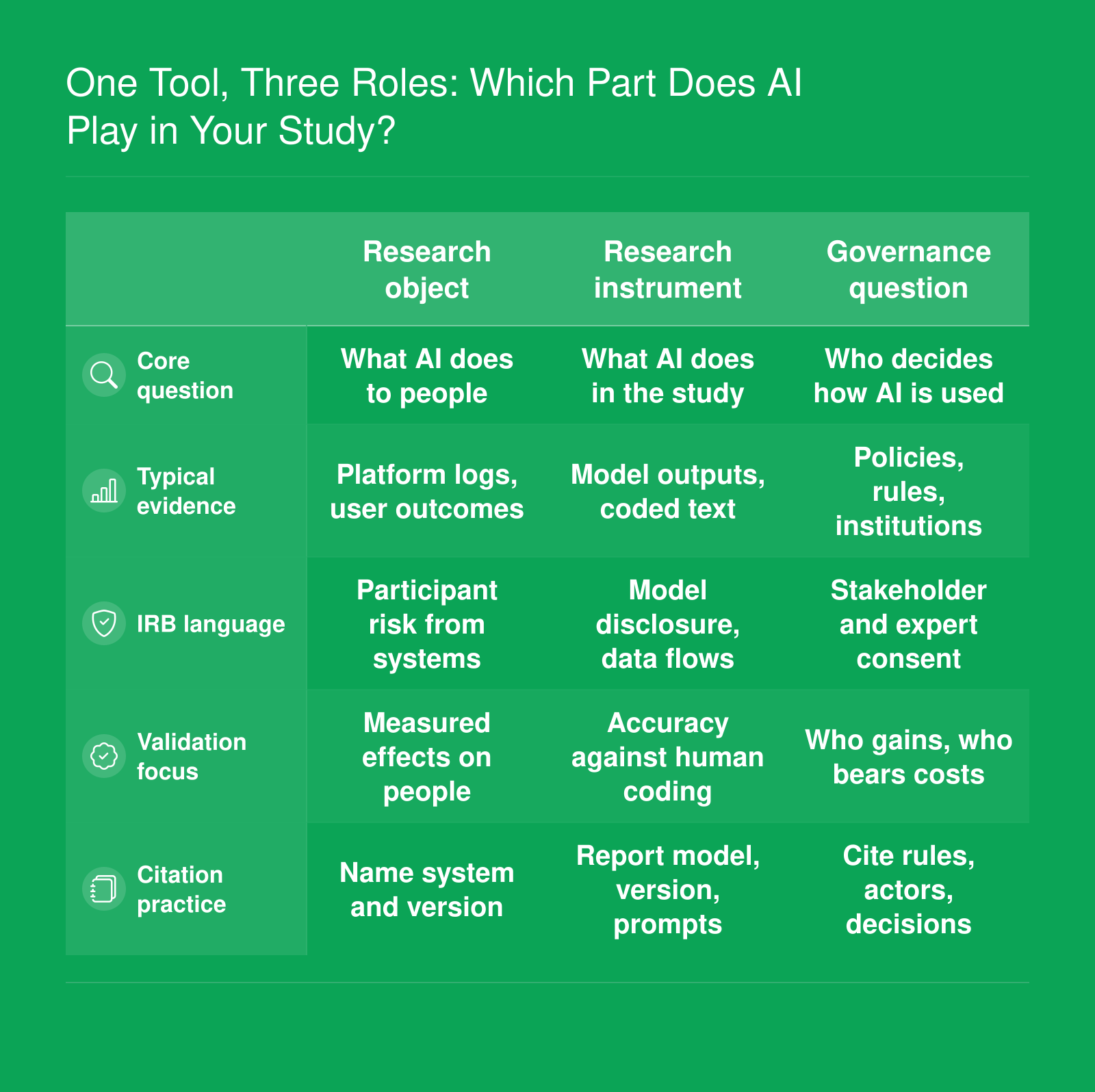
AI enters social science research in three distinct roles: as the thing being studied, as an instrument inside the research process, and as a governance question about who decides how it is built and used. The same large language model can occupy any of these roles, and each one calls for different IRB language, validation and citation practice. Naming the role before the study begins shapes every methods decision that follows.
Challenge 2: Beyond AI — Robotics, Synthetic Media, and Quantum Computing
Challenge 2: Beyond AI, Robotics, Synthetic Media, and Quantum Computing
Project names in robotics, synthetic media, quantum, and nano/biotech research go stale fast. A repeatable search method will serve you longer than any frozen list of examples.
Run This Search Sequence
First, search the technology name plus "research centre," "lab," or "institute," alongside "social science" or "STS." Second, go directly to university department and lab websites and check the newsroom, current projects page, and recent faculty publications. Third, confirm any named project against a primary source: a peer-reviewed paper, an institutional press release, or a funded grant listing.
What a Credible Example Looks Like
A credible example has a named principal investigator, a host institution, a year, and a peer-reviewed or officially funded venue. A vendor blog post, or a press release with no study behind it, does not qualify.
Robotics shows the pattern. Oregon State's NSF-funded Quori project, led by Bill Smart, is developing a humanoid robot for studying social cues, with 50 units due to go to researchers nationwide starting March 2026. UT Austin's planned five-year, $30 million NSF center on human and robot co-adaptation brings robotics, AI, social science, and humanities together to study how people and assistive robots adjust over time. Each one gives you a person, an institution, a funder, and a date to verify.
Sources Worth Bookmarking
- BLS.gov: The Occupational Outlook Handbook and O*NET show how these technologies are reshaping research and technical job roles.
- University sites: Robotics institutes, quantum information science centres, and media-lab programs list named projects and PIs.
- IEEE and the IEEE Robotics and Automation Society: Conference programs and journals for robotics work.
- ACM, APS, and AAAS: Programs and publications that cover computing, physics, and cross-field science.
- Society for Social Studies of Science (4S): Venues where studies treating these technologies as research objects appear.
- NSF Award Search: Dated, verified records of funded projects.
- NIH RePORTER: The same kind of record for biomedical and biotech-related awards.
Challenge 3: Human Participants, Synthetic Respondents, or AI-Generated Data?
The choice between human respondents and synthetic ones is an inference question before it is a budget question. Match the data source to the claim you intend to make, then show evidence that the source can carry that claim.
What the Benchmarks Actually Show
Aggregate agreement is the weakest test available. The When Synthetic Users Fail benchmark found simulated respondents missing human survey answers by 11 to 22 percent, at best tying a simple demographic lookup in the General Social Survey and trailing a learned baseline in the World Values Survey. The same benchmark documented positive stereotyping across nearly every model and prompt: demographics treated as more decisive than they are among real people, which inflates between-group differences and erases within-group variation. Who Speaks for Whom estimated that demographics explained 68 percent of LLM answers against 9 percent of human answers, with that share ranging from 38 to 91 percent across settings. A 74-country Nature Human Behaviour study, drawing on 1.39 million personas and 27.8 million generated answers, found weak systematic alignment and flagged identity flattening.1 SimBench, spanning 20 datasets, reported task-level variation and an alignment-simulation tradeoff, where instruction tuning helped low-entropy consensus questions and hurt pluralistic ones. AAPOR's 2026 benchmark found that more persona detail did not improve accuracy, and that deep demographic matching performed significantly worse.2
Where Simulation Earns Its Place
Use generated respondents to pretest an instrument for comprehension and flow, to generate hypotheses, and to inform power analysis. Do not use them to estimate prevalence, to stand in for small or marginalised populations, or to measure sensitive political attitudes; distortion varies by group there, and the failure is hardest to detect.
The Reporting Row
Every paper using generated respondents should state that the data are simulated, name the model and version, publish the prompts, and describe any calibration to human data. FairSynth's calibration reduces representation-error disparities, but calibration is not absolution.3
- Simulated responses from large language models are weak proxies for human economic preferences across 74 countries, Nature Human Behaviour
- Can AI Replace Human Respondents? A Systematic Benchmark, AAPOR
- FairSynth: Instrument-Relative Evaluation and Calibration of Synthetic Survey Respondents, ACL Anthology (Findings of EMNLP)
Did You Know?
Before you submit, state in one sentence whether AI is your object of study, your instrument, or the question itself, and name the evidence that supports that role. For example: "In this study, AI is a measurement tool, and we validate its outputs against a human-coded sample." If you can't write that sentence, reviewers will notice.
Challenge 4: Informed Consent When AI Generates, Transforms, or Analyzes the Data
Why the Standard Form Breaks
Conventional consent assumes researchers collect a defined dataset for a defined purpose. AI-mediated studies strain that assumption in three ways. Some data are generated during the study rather than collected, as when a participant's conversation with a chatbot becomes the research record. Participants cannot reasonably anticipate whether transcripts will later be used to prompt, fine-tune, or evaluate a model. Transformation is open-ended: embeddings, paraphrases, and synthetic records derived from real responses can travel far from the original study. NIH's secondary research guidance does not treat these transformations as erasing obligations.6 Source data, identifiability, researcher access, and proposed use all still matter.
Deception and the Synthetic Participant
Should people be told they are interacting with an AI rather than a human? This is the hardest disclosure question in the field, and no U.S. national research ethics body has taken a position on it during 2024 to 2026.4 What is clear is that no blanket exemption exists for LLM-generated synthetic participants once actual people are recruited, responses are collected, deception is used, or identifiable source data feed the model.5 Any concealment of an AI counterpart belongs in the protocol, with a debriefing plan the IRB can evaluate.
Protocol Moves That Hold Up
- Tiered or dynamic consent: Let participants opt separately into analysis, model training, synthetic data generation, and public release of outputs.
- Model-provenance disclosure: Name the model, who hosts it, and whether inputs leave the research environment.
- Re-consent triggers: Define them in advance. A secondary use inconsistent with the original consent requires new consent, and an IRB waiver cannot authorize broad, unspecified future use.
- Data minimization defaults: Strip identifiers before data reach any model, and retain only what the analysis needs.
Where Guidance Speaks, and Where It Is Silent
The Common Rule (45 CFR 46) still governs.1 Secondary research on data without identifiers generally falls outside HHS's human subjects definition,2 while non-exempt secondary research needs consent or an IRB waiver.3 Studies testing AI medical devices can become FDA-regulated clinical investigations under 21 CFR 50 and 56 even when identifiers are absent.4 NIH-funded researchers must disclose substantive AI use.4 The gaps are notable: no special waiver category for LLM research, no single professional-association rule on AI data, and no AI-specific consent template. Until those arrive, a conservative, well-documented protocol is the safest position.
- ORI Generative Artificial Intelligence Guidance, HHS Office of Research Integrity
- NIH IRB Review: Not Human Subjects Research, NIH Institutional Review Board Operations
- NIH IRB Review: Secondary Research, NIH Institutional Review Board Operations
- Helpful Reminders to Ensure Integrity of NIH-Supported Research When Using Artificial Intelligence, NIH Grants
- NIH Policies: Artificial Intelligence, NIH Office of Science Policy
- NIH IRB Informed Consent Guidance, NIH Institutional Review Board Operations
Challenge 5: Methods Training, Deskilling, and the Minimum Technical Skills Floor
Helen Margetts, Luis Garicano and Patrick Sturgis, chaired by Larry Kramer, argue at an LSE public event on 22 February 2027 that deciding what technology ought to do is "wholly matters of social science." That claim holds only if social scientists can still run and interrogate the analysis themselves.
Where Deskilling Actually Bites
The erosion is quiet and practical. Coding, transcription, literature review and instrument design are the tasks graduate training has always used to build methodological judgment, and they are the four most commonly handed to a model. A researcher who has never coded a transcript cannot reliably separate a defensible theme from a fabricated one. Someone who has never debugged a script cannot tell a broken pipeline from a surprising result. The tool removes the friction that was doing the teaching.
A Minimum Floor for Every Researcher
Not mastery, but a floor:
- Sampling and uncertainty literacy: knowing what a sample can support before any model touches it.
- Provenance logging: recording prompts, model versions and data transformations as part of the record.
- Output evaluation: testing results against held-out cases or human-coded benchmarks, not reading them for plausibility.
- Benchmark literacy: asking what an evaluation table tested, on whom, and against which baseline.
The Outcome to Assess
The exit standard is not fluency with a particular product. It is the ability to explain and defend the tool you used: why this model, why this prompt, what it was validated against, and what would have changed your mind. Product fluency expires with the next release; justification skills transfer.
Methods specialists need a deeper tier: designing validation studies, auditing pipelines, and building the benchmarks the rest of the field depends on. Departments that teach only the floor produce competent consumers of tools. Departments that teach neither produce researchers who cannot check the work.
Challenge 6: Compute, Energy, and the Access Gap Between Well-Resourced and Low-Resource Research
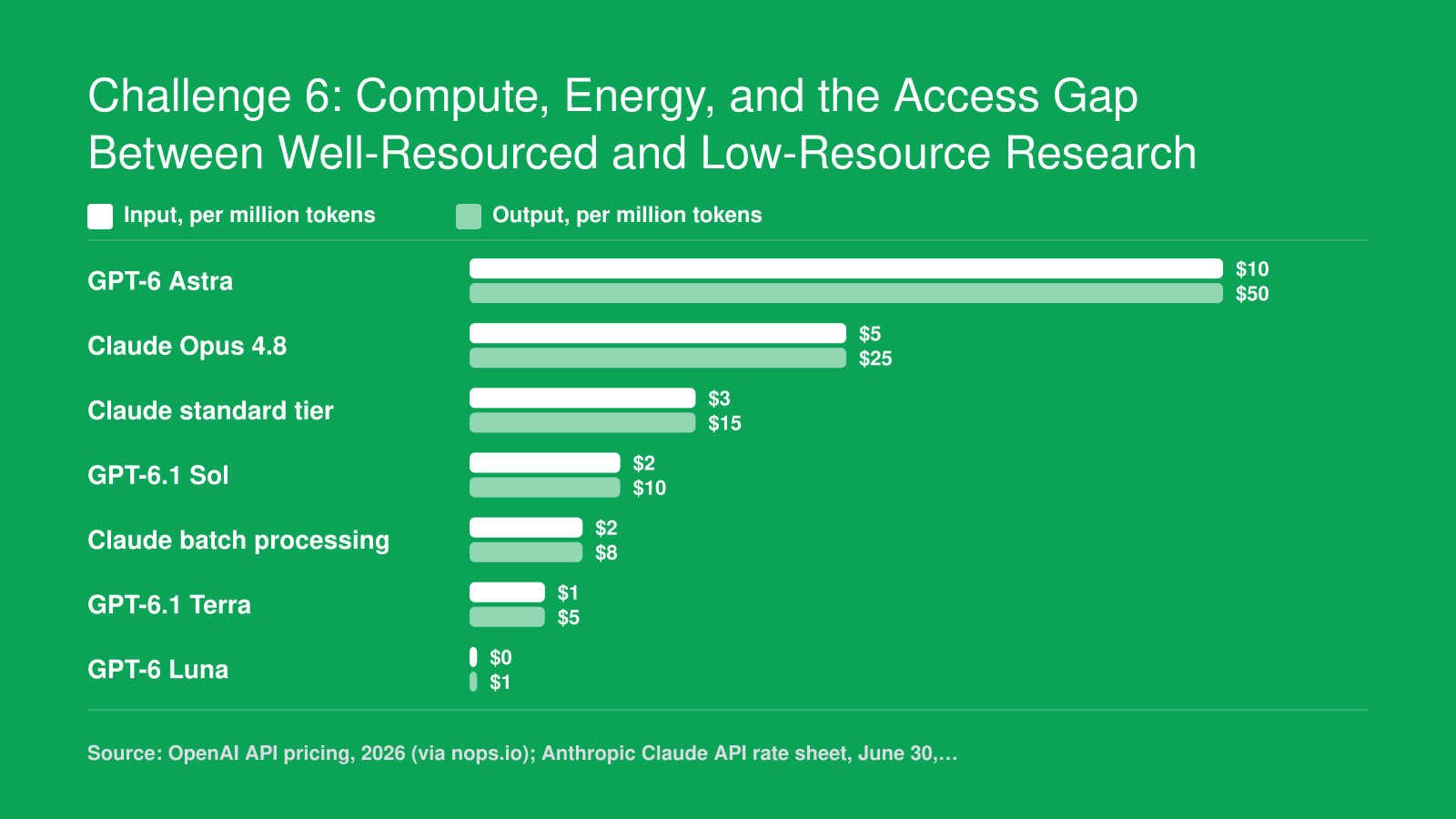
Commercial AI list prices in 2026 span roughly a hundredfold, from $0.10 to $10 per million input tokens and $0.50 to $50 per million output tokens. Long prompts or regional endpoints raise them further (OpenAI adds 10% for regional processing on models released on or after March 5, 2026), and some rates are scheduled to change: Gemini 3.8 Flash pricing doubles on January 1, 2027. Self-hosting an open-source model replaces those fees with GPU purchase or rental, electricity, cooling, storage and engineering staff time, and its energy use per query depends on model size, hardware, utilization and data center efficiency, so methods sections should report those parameters rather than borrow a headline figure, while for researchers in low-resource settings the practical ceiling is often reliable access to hardware, power and payment for these services rather than what the models can do.
In a 2023 audit of GPT-generated literature reviews posted to arXiv, 55 percent of GPT-3.5 citations were completely fabricated, while GPT-4's rate fell to 18 percent. A polished reference list can still contain invented sources.
What Departments Should Change: Collaboration, Curriculum, and Governance
Departments that treat frontier technology as someone else's portfolio will lose students, faculty lines, and grant ground within a couple of hiring cycles. The response has to be structural, and Oxford's AI governance build-out shows what the structure looks like.
Three Changes Worth Adopting
- A shared methods curriculum on sociotechnical design. A required sequence co-taught with computing and law, so governance questions sit inside technical training rather than trailing after it.
- Joint appointments and co-supervision with computing and law. Oxford's Technical AI Governance Programme sits in Engineering Science and pairs technical AI training with governance work; a related four-year DPhil beginning October 2026, funded through the EPSRC Centre for Doctoral Training in AIMS, is jointly supervised across the Oxford Martin AI Governance Initiative and Engineering Science. Read that as a working template, not as university-wide policy.
- A standing ethics review route for model-based work. Give it its own track, with reviewers who understand training data, fine-tuning, and synthetic respondents, rather than folding it into an approval process written for human subjects alone.
Incentives Decide Whether Any of It Sticks
Reward co-authored work with computing and law in promotion criteria, not only solo disciplinary papers. Publish an authorship convention that says plainly when a model counts as a tool, a co-author, or neither. Require that AI-assisted contributions be described in the methods section in prose a reviewer can audit.
A 12-month Action List
- Months 1-2: appoint a small working group with a fixed remit and a reporting date.
- Months 3-4: audit existing methods requirements and name one course to redesign.
- Months 5-6: negotiate one co-supervision arrangement and one joint appointment line.
- Months 7-9: stand up the model-based ethics review route with named reviewers.
- Months 10-12: revise promotion and authorship guidance, then publish it.
Determining what technology choices ought to be, and how to make them, are wholly matters of social science.