Key Points
- SDSU funded 37.8% of seed grant applications in 2026.
- Emory's AMPLIFY fund awarded over $600,000 across 20 projects.
- Funders increasingly reward public outputs like podcasts, documentaries, and concerts.
Introduction: Why Internal Interdisciplinary Grants Matter for Social Scientists
Competition for interdisciplinary social science funding has tightened as external award rates flatten, and universities are expanding internal seed programs built around public engagement. Emory's AMPLIFY fund, launched in summer 2026, awarded more than $600,000 across 20 publicly engaged arts, humanities and social science projects, with outputs ranging from podcasts to a public concert. For social scientists, that makes the internal grant less of a consolation prize and more of a proving ground for methods, teams and non-traditional outputs before external review.
At San Diego State University, the internal Seed Grant Program funded 37.8% of applications for the 2026 funding year, a success rate that outpaces many external competitions where awards often go to under a quarter of applicants.
Writing a Pitch That Bridges Disciplines
How do you write a research proposal that an economist, a historian, and a public health scholar all find compelling in the same reading? The answer is not to split the difference. Build the entire pitch around a problem no single discipline can solve alone, then make every reviewer see their own expertise reflected in the solution.
Lead with the Problem, Not Your Research Question
A discipline-specific research question narrows your audience to people who already speak your language. A problem statement widens it. Instead of opening with "This project tests whether network centrality predicts policy adoption," open with the stakes: "Communities facing repeated climate displacement keep rebuilding in the same floodplains, and we do not understand why policy warnings fail to change behavior." That framing invites the environmental scientist, the behavioral researcher, and the historian to all lean in. Save the precise hypotheses for the design section, where specialists expect them.
Cut the Jargon, Keep the Rigor
Reviewers from other fields will not penalize you for unfamiliar methods, but they will quietly downgrade a proposal they cannot follow. Translate every technical term into a plain-language gloss the first time it appears. Write "ethnography (long-term participant observation, where the researcher embeds in a community for months to document everyday practice)" rather than assuming the word carries. Do the same for regression discontinuity, grounded theory, or difference-in-differences. The parenthetical costs you ten words and buys you a reader.
Show Why the Collaboration Is Necessary
Name your collaborators and assign each a concrete role that the others cannot fill. A convincing pitch makes the interdependence obvious: the demographer supplies the longitudinal survey design, the oral historian collects the lived narratives that explain the survey's outliers, and the data scientist builds the model that links them. State plainly what the project would lose if any one contributor were removed. Panels fund teams whose combined output is clearly greater than the sum of three solo projects.
Put Public Engagement Up Front
Do not bury the outputs in a final paragraph. Reviewers from unfamiliar disciplines anchor on things they can picture: a community workshop series, a public-facing podcast, a documentary short, a policy brief delivered to a county commission. Name the specific product, the audience, and the timeline early. A concrete deliverable gives a skeptical reviewer something tangible to champion when the panel debates your proposal.
Did You Know?
Internal funders increasingly reward work the public can see and use. Emory's AMPLIFY fund backed podcasts, documentaries, graphic novels, and concerts alongside traditional scholarship. A proposal that promises only a journal article may lose to one that adds a public event or accessible media, so plan an engagement output from the start.
Common Pitfalls: Methods Justification, Team Composition, and Budgets
Some proposals sink because they read as if reviewers already share the author's disciplinary assumptions; others sink because they never explain why the project needs more than one field at all. Approach the methods section as a translation task rather than a formality.
Methods Justification
The most common failure is writing for a single audience. A phrase like "reflexive thematic analysis" may signal rigor to qualitative researchers, but an interdisciplinary panel also needs to know what the method produces, how it handles bias, and why it is paired with another tradition such as comparative case data or computational text analysis. Assume reviewers do not know your terminology. More importantly, do not treat interdisciplinarity as decoration. Explain why the research question cannot be answered by one method alone, and name the specific integration point: where the datasets meet, how coding categories are reconciled, or how a model's output is interpreted through field interviews.
Team Composition
Weak teams often list collaborators from different departments but give no plan for shared work. Reviewers look for an integration strategy: who will run joint analysis, who owns each stage, how often the team meets, and how authorship is handled. A token co-investigator with no budget line, no stated responsibility, and no history of collaboration undermines credibility. Career-stage balance can help. Pairing senior faculty with early-career scholars signals mentoring and continuity, while a team composed only of one rank can raise questions about capacity and workload.
Budgets
Budget problems usually fall into three groups: requesting disallowed costs, inflating travel or participant payments, and forgetting publication expenses. Rules are program-specific, so check before you paste a standard budget. For example, the University of Texas at Dallas Social Sciences Grant frames awards as preliminary data collection for an external proposal, allows publication costs and graduate or postdoctoral support, and is capped at $8,000 for 12 months.1 Cincinnati's internal funding caps PI salary at one month, bars external consultants and conference travel, but permits participant costs. The University of Wisconsin-La Crosse excludes dissemination travel and publication costs entirely.2 Carleton's SSHRC Explore Bridge allows research travel and student or postdoc stipends, but small equipment including computers cannot exceed one-third of the total budget.3
When travel is allowed, the University of North Texas asks reviewers to see lodging, airfare, per diem, ground transportation, registration, number of travelers, trip length, and destinations, so provide those details rather than a single round-trip figure.4 Participant compensation should state the per-person amount, number expected, and institutional review board basis. Publication costs, where allowed, may include page charges, reprints, printing, distribution, and promotion.4 Because no single cap or allowable list applies everywhere, match every budget line to the solicitation's guidance and connect each cost to a research task.
- Social Sciences Grant, University of Texas at Dallas
- FRG Budget Justification Template, University of Wisconsin–La Crosse
- SSHRC Explore Bridge, Carleton University
- Budget Basics: Cost Categories, University of North Texas
If a reviewer from engineering cannot follow your qualitative methods, the proposal dies in the methods section, no matter how important the question.
Leveraging Small Internal Awards into External Funding
External funding for social science has become harder to predict, and that raises the value of what a small internal award can prove. A Science analysis of FY 2026 counted about $95 million across 91 new NSF social-science awards, against 2021 to 2024 averages of roughly $247 million and about 800 awards a year.3 NSF's own budget materials present the figures differently, so treat the exact gap with caution.4 In a tighter competition, reviewers lean harder on evidence that a project already works.
What a Seed Grant Proves to External Reviewers
External panels rarely fund an idea on its own. A modest internal award can supply three kinds of evidence they trust:
- Preliminary data: a pilot survey, a coded interview sample, or a field-tested instrument that shows the design is feasible.
- Collaborative proof: evidence that, say, an economist and a public health researcher can produce work together, not just co-sign a letter.
- Track record: a completed, reported project shows you can manage a budget, a timeline, and deliverables.
Where Seed Projects Commonly Go Next
- NSF Social, Behavioral, and Economic Sciences: FY 2026 priorities include AI, health, disaster, energy, infrastructure, and workforce effects. Award sizes vary by solicitation, and proposals generally come through an eligible U.S.-based accredited institution.
- NIH, through the Office of Behavioral and Social Sciences Research: behavioral and social follow-on work often moves through mechanisms such as R03, R21, or R01 or institute-specific announcements. Confirm current terms in each notice.
- NEH: limits are program-specific. The FY 2026 Awards for Faculty at HBCUs, for example, cap at $60,000, paid at $5,000 per month.
- Spencer, Ford, and Mellon foundations: private funders whose interests in education, social change, and the humanities can suit publicly engaged social science. Check each foundation's current calls.
- British Academy International Interdisciplinary Research Projects: a route for teams whose questions cross both disciplines and borders.
If a graduate student did substantial work on the seed project, the NSF Graduate Research Fellowship is worth flagging. For FY 2026 it anticipates 1,500 fellowships, pending funds, with a $37,000 annual stipend and three years of support, open to U.S. citizens, nationals, and permanent residents.
Design the Internal Project Backward from the External Call
Pick the likely follow-on funder before the internal proposal is written. Read its current solicitation, note the outcomes and methods it rewards, and collect data that maps directly onto them. A pilot built around variables an NSF program cares about converts far more easily than one that must be reframed after the fact.
Consider a hypothetical path. A historian and a sociologist use an internal events grant to host a community symposium on local migration histories. They record oral histories, track attendance, and document partnerships with a library and a neighborhood association. A year later, those recordings, partner letters, and audience numbers become the backbone of an NEH public humanities proposal: proof of public demand, a tested format, and a team that has already delivered together.
- How NSF Gutted Its Social Sciences Research, Science
- NSF FY 2026 Budget Request, National Science Foundation
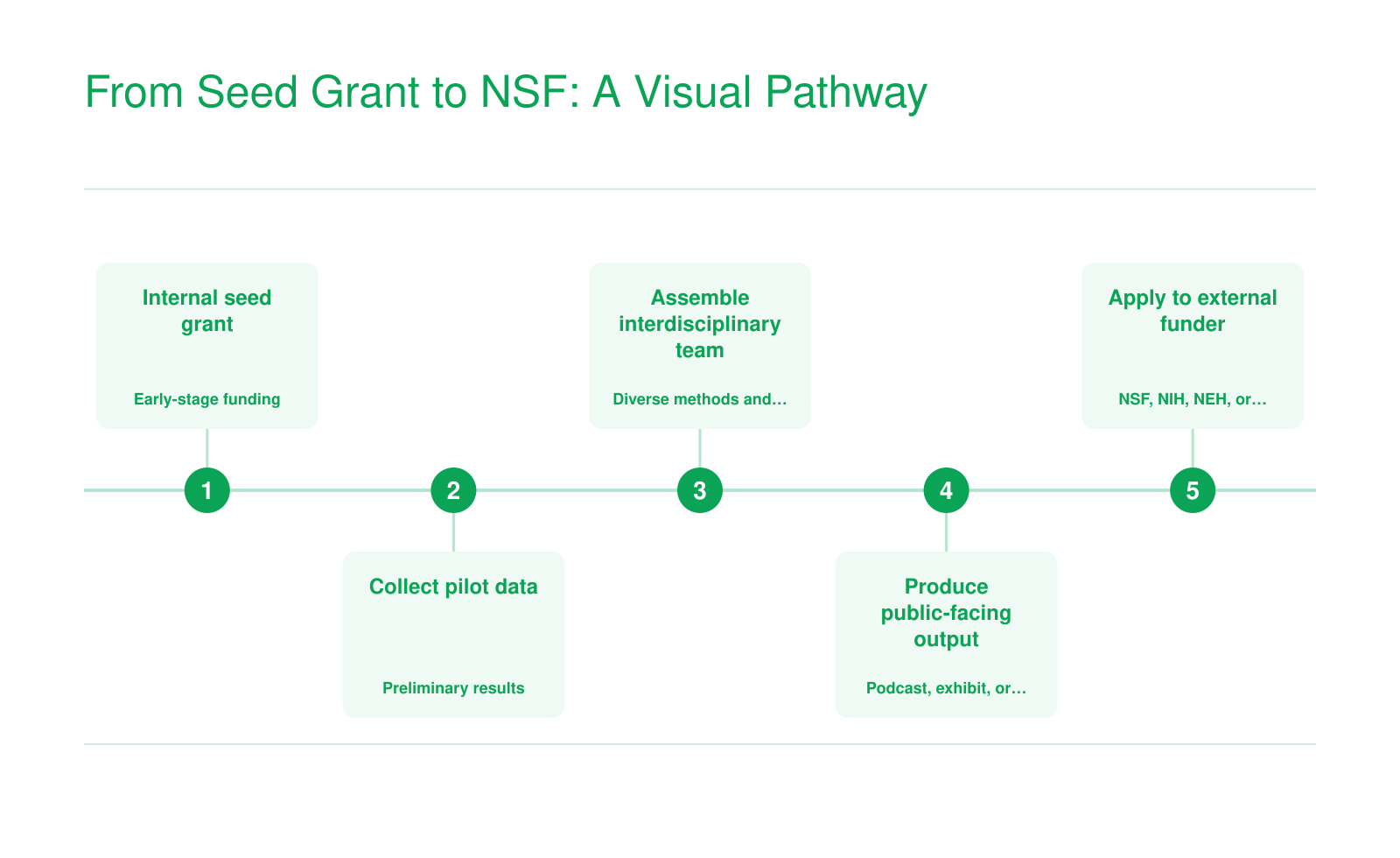
From Seed Grant to NSF: A Visual Pathway
Internal seed grants can create a repeatable runway to national funding. Each stage produces evidence that makes the next ask more credible.
Did You Know?
Emory's three-tier AMPLIFY structure, with Impact Grants for newly tenured faculty, Events Grants for community-engaged programming, and Humanities Seminar Fellowships, signals what institutions now reward most: publicly engaged output at key career stages. Social scientists should read the tiers as a map of institutional priorities.