
Key Points
- Gerald Fisher built his MSU degree from business, English, and psychology.
- Stipends generally follow whichever unit holds the assistantship line.
- In 2024, U.S. institutions awarded 1,623 multidisciplinary and interdisciplinary science doctorates.
Building Your Own Major: What Interdisciplinary Graduate Training Actually Looks Like
In the 1960s, Michigan State University let an undergraduate named Gerald A. Fisher assemble a Social Science Interdisciplinary program across business, English, and psychology while still taking hard sciences. His graduate degrees, though, were disciplinary: a law degree, then a Master of Law in corporations and securities.
That split is what makes his case useful. Cross-field training came first, deep credentialing second, and the order mattered. Anyone weighing an interdisciplinary graduate program now faces the same tension: a curriculum no single department owns, funding that follows an administrative line, and employers who hire for named expertise.
The MSU Program That Let One Student Build His Own Major
Gerald A. Fisher was an undergraduate at Michigan State University in the 1960s, when MSU's Social Science Interdisciplinary program let him build a degree around business, English, and psychology while still taking hard science courses. That is a self-designed combination, not a single-department major, and the difference shapes what students should expect from interdisciplinary structures today.
An Undergraduate Structure, Not a Graduate One
The self-designed piece was Fisher's undergraduate degree. His graduate work ran disciplinary. He earned a master's at MSU; a Juris Doctor from Detroit College of Law, now part of MSU Law, earned while he clerked in the Oakland County Circuit Court; and a Master of Law from Wayne State University, where his thesis addressed financing public infrastructure.
Decades, Not Years, Before the Payoff
Fisher practiced roughly 30 years as a local government attorney. He was general counsel for cities such as Novi, villages such as Bingham Farms, and townships including Bloomfield and West Bloomfield, served as special counsel to several dozen Michigan communities, and appeared in many cases before the Michigan Supreme Court.
The Turn Back Toward Teaching and Scholarship
He then taught full time for 15 years at WMU Cooley Law School in Auburn Hills, in constitutional and property law. A 1970 summer course in British Land Use in London suggests how early cross-field exposure compounds later. The books came outside the tenure track: "Local Government Law" (Routledge, 2021), co-edited "Michigan Municipal Law" (2012), and co-authored "Michigan Zoning, Planning and Land Use" (2008).
He also played varsity hockey on MSU's 1966 NCAA championship team, a roster stocked with players raised from British Columbia to Ontario. The MSU Today account is here: https://msutoday.msu.edu/news/2026/10/graduate-voice-gerald-fisher-interdisciplinary-education
Interdisciplinary, Multidisciplinary, Joint, or Dual: What Each Label Actually Commits You To
These four labels are not interchangeable, and the difference is administrative before it is intellectual. The model a program uses tends to decide which office signs off on your course plan, which committee oversees your progress, and which academic unit has a budget line that can support you. The definitions below come from published graduate-school policies, including those at the University of North Carolina, the University of Washington, George Mason University, the University of Illinois and the University of Pennsylvania.
| Model | How the Curriculum Is Built | Who Confers the Credential | Typical Approval Path |
|---|---|---|---|
| Interdisciplinary degree | A single course of study that draws on several disciplines and is not identified with one formal department. | The participating university confers one degree. | An interdisciplinary curriculum oversight committee, with representatives from the administrative homes of the participating certificates, oversees the degree. |
| Multidisciplinary degree | Coursework spans several disciplines. When the degree is not tied to a formal department, policy treats it the same way structurally as an interdisciplinary degree. | The participating university confers one degree. | A stacked degree with "multidisciplinary" in its title must set up an interdisciplinary curriculum oversight committee, with representation from each participating certificate's administrative home. |
| Joint degree | Two academic units, or two institutions, collaborate to offer a single approved program that ends in one completion credential. | Two or more participating institutions award one degree together. | The collaborating units or institutions approve the course of study jointly. |
| Dual degree | The student completes two post-baccalaureate degrees at the same time and must meet the requirements of each one without overlap. | Two separate credentials, such as two diplomas, are issued. | The student takes on the combination with the agreement of the relevant advisors and graduate-group chairs, and each degree remains a separate program. |
- Policy on Transdisciplinary Programs of Study, University of North Carolina Graduate School
- Policy Topic: Degree Creation & Oversight, University of Washington Graduate School
- Dual Degree Program Arrangements – University Policy, George Mason University
- Graduate Degree Requirements, University of Illinois Graduate College
- Joint/Dual Degree, University of Pennsylvania Graduate Division
Who Approves the Curriculum — And Who Sits on the Committee
Who Approves the Curriculum, and Who Sits on the Committee
If no single department owns an interdisciplinary degree, who signs off on your courses and your committee?
In many interdisciplinary doctoral programs, authority sits above the department: with a graduate school, an interdisciplinary program chair, or both. Published 2026 policies at three U.S. universities show how that works in practice.
Course Approvals Run Through More Than One Office
Texas A&M University's interdisciplinary PhD catalog sends different requests to different offices. Adding a professional course requires the approval of the Department Head or interdisciplinary Program Chair for the unit offering it.2 Transfer credit needs both the advisory committee and the Graduate and Professional School.2 Degree-plan changes go by petition to the Graduate and Professional School, and no further changes are allowed once it approves the final examination request.2
Ohio State University's 2026 Biostatistics PhD guide is narrower: a course waiver or substitution petition is approved by the course instructor and the Graduate Studies Chair.4
The University of Missouri, Kansas City puts guardrails on the plan itself. At least 75% of degree-plan coursework, excluding the dissertation, must fall in eligible disciplines, and no more than 50% may be transferred in.3
How Committees Are Assembled
Texas A&M and UMKC both require at least four members.1 At Texas A&M, the chair or co-chair comes from the student's major department or the intercollegiate faculty, and in interdisciplinary programs at least one member must hold a primary appointment outside the chair's unit.1 UMKC requires at least one doctoral faculty member from both the primary discipline and the co-discipline, and the Dean of the Graduate School approves the final composition.3
Swapping members is tightly controlled. Texas A&M permits one substitution per evaluation, requires graduate-school approval, and does not allow committee chairs to be replaced.1
Expect Approval to Be Recurring
Because each departure from the approved plan triggers its own sign-off, the paperwork does not end at admission. If your coursework shifts as your research evolves, budget time for petitions and keep a written rationale ready for every change.
- Interdisciplinary PhD Program Catalog, Texas A&M University
- Toxicology PhD Program Catalog, Texas A&M University
- Minimum Interdisciplinary PhD Academic Regulations and Degree Requirements, University of Missouri–Kansas City
- Biostatistics PhD Program Guide 2026, Ohio State University College of Public Health
Interdisciplinary PhD Funding: Stipend Parity and Who Holds the Assistantship Line
A departmental teaching assistantship and a graduate-school fellowship can show the same number on an offer letter and still be two different jobs.
The Line, Not the Label
One rule resolves most of the confusion: your stipend generally follows the unit that holds the funding line, not the interdisciplinary label on your program. Two students in the same cohort can be paid on different scales because one is appointed by a department and the other by a center or the graduate school. Parity, where it exists, usually tracks the appointing unit's published rate or collective bargaining agreement, and it can shift with appointment percentage, nine- versus twelve-month terms, and whether the work is teaching or research.
Three Common Arrangements
- Designated home department: one department runs the teaching assistantship, sets pay, and often controls tuition remission.
- Training grants and center funding: a program, institute, or grant-funded center pays the stipend, sometimes for research rather than teaching.
- Graduate-school fellowships: the university pays, usually with no teaching obligation attached.
Ask which one your offer describes, and whether health insurance, fees, and summer support are included or billed separately.
External Fellowships and the Format Trap
National fellowship programs typically ask you to pick an eligible field and a sponsoring institution. The NSF Graduate Research Fellowship is the clearest case: review and deadlines follow the first Major Field of Study you list, so a self-designed field can raise eligibility questions worth settling early.1 The 2026 award pays a $37,000 stipend plus a $16,000 cost-of-education allowance per funded year, three funded years within five, and requires full-time enrollment in a research-based degree with a thesis; joint programs such as MD/PhD and JD/PhD are ineligible.2
Part-time, hybrid, and online students are often disqualified from assistantships and tuition waivers. Get that rule in writing before you accept.
- NSF GRFP Fields of Study, National Science Foundation
- NSF GRFP Applicant FAQ, National Science Foundation
In 2024, U.S. institutions awarded research doctorates to 1,623 people in multidisciplinary and interdisciplinary sciences, according to the National Science Foundation's National Center for Science and Engineering Statistics. That count covers fields such as interdisciplinary computer sciences alongside other cross-field programs.
Designing an Interdisciplinary Dissertation Committee That Can Examine the Work
Who has to sign off when a dissertation sits between two departments? Usually a committee drawn from both fields, appointed by a graduate school and not by either department alone.
Three Workable Structures
- Bridging problem, two chairs: One question requires both literatures, and each field supplies a chair who answers for its half of the work.
- One chair, cross-department committee: A single advisor directs the project while members from other units cover the remaining methods and theory.
- Shared methods chapter: The dissertation adds a chapter that serves both literatures, which gives each side something it can examine directly.
What Examination Rules Look Like
Published policies point the same way. At MIT, the Office of Graduate Education appoints the interdisciplinary committee, which administers general and thesis exams, while the registered department recommends the degree.1 Rochester requires at least two inside members, one of them the advisor, plus an outside reader, and it bars committees drawn entirely from one department.2 UC San Diego's interdisciplinary political science PhD asks for four members, including one external and two from different specialties.3 UAB's interdisciplinary engineering PhD requires five members from at least two schools or colleges.4
The cited policies do not describe a formal department-versus-department appeal. Where a dispute over standards can't be settled informally, the graduate school is the natural place it lands, since it appoints or approves committees at MIT, Rochester, and Arizona State.5
Settle the Rulebook Before the Prospectus
Some programs, such as Kennesaw State's interdisciplinary engineering PhD, keep a handbook of their own.6 Others refer students to a graduate college policy, as Northern Arizona's sustainability program does.7 Ask in writing which handbook governs, and do it before the prospectus, not before the defense.
Then ask the question that matters most: must the dissertation satisfy both departments' methodological standards, or a program-specific standard written for cross-field work? Get the answer from the program director in an email you can keep.
- Interdisciplinary Doctoral Degree Policy, MIT Office of Graduate Education
- Dissertation and Final Examination Policies, University of Rochester Graduate Studies
- Interdisciplinary PhD Program in Political Science, UC San Diego Department of Political Science
- Interdisciplinary Engineering PhD Handbook 2024-2025, University of Alabama at Birmingham
- PhD Educational Policy and Evaluation Degree Handbook 2024-25, Arizona State University
- PhD in Interdisciplinary Engineering Program Handbook 2025, Kennesaw State University
- Sustainability PhD Handbook 2024, Northern Arizona University
How Long Interdisciplinary Degrees Actually Take
In the 2024 Survey of Earned Doctorates, interdisciplinary science doctorates took about as long from doctoral program start as a disciplinary benchmark like geosciences, but slightly longer when measured from the bachelor's degree. Treat these figures as approximate for any single program: national surveys sort interdisciplinary work into fixed field categories, so many interdisciplinary programs are counted under a home discipline instead. The data also covers only people who finished, so it shows how long completers took, not how many students leave before the degree.
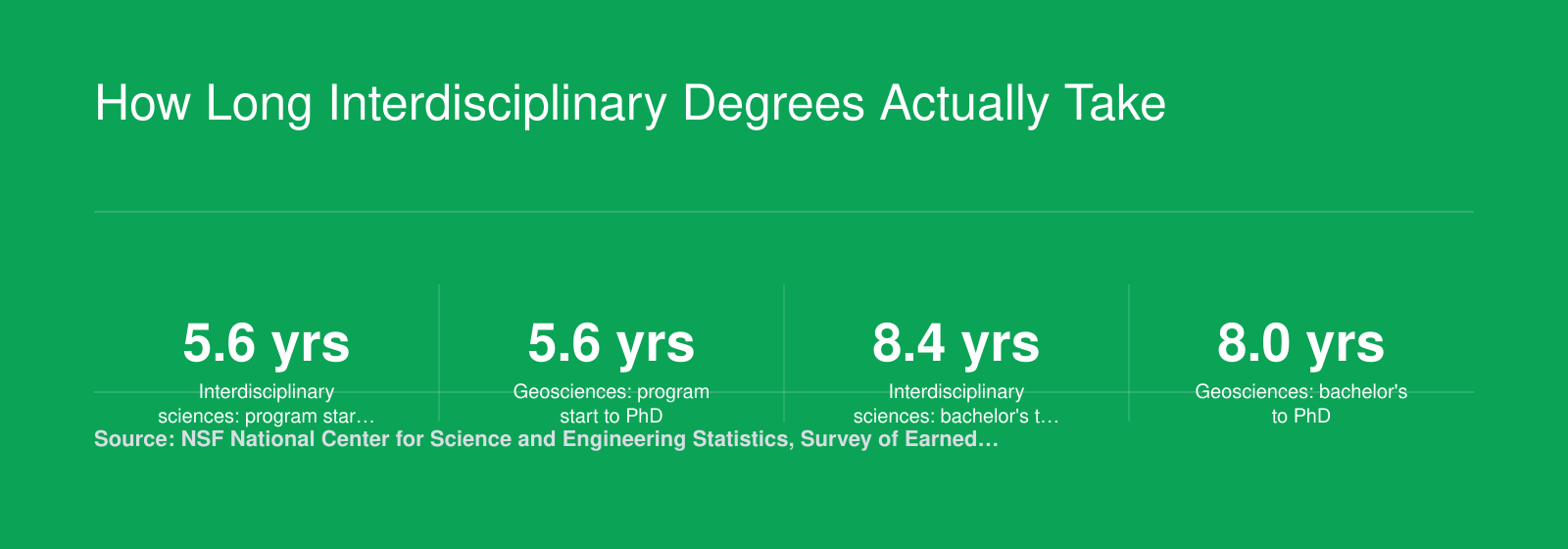
- NSF 2024 Doctorate Recipients: Median Time to Doctorate for Interdisciplinary Sciences, NSF National Center for Science and Engineering Statistics (NCSES)
- NSF 2024 Doctorate Recipients: Median Time to Doctorate for Geosciences, NSF National Center for Science and Engineering Statistics (NCSES)
Interdisciplinary PhD vs Traditional PhD: Breadth, Depth, and the Job Market
A fair comparison between an interdisciplinary PhD and a traditional departmental PhD is one you build yourself, from occupation data, program records, and employer language, rather than from a general claim about which is better. The published salary numbers show why. National Science Foundation survey tables put the median expected salary for interdisciplinary doctorate recipients at $150,000 in 20241, and median basic annual pay by postgraduation plan at $150,000 in 2025.2 A separate 2024 table by sector and broad field lists $150,500.3 Traditional fields are reported one broad field at a time, so match your own discipline's row instead of looking for a single aggregate.
Start with Target Occupations
Pick three to five jobs you might want. Look up each in the BLS Occupational Outlook Handbook and in O*NET for pay, typical education, and skill requirements. Note where a posting or profile asks for cross-field methods (breadth) and where it asks for deep specialization in one literature (depth).
Ask Programs for Evidence
On each program's website, and then by email, look for:
- Structure: how coursework and committees are organized.
- Completion data: finishing and attrition rates by entering cohort.
- Placement reports: career-services outcomes and alumni job titles.
- Hiring networks: where recent graduates of the faculty's advisees actually landed.
Test How Employers See It
Search professional association reports, industry salary surveys, and live postings for the phrase "interdisciplinary" and its close relatives. Then request informational interviews with hiring managers in your field and ask directly whether they screen for breadth or depth.
A Verification Checklist
- Collect five to ten real job postings in your target field.
- Check each posted salary range against BLS or state labor-market data.
- Request placement and completion statistics in writing.
- Compare answers from at least two interdisciplinary and two traditional programs before you conclude anything.
- Expected Median Salaries for Doctorate Recipients Are Highest in the Industry Sector, National Center for Science and Engineering Statistics, National Science Foundation
- Table 6-6 NSF 26-326, National Center for Science and Engineering Statistics, National Science Foundation
- Table 6-7 NSF 24-336, National Center for Science and Engineering Statistics, National Science Foundation
Breadth gets you into rooms that depth alone will not open, but depth is what keeps you in the room once the questions turn technical.
Careers for Interdisciplinary PhD Graduates: Where They Actually Land
The tension in a cross-field doctorate is straightforward: breadth widens the set of problems you can work on, but almost no employer posts a vacancy titled "interdisciplinary PhD," so the payoff depends on how clearly you can name the problem you solve. Those destinations are real, and more specific than the catch-all "alt-ac" label suggests.
Where the Destinations Cluster
- Professional schools: law, public health, education, and social work faculties hire cross-field scholars to teach research methods and policy analysis.
- Government and agency research units: offices that need fluency in both quantitative methods and a substantive domain.
- Policy shops and consultancies: contract research firms and legislative research offices.
- Program evaluation in nonprofits: foundations and service agencies needing designs that span economics, sociology, and public administration.
- Industry research roles: user research, evaluation, and data roles, increasingly common for social science doctorates.
- Interdisciplinary centers on campus: area studies, environmental institutes, and computational social science labs, where the home is a center rather than a department.
What the National Data Can and Cannot Tell You
No national survey isolates interdisciplinary social science doctorates, so treat sector figures as a proxy. Of 45,929 science and engineering doctorate recipients in 2024, 70 percent reported definite commitments1; among those with non-postdoctoral employment commitments, roughly 40 percent went to academia, 40 percent to industry or business, 8 percent to government, 7 percent to nonprofits, and 6 percent to other or unreported categories.2 Read that as the shape of the market, not a count of cross-field graduates.
The Return Arrives on a Career Clock
Gerald Fisher's trajectory shows the long horizon. Roughly 30 years of municipal practice came first, then 15 years of full-time law teaching, then the treatises and continuing legal education volumes he authored and co-edited. Cross-field training rarely pays off at graduation; it compounds.
Practice-based scholarship is a genuine publication route here: treatises, continuing legal education materials, and agency guidance sit outside tenure-track funding models.
Did You Know?
A self-designed program is only as strong as the paperwork that records its coherence: a written rationale, named standards, and a committee with real authority to enforce them. A student who can state the through-line in one sentence is legible to employers and fellowship panels. One who cannot simply looks underspecialized.
Questions to Ask Before You Enroll
Two questions decide most of this: who pays, and who signs. Ask both before you pay a deposit.
1. Which unit holds my funding line, and is the stipend guaranteed in writing for how many years? A good answer names the paying department or college, the exact number of guaranteed years, and the conditions that void the guarantee. 2. Who approves course substitutions, and how often does that body meet? A good answer names a person or standing committee and a meeting schedule, not "your advisor handles it." 3. Who chairs my committee, and who escalates when two departments disagree? A good answer names a chair with standing in a specific department and a graduate school office authorized to arbitrate. 4. Which handbook governs my defense? A good answer cites one document by name and states which version applies to your cohort year. 5. What are your median time-to-degree and completion rate for this program? A good answer gives figures for recent cohorts, not placement anecdotes. 6. Where have your last five graduates landed, and in what roles? A good answer lists names and positions you can verify independently. 7. What happens to my funding if I switch to part-time or take a medical leave? A good answer separates a pause from a termination and identifies who must approve either. 8. What does the credential read as on my transcript and diploma? A good answer shows you the exact string, because some interdisciplinary degrees print the parent department rather than the program name.
When the Answer Is Vague
"We'll work it out" is a funding risk, not a personality quirk. Ask for the answer by email and keep it. An interdisciplinary program's flexibility is genuine, but flexibility that exists only in conversation belongs to whoever holds the budget that year, and that person is not you.