Lowest In-State Tuition for a Bachelor’s
University of Maryland Global Campus
$8,136 in annual undergraduate tuition and required fees for state residents (2024–25), the lowest among the 8 bachelor’s programs shown here.
Program Rankings
Ranked lists for every field and degree level, scored within that field and level.
All Program RankingsDegrees for Working Adults
Most Affordable Degrees
Online Degrees
Careers
What the work involves, what it pays, and the education each job usually asks for.
All Career GuidesBachelor’s Entry Routes
Graduate Study Routes
Compare Majors
Courses, research methods, and career routes, side by side before you choose a major.
Compare All MajorsHead-to-Head Comparisons
Explore a Field
Browse by State
State lists by subject and degree level, ordered by the national comparison score.
Browse All StatesPrograms by State
Compare 10 political science programs in Maryland, grouped by degree level. University of Maryland leads the bachelor’s list. Each section starts with its highest-scoring eligible programs, so you can focus on the degree you plan to earn.

By Taylor Rupe, Editor
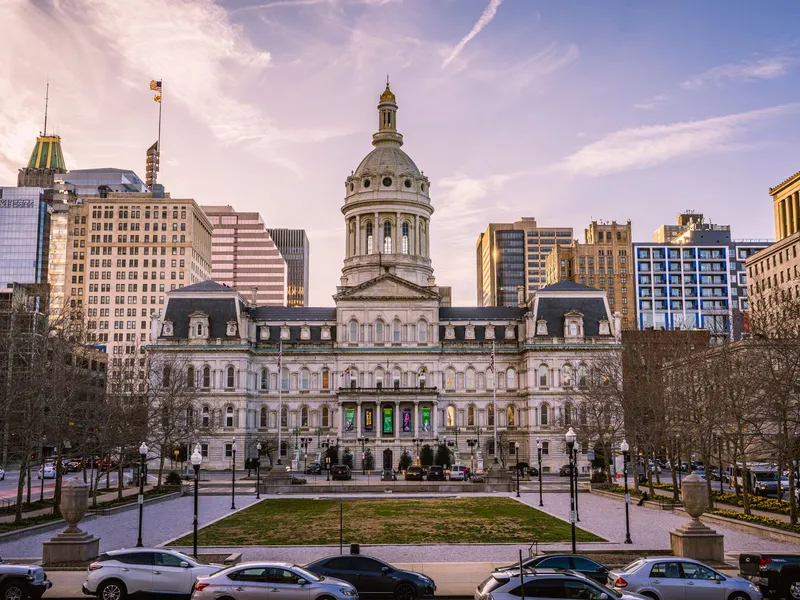
8 schools in Maryland awarded political science bachelor’s degrees in 2023–24, scored against 991 bachelor’s programs nationwide. This section shows the top 8 of 17 eligible programs at this level.
Maryland's Government and Politics major splits into two curriculums. The Bachelor of Arts trains you to read and interpret political science research, while the Bachelor of Science pushes you to produce it, adding Advanced Empirical Research plus 300 and 400-level methods and quantitative methods courses. Both start with American Government, a math or statistics course and Scope and Methods for Political Science Research, and the BA adds The Study of Political Philosophy as its theory requirement. You'll need at least 36 GVPT credits, half of them upper-level, plus Principles of Microeconomics and a foreign language through the elementary level. Benchmarks keep you on pace, and the first set has to be done within two semesters of entering the major.
Program Sources: Government and Politics Major | University of Maryland Catalog
Major in Political Science
Hopkins has you sample the whole discipline early, with one 100-level course each in American politics, comparative politics, international relations and political theory. After that come five courses at the 300 to 400 level, three more at any level, and 12 credits from neighboring fields such as history, philosophy, economics or sociology. At least two of your political science courses must carry the Writing and Communication designation. In senior year you can write a thesis, which begins with a three-credit colloquium in the fall, and a distinguished thesis with a 3.7 major GPA earns departmental honors. In 2023–24, 27 degrees were awarded.
Program Sources: Requirements | Political Science | Johns Hopkins University
B.A. in Political Science
The UMBC major is 36 credits of POLI courses, each completed with a C or better. At least five are lower-level, and a minimum of 21 credits sit at the 300 and 400 level, including two or more 400-level courses. You also pick one methods requirement, Quantitative Analysis in Political Science (POLI 300) or Research Methods in Political Science (POLI 301), and the department suggests taking it in sophomore or junior year. You can follow one subfield concentration or combine two, and POLI 448 is an internship course in policy, politics and administration. With 70 degrees awarded in 2023–24, UMBC is one of the larger options on its state page.
Program Sources: Majors – Department of Political Science – UMBC
Major in Political Science
Towson’s major runs 39 units and spreads you across the discipline on purpose: you choose four courses from six topical areas, and each one has to come from a different area. The areas include American government and public administration, comparative politics, international relations, law and the judicial system, political theory, and state and local government. You then add four upper-division electives and finish with a seminar in the area of your choice. Classes travel to Annapolis and Washington, D.C., and placements with the Maryland General Assembly or a member of Congress are the most common internships.
Program Sources: Major in Political Science < Towson UniversityDepartment of Political Science | Towson University
Political Science Bachelor’s Degree
UMGC’s bachelor’s totals 120 credits, split into 30 in the major, 41 in general education and 49 in electives, so there is plenty of room for credits you bring with you. Major coursework opens with Introduction to Political Science and Introduction to Political Theory, then seven GVPT courses drawn from recommended groups. One group centers on American government, with courses on the judiciary, the legislative branch and lobbying, and constitutional politics. Another covers international relations, comparative politics, global political economy and human rights. A political science capstone, GVPT 495, finishes the degree.
Program Sources: Online Political Science Bachelor's Degree | UMGC
Political Science Major
Loyola’s political science major asks for 13 courses, and the department divides the field into four principal subfields: political theory, American government and politics, comparative government and politics, and international relations. Inside those sit narrower specialties you can steer toward, such as political behavior and public opinion, parties and interest groups, the legislative process, the executive and public administration, public law and judicial behavior, and state and local government. If you would rather pair politics with another major, a seven-course minor is available. Loyola’s 2023–24 total was 29 degrees.
Program Sources: Department of Political Science | Loyola University Maryland
Political Science Major
Salisbury splits its major into two tracks. The traditional track adds three political science courses to the core for an in-depth look at politics and political life. The applied politics track points toward consulting, lobbying and campaign management and requires an internship, with courses that may include public policy analysis and modern statistics. Two internship routes are especially popular, one through the Maryland General Assembly and the other through The Washington Center. Back on campus, the Institute for Public Affairs and Civic Engagement hosts speakers, voting drives and candidate debates, and Model UN and study abroad count as experiential options.
Program Sources: Political Science Major | Salisbury University
Political Science Major
St. Mary’s builds its political science major from core courses in American government, comparative politics, international relations, political theory and quantitative methods, then moves you into small, discussion-based seminars. The senior capstone is the St. Mary’s Project, an independent research effort you design around policy, law or international affairs. Washington is a short drive away, and the Washington Program, the Schaefer Internship and the Steny H. Hoyer Center for the Study of Democracy place students in congressional offices, nonprofits and policy centers. Many majors also study abroad in places like South Korea, France or South Africa.
Program Sources: Political Science | SMCM
2 schools in Maryland awarded research doctorates in political science in 2023–24. Doctoral scores leave out tuition because funding offers, not sticker price, decide the real cost. This section shows the top 2 of 2 eligible programs at this level.
The Political Science PhD at Johns Hopkins asks you to build depth in a major field and a minor field, or two major fields, chosen from American politics, comparative politics, international relations and political theory. Coursework totals 11 graduate courses at the 600 level with a B or better, and at least eight of them come from the department. The comprehensive exams are long: a major field exam runs over two days, eight hours each, and a minor field exam takes one. You can add a minor outside the department or a certificate in comparative racial politics. Two professors must accept your dissertation prospectus, and the degree ends with a dissertation defense. From the second year on, funded students serve as teaching assistants one semester each year.
Program Sources: Political Science, PhD | Johns Hopkins University Academic Catalogue
Ph.D. in Government and Politics
Maryland’s doctoral students are paired with a faculty mentor from their area of study from the start. The program requires 14 courses and a minimum of 12 dissertation research credits. For recent cohorts, the required courses include GVPT 622, Quantitative Methods for Political Science, and GVPT 722, Advanced Quantitative Methods. You choose a major field from American politics, international relations or comparative politics, plus a minor field that can be political methodology or one you design yourself with approval, and you take the comprehensive exam in both. Being near Washington, D.C. gives you access to government agencies and international organizations for data collection. Eight degrees were awarded in 2023–24.
Program Sources: Graduate Overview | Department of Government and PoliticsGVPT Doctoral Program Handbook
Each program gets the same comparison score it earns in our national political science model, calculated against the nationwide group that meets the numeric and directory criteria. We then order Maryland’s eligible programs by that score within each degree level. This page features up to 10 programs, taking the next highest-ranked program from each degree-level list in turn. Scores are compared only within the same degree level. Bachelor’s lists weigh graduation rate (20%), published tuition (20%), graduate earnings (20%), program reputation (25%), and degrees awarded (15%). Doctoral lists weigh research activity (35%), program reputation (35%), and doctoral degrees awarded (30%). Methodology and data sources.
These picks compare only the programs featured in the lists above.
University of Maryland Global Campus
$8,136 in annual undergraduate tuition and required fees for state residents (2024–25), the lowest among the 8 bachelor’s programs shown here.
254 political science bachelor’s degrees awarded in 2023–24, the most of any school on this list.
94% of first-time, full-time students at the school finished a bachelor’s within six years. This is a schoolwide rate, not a political science-only rate.
The highest-scoring private school on the bachelor’s list (No. 2 overall), with a comparison score of 74.7.
Carries the Carnegie 2025 Research 1 designation for very high research spending and doctorate production.
9 research doctorates awarded in 2023–24; ranked first of 2 doctoral programs shown here.
This statewide overview includes all 19 eligible programs at 17 schools. Its totals, tuition comparisons, and ranks describe that wider group; the lists above feature 10 programs.
Nine public and eight private schools offer Maryland’s 19 ranked political science programs, and only two of them appear on the doctoral list.
University of Maryland awarded 254 of the 679 political science bachelor’s degrees at ranked Maryland schools in 2023–24 and scores 83.4. Johns Hopkins University ranks second at 74.7, and the next six schools, from University of Maryland-Baltimore County (69.7) to St. Mary’s College of Maryland (64.3), sit within about five points of each other, so cost and size may matter more than their order. Towson University, Salisbury University, and University of Maryland-Baltimore County charge between $11,084 and $13,256 in annual in-state tuition and fees, schoolwide for 2024–25. University of Maryland Global Campus awarded the second-most degrees, 122, but reports a 20% schoolwide graduation rate, compared with 89% at College Park.
These are BLS median annual wages for Maryland and the United States from the May 2025 Occupational Employment and Wage Statistics survey. A median is the midpoint among workers in the occupation, from new hires to senior staff, so it is not a starting salary for a new graduate. The 10th–90th percentile range shows what the middle 80% of workers earn in the state.
| Occupation | Maryland Median | Maryland 10th–90th Percentile | U.S. Median | Maryland Jobs |
|---|---|---|---|---|
| Political Scientists | $153,380 | $101,400–$195,190 | $142,080 | 100 |
| Social Science Research Assistants | $65,550 | $47,260–$113,020 | $61,990 | 700 |
| Survey Researchers | $84,030 | $44,730–$135,520 | $69,460 | 390 |
| Urban and Regional Planners | $88,570 | $62,920–$140,980 | $89,320 | 900 |
Source: BLS Occupational Employment and Wage Statistics, May 2025. Wage data does not enter the program scores.
8 schools in Maryland appear in the lists shown here (8 bachelor’s, 2 research doctorate programs). A school can appear at more than one degree level. The page features 10 programs selected from 19 eligible programs at 17 schools. The degree counts come from federal IPEDS completions for 2023–24.
University of Maryland Global Campus lists $8,136 in annual undergraduate tuition and required fees for state residents in 2024–25, the lowest among the bachelor’s programs shown here. That is a schoolwide figure before aid, so check the program’s own costs and any fees for fieldwork or labs.
The federal IPEDS completions file records political science research doctorates awarded in 2023–24 at Johns Hopkins University (9 degrees), University of Maryland (8 degrees). These are historical award counts. Check current admissions, advisor availability, and funding directly with each department.
This statewide comparison covers all 19 eligible programs, including those outside the featured lists. Johns Hopkins University ranks first among 2 political science research doctorate programs on the Maryland list. It reported 9 research doctorates in 2023–24. University of Maryland also appears on the list. Read the doctoral program’s research areas and advisor information before you apply. Degree awards describe past graduates, not the size of the next entering cohort.
This statewide comparison covers all 19 eligible programs, including those outside the featured lists. Coppin State University in Baltimore has the lowest resident tuition and required fees among the ranked political science bachelor’s programs: $7,100 for 2024–25. The nonresident figure is $14,024. Those are schoolwide undergraduate charges. Compare your aid offer and housing costs before deciding which school fits your budget.