Lowest In-State Tuition for a Bachelor’s
$19,058 in annual undergraduate tuition and required fees for state residents (2024–25), the lowest among the 5 bachelor’s programs shown here.
Program Rankings
Ranked lists for every field and degree level, scored within that field and level.
All Program RankingsDegrees for Working Adults
Most Affordable Degrees
Online Degrees
Careers
What the work involves, what it pays, and the education each job usually asks for.
All Career GuidesBachelor’s Entry Routes
Graduate Study Routes
Compare Majors
Courses, research methods, and career routes, side by side before you choose a major.
Compare All MajorsHead-to-Head Comparisons
Explore a Field
Browse by State
State lists by subject and degree level, ordered by the national comparison score.
Browse All StatesPrograms by State
Five schools offer ranked political science bachelor’s programs in Vermont. The University of Vermont ranks first and awarded 85 of the 135 degrees in 2023–24. Four of the five are private nonprofits, spread from Colchester to Bennington.

By Taylor Rupe, Editor
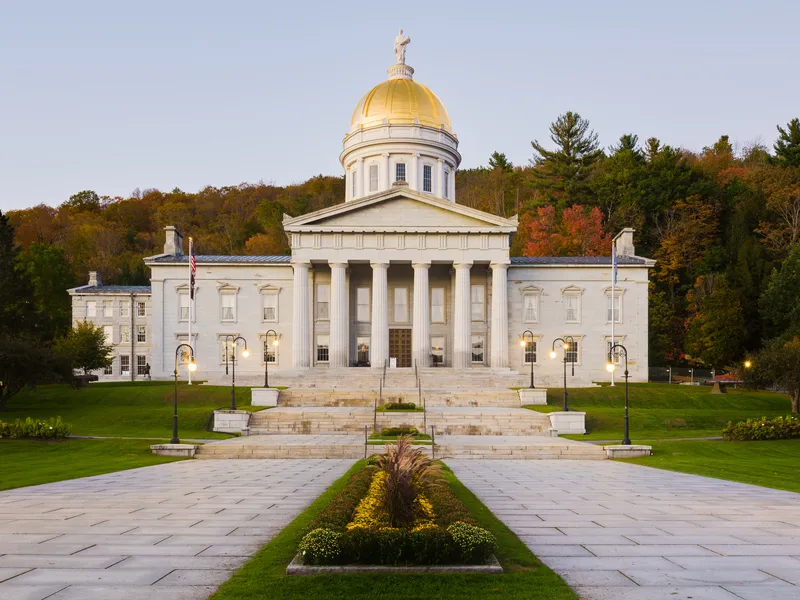
5 schools in Vermont awarded political science bachelor’s degrees in 2023–24, scored against 991 bachelor’s programs nationwide.
Political Science B.A.
The Vermont major begins with four 1000-level courses: introductions to political theory, the US political system, international relations and comparative world politics. You then take courses in three of four subfields and a seminar. A separate skills requirement lets you choose one route from statistics and methodology, political economy, a language, philosophy or geography. Certain internship experiences can replace the political science elective with the chair’s approval. The degree takes 30 credits in the major plus 3 to 6 in ancillary courses, and UVM awarded 85 degrees in it in 2023–24.
Program Sources: Political Science B.A. | University of Vermont Catalogue
Political Science
Middlebury requires ten political science courses. One must be introductory political theory, two more introduce other subfields, and the department expects you to finish those three before the end of sophomore year. A field distribution rule asks for two courses in any three of theory, American politics, comparative politics and international relations, plus one in the fourth. Every major ends in a 0400-level seminar. Honors candidates write a thesis across three terms and defend it in an oral examination. The department awarded 31 degrees in 2023–24.
Program Sources: Requirements | Middlebury CollegeRequirements | Middlebury College
Political Science (B.A.)
Norwich sorts its requirements by subfield. You take at least one international relations course, one comparative politics course and PO321 in American politics, then two upper-level political science electives, each with a grade of C or higher. The core pairs political science introductions with two history courses, HI121 and HI122. Students in the Accelerated Master’s Pathway can count GD 510 or GD 511 toward the international relations requirement, and an optional concentration can be added to the major. Norwich awarded 11 degrees in this program in 2023–24.
Program Sources: 9PO Program | Norwich University Catalog
Bachelor of Arts in Political Science
Saint Michael’s builds the major from six required courses and five political science electives, at least two of them at the 300 level. A practicum requirement follows, which you meet with an academic internship or another applied experience approved by the department chair, or by completing a second major. The catalog describes faculty mentoring students through academic internships, study abroad, collaborative research, student activism and campus leadership. Five students completed the degree in 2023–24.
Program Sources: BA.PO Program | Saint Michael's College Catalog
Political Science Major
Bennington students work with faculty to design the content, structure and sequence of their own study, which the college calls the Plan. The work combines coursework and fieldwork on political institutions, processes, behavior and outcomes at national and international levels. Questions the department raises include what drives democracy, how inter-group and international conflicts are managed, and what institutional design and civil society contribute to political development. You learn to connect your work to real developments in the world and to communicate it in writing and aloud. Three students completed the degree in 2023–24.
Program Sources: Political Science Major | Bennington College
Each program gets the same comparison score it earns in our national political science model, calculated against the nationwide group that meets the numeric and directory criteria. We then order Vermont’s eligible programs by that score within each degree level. This page features up to 10 programs, taking the next highest-ranked program from each degree-level list in turn. Scores are compared only within the same degree level. Bachelor’s lists weigh graduation rate (20%), published tuition (20%), graduate earnings (20%), program reputation (25%), and degrees awarded (15%). How these scores work.
These picks compare only the programs featured in the lists above.
$19,058 in annual undergraduate tuition and required fees for state residents (2024–25), the lowest among the 5 bachelor’s programs shown here.
85 political science bachelor’s degrees awarded in 2023–24, the most of any school on this list.
91% of first-time, full-time students at the school finished a bachelor’s within six years. This is a schoolwide rate, not a political science-only rate.
The highest-scoring private school on the bachelor’s list (No. 2 overall), with a comparison score of 69.8.
The University of Vermont is the clear volume leader, with 85 degrees. Middlebury College follows with 31. Norwich University awarded 11, Saint Michael’s College 5, and Bennington College 3. A large program means more classmates in the major. A small one can mean a tighter group. Both counts are shown on each card.
Price splits along public and private lines. UVM charges $19,058 in state. The four private schools range from $49,740 at Norwich to $67,600 at Middlebury. Schoolwide graduation rates run from 91 percent at Middlebury down to 60 percent at Norwich, with Saint Michael’s at 73 and Bennington at 71.
These are BLS median annual wages for Vermont and the United States from the May 2025 Occupational Employment and Wage Statistics survey. A median is the midpoint among workers in the occupation, from new hires to senior staff, so it is not a starting salary for a new graduate. The 10th–90th percentile range shows what the middle 80% of workers earn in the state.
| Occupation | Vermont Median | Vermont 10th–90th Percentile | U.S. Median | Vermont Jobs |
|---|---|---|---|---|
| Social Science Research Assistants | $47,510 | $47,510–$76,650 | $61,990 | 40 |
| Urban and Regional Planners | $84,750 | $61,400–$103,540 | $89,320 | 100 |
Source: BLS Occupational Employment and Wage Statistics, May 2025. Wage data does not enter the program scores.
5 schools in Vermont appear in the lists shown here (5 bachelor’s programs). A school can appear at more than one degree level. The degree counts come from federal IPEDS completions for 2023–24.
University of Vermont lists $19,058 in annual undergraduate tuition and required fees for state residents in 2024–25, the lowest among the bachelor’s programs shown here. That is a schoolwide figure before aid, so check the program’s own costs and any fees for fieldwork or labs.
Middlebury College is the top-scoring private college on this list, ranking second overall. Its 2024–25 tuition and fees are $67,600, and its schoolwide graduation rate is 91 percent.
The five ranked schools are in Burlington, Middlebury, Colchester, Northfield, and Bennington.