Key Points
- A 2026 Nature review maps LLMs as subject, assistant, collaborator, evaluator.
- LLMs struggle with causal inference, and reproducing social complexity remains unproven.
- Open-source models often match proprietary LLMs on single-language sentiment and survey simulation.
Introduction: What LLMs Change for Social Science Research
A review published in Nature Human Behaviour on 26 October 2026 treats large language models as two things at once: instruments for studying society and objects that are now reshaping it. That dual status creates a recursive problem. Understanding how AI is changing social life requires the very tools driving the change.
The practical tension is credibility. The authors describe LLMs' capacity to reproduce social complexity as uneven and unproven, yet annotation, simulation, and hypothesis generation are already spreading through sociology, political science, psychology, and economics.
For doctoral programs and grant panels, the gap now sits between adopting the tools and being able to validate what they produce.
The Four Roles of LLMs in Computational Social Science
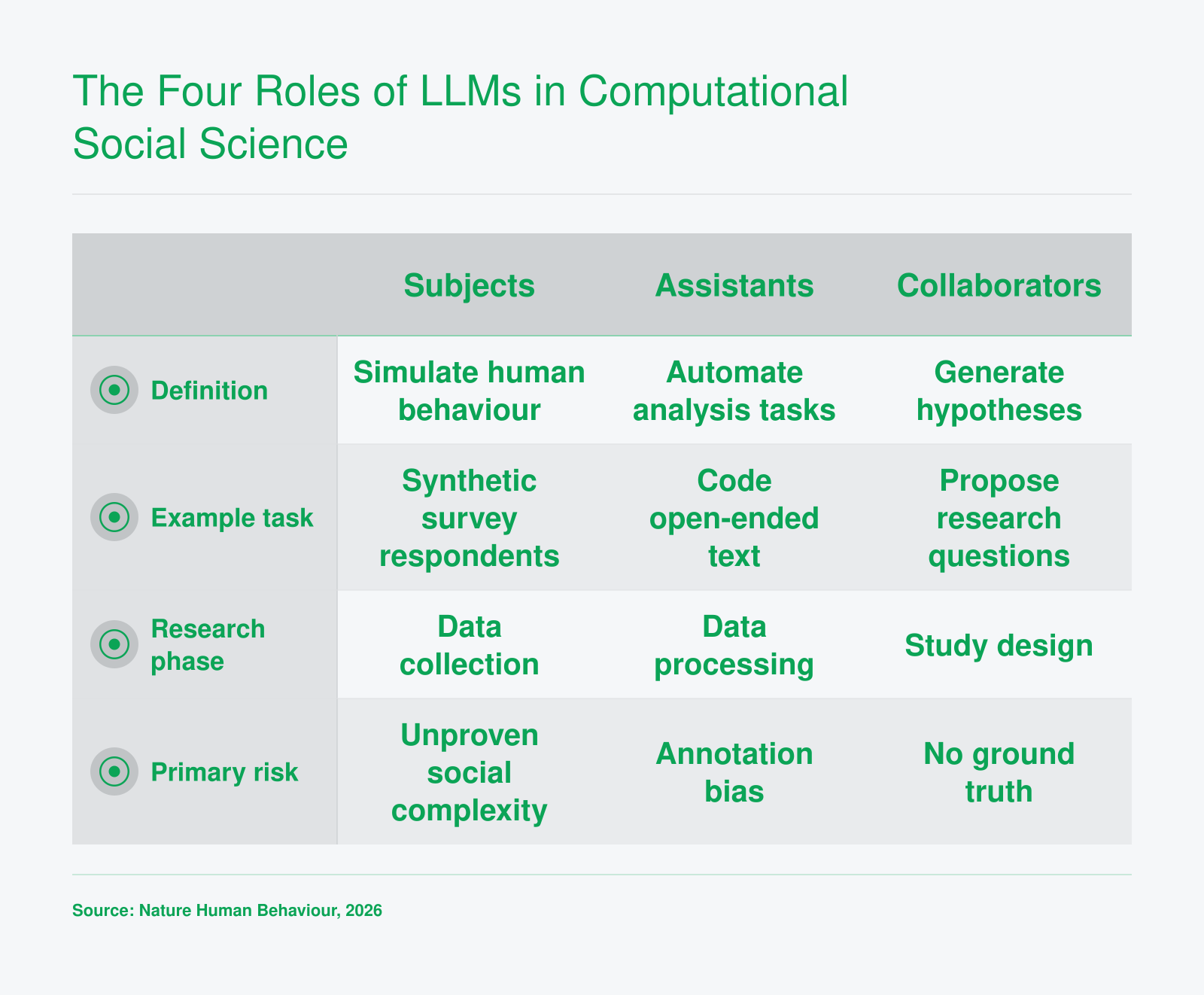
A Nature Human Behaviour review (Fig. 1) maps four roles for LLMs in computational social science: subjects that simulate human behaviour, assistants that automate analysis, collaborators that generate hypotheses, and evaluators that audit research quality. The roles overlap and are not mutually exclusive.
Did You Know?
The review's wording is blunt: LLMs' ability to reproduce social complexity "remains uneven and unproven." Read that as a credibility warning, not a dismissal. Trust LLM-based findings only when researchers show validation against human data, transparent prompts, and uncertainty estimates.
Text-as-Data and Annotation Workflows with Multilingual Checks
Cheap, fast LLM annotation is tempting, but the savings only hold if the labels survive scrutiny, and that scrutiny gets harder outside English. Treat the model as one coder among several, not as ground truth.
Prompt Design for Classification, Stance, and Entities
For classification, sentiment, and stance, write the codebook into the prompt: define each category, give boundary cases, and constrain output to a fixed label set. For entity extraction, specify span rules and return structured output you can parse. Run a pilot on a hand-coded sample before scaling, and revise the codebook, not just the wording, when errors cluster.
Cost and speed matter too. In a 2026 LLMs4SSH evaluation of South Slavic languages and English, zero-shot LLMs often matched or beat fine-tuned BERT-like models. They were also slower, costlier, and less predictable, so BERT-like models stayed more practical for large-scale annotation.
Human-in-the-Loop Checks
Draw a stratified sample for double coding by trained humans, then report model-human agreement alongside human-human agreement. Evidence on interpretive tasks is a caution. In the same workshop's Critical Discourse Analysis test, models tracked human consensus on macro-level features but struggled with implicit, microstructural meaning. A 2026 multilingual span-annotation resource with more than 40,000 annotations found only moderate agreement with skilled humans, though error rates resembled those of skilled crowdworkers at much lower per-annotation cost.
Multilingual and Cross-Cultural Validation
English results do not transfer automatically.1 The gaps are measurable:
- German aspect-based sentiment: Gemini 3 Flash showed an English advantage of 2.4 to 10.0 percentage points.3
- Asian languages: The Camellia benchmark covers nine languages and six cultures, with 19,530 annotated entities. Models struggled on cultural adaptation, sentiment association, and entity-extractive QA, and results varied by model.2
- Swedish everyday knowledge: Models approximated prototypical answers but missed culturally specific nuance and within-culture variation.3
- Benchmark artifacts: Re-auditing five non-English languages in GAIA-v2-LILT lifted agent success by up to 32.7% over minimal translation, so some apparent gaps are measurement error.2
Zero-shot judge transfer is unreliable for discourse-level assessment in morphologically rich languages. Workshop guidance favors chain-of-thought prompting, dozens of samples per evaluation, and several metrics.
Transferability Checklist
- Validate in each target language against its own human baseline.
- Check the four bias sources in the Multilingual Safety Annotation Gap framework: language-coverage, dialect-representation, cultural-semantic, and annotation-guideline.
- Adapt benchmarks at the task level rather than by literal translation.
- Report agreement per language, never pooled.
- LLMs4SSH 2026 Proceedings, ACL Anthology
- MME 2026 Multilingual and Multicultural Evaluation Proceedings, ACL Anthology
- MELLM 2026 Event Page, ACL Anthology
Synthetic Respondents and Human Behavior Simulation
Generating survey responses versus measuring them marks the central divide. An LLM prompted with a demographic profile and a question can produce a plausible answer, and researchers have begun chaining thousands of such profiles to simulate an entire survey panel or to forecast how an experimental manipulation might play out. The appeal is obvious: no recruitment costs, no attrition, instant pilot data. The danger is mistaking a fluent simulation for a measurement of what real people would do.
How the Simulation Works
To build synthetic respondents, researchers condition the model on persona attributes (age, region, political leaning, occupation) and then query it the way a human subject would be queried. The same mechanism can approximate experiment outcomes by varying a treatment prompt and reading off the model's shifted responses. What comes back is a distribution of answers shaped by the model's training corpus, not a sample drawn from a population. That distinction governs everything that follows.
Exploration Versus Measurement
The recent Nature Human Behaviour review separates two uses that are easy to conflate. One is exploratory: generating hypotheses, stress-testing an instrument, or scoping which conditions might be worth running with human participants. The other treats synthetic output as a direct measure of human behavior, a substitute for data collection. The first use is defensible and often cheap. The second carries real risk, because the review flags that LLMs' ability to reproduce social complexity remains uneven and unproven, and that these models struggle with causal inference. A simulation that predicts an average response may still misrepresent subgroup variation, minority viewpoints, or the mechanism driving an effect.
When Synthetic Respondents Are Acceptable
Use synthetic respondents to:
- Prototype: Pilot question wording, branching logic, or experimental conditions before fielding with humans.
- Generate hypotheses: Surface candidate effects worth testing, clearly labeled as model-generated.
- Benchmark: Compare simulated distributions against held-out human data to quantify where the model diverges.
Treat them as misleading when they stand in for a population estimate, when subgroup accuracy matters, or when a causal claim rests on them. In those cases, synthetic data belongs in the design phase, with human data carrying the inference. Report the model, prompts, and any human validation so reviewers can judge which role the synthetic respondents actually played.
Validation, Bias, and Statistical Uncertainty in LLM-Based Research
Validating an LLM-based study means checking that the labels or simulated answers a model produces are accurate, stable, fair across groups, and honestly qualified by uncertainty before they feed into an inference. Treat the model as a measurement instrument that must be calibrated, not as an oracle.
Prompt Sensitivity and Evaluation
Start with a human-coded gold set and score every prompt variant against it. Small wording changes, label order, or model version swaps can shift outputs, so report results across several prompt formulations rather than the one that happened to work. Where possible, benchmark an open-source model against a proprietary one on the same gold set and rerun the pipeline later with pinned versions and fixed settings to confirm results hold.
Demographic Bias Checks
Accuracy averaged over a corpus can hide uneven errors. A 2026 socio-demographic and cross-societal fairness audit found that bias depends on context: in the United States the disparities were most pronounced along race and political identity, while in Chile gender, education and religion were more salient, with lower accuracy for women and senior adults. The lesson is not to assume one bias profile travels. Break out error rates by the groups relevant to your population, and do the same for simulated respondents, where a model may flatten or caricature subgroups.
Quantifying Uncertainty
LLMs tend to sound surer than they should be. In a 2026 study of eleven LLMs estimating population statistics such as health prevalence and personality-trait distributions, nominal 95% credible intervals contained the true value only 9 to 44 percent of the time. Post-hoc conformal prediction widened the intervals and corrected coverage.
Conformal prediction is a distribution-free, model-agnostic approach that builds label sets or intervals meant to contain the true answer with user-chosen probability 1 minus alpha. A scoping review covering more than 106 studies in six method groups reports that logit-free approaches, which rely on signals such as self-consistency and semantic diversity, tend to beat logit-based ones on coverage error and set size. That matters for closed models that expose no token probabilities.
Bayesian options are maturing too. Work on uncertainty-aware generation in tutoring and peer review pairs Bayesian expected-utility decisions with conformal sets, and finds Bayesian rules generally outperform risk-averse ones that default to generic outputs under ambiguity. Empirical Bayes conformal methods add r-values as an uncertainty-aware score, with both a closed-form Normal-Normal estimator and a nonparametric posterior-sampling version.
In practice, calibrate on a held-out human-coded sample, propagate label uncertainty into downstream regressions, and report coverage alongside accuracy.
Did You Know?
Do not treat LLM outputs as causal estimates. The 2026 Nature Human Behaviour review states that LLMs "struggle with causal inference," so a model's answer about why something happens is a hypothesis at best, not evidence. Designs that need causal claims still require experimental or quasi-experimental identification. The validation section below covers safer uses.
Cost, Latency, and Deployment for Research Labs
Pay-per-token proprietary APIs and self-hosted open-weight models solve different problems. The first buys convenience and a predictable bill. The second buys control over data, at the price of engineering time. For most annotation projects, the token rates are small next to the cost of validation.
Current Token Prices and Latency
List prices below are per 1K tokens, input then output, with time to first token (TTFT) where reported.
- GPT-4o: $0.0025 and $0.010, roughly 380 to 450 ms.
- Claude 3.5 Sonnet: $0.003 and $0.015, about 520 ms.
- Claude 3 Opus: $0.015 and $0.075, about 1,200 ms.
- Gemini 2.5 Pro: $0.00125 and $0.010, about 450 ms.
- Gemini 2.5 Flash: $0.00015 and $0.00060, roughly 200 to 280 ms.
- Llama 3.1 70B on Groq: $0.00059 and $0.00079, about 180 ms.
- Mistral Large 2: $0.002 and $0.006, about 480 ms.
- Mistral Small 3.1: $0.00010 and $0.00030, about 310 ms.
Treat the latency numbers as rough. Benchmarks use different prompt sizes and setups, and sources disagree even on Gemini 2.5 Flash. Llama is open-weight, so the figure above reflects one hosted provider. Self-hosted cost and speed depend on hardware, quantization, and batching.
What 1,000 Annotations Might Cost
No source publishes a verified per-observation cost, because that depends on your task. As an illustration only, assume 300 input tokens and 20 output tokens per item, one label, no retries. Per 1,000 items, that works out to about $0.04 for Mistral Small 3.1, $0.06 for Gemini 2.5 Flash, $0.19 for Llama 3.1 70B on Groq, $0.58 for Gemini 2.5 Pro, $0.95 for GPT-4o, $1.20 for Claude 3.5 Sonnet, and $6.00 for Claude 3 Opus.5
Longer codebooks, few-shot examples, multiple labels, repeated runs for reliability checks, and human adjudication will multiply these figures. Budget the validation sample before the API bill.
Privacy and Deployment
Sensitive material such as interview transcripts, clinical notes, or identifiable social media data calls for caution. Sending it to a hosted API means a third party processes it, so check data-retention and training terms and your IRB protocol first. Hosted open-weight models, including Llama on a commercial provider, carry the same exposure. Running an open-weight model on institutional or local hardware keeps data in-house and lets you pin a model version for reproducibility. Hosted APIs retire models over time, so record the exact model identifier and run date for every job.
- LLM Cost Calculator, GitHub
Reporting Standards and Privacy Governance for LLM Methods
What do journals and ethics boards actually expect when a study uses an LLM on sensitive social data? No single cross-disciplinary legal framework governs this, and commercial LLMs are not automatically safe for sensitive data. What exists is a set of institutional and publisher rules that agree on the basics: approval first, minimal data, secure tools, and named human accountability.
Ethics Review and Data Governance
Penn State's 2026 guidance requires IRB approval before generative-AI research begins, and it warns that deidentification is not foolproof. AI can infer personal details from residual text, linked metadata, file names, geolocation, and timestamps. Participants should be told when AI may process their data, with consent materials naming the AI function, risks, data types, and vendor.
San Diego State bars designated PL-1 and PL-2 FERPA data from AI platforms. Other sensitive participant data may go to public or non-secure tools only with safeguards such as data-use agreements. Its IRB application asks for vendors and APIs, storage, bias and fairness, monitoring, and human validation of outputs. Finland's TENK says confidential data should be handled with AI only securely, and that authors should state whether a GDPR data-protection impact assessment was completed when relevant.
A workable baseline:
- Least data: strip identifiers and metadata before anything leaves your environment.
- Approved systems: use vendor contracts with retention, deletion, and secondary-use limits.
- Audit trail: log tools, versions, prompts, inputs, outputs, and human review.
Disclosure and Preregistration
Publisher and agency guidance is consistent. The HHS Office of Research Integrity and the CDC expect disclosure of substantive generative-AI use. ICMJE treats AI as ineligible for authorship and requires replication information, WAME calls for full prompt disclosure, and APA requires full citation and deidentification before AI submission.5 The Journal of Korean Medical Science exempts routine grammar correction but requires disclosure of substantive use and of its extent to editors.6 Responsibility stays with named human authors.
Preregister the model, version, prompt templates, and the validation plan you will use against human coding. Frozen specifications make it harder for reviewers to suspect prompt tuning after the fact.
Presenting Findings Credibly
Reviewers will look for five elements: tool, version, purpose, prompts, and human verification. Put prompts in an appendix or repository, report agreement with human-coded samples, and state limits plainly, especially for simulated respondents and any causal claim. Calibrated language reads as rigor, not weakness.
- Guidance on Generative AI in Research and Writing, PubMed Central
- JKMS Guidance on AI Use in Manuscripts, Journal of Korean Medical Science
Skills Graduate Students Should Build Now
Every doctoral student faces the same budget problem: hours spent learning to run models are hours not spent reading theory, and no committee has yet agreed on how to trade the two. The Nature Human Behaviour review, published on 26 October 2026, does not resolve that tension, but it does clarify which technical skills are now load-bearing rather than optional. If LLMs function as subjects, assistants, collaborators and evaluators across sociology, political science, psychology, anthropology and economics, then the students entering those fields will be asked to defend LLM-based designs long before the methodological consensus settles.
Three Capabilities to Prioritize
- Prompt and protocol design: Treat prompts as measurement instruments. Learn to version them, document them, and test how small wording changes move your outputs, because that sensitivity is itself a finding reviewers will ask about.
- Evaluation design: Build the habit of asking what a model's output is being compared against. A human-coded gold standard, an inter-rater statistic, and a held-out sample are not technical niceties; they are the argument.
- Reproducibility practice: Pin model versions, record decoding settings, archive raw outputs, and script the pipeline end to end. Hosted models change under you, which makes a documented trail the difference between a replicable study and an anecdote.
Bridge the Two Halves of the Training
The harder skill is translation. Someone has to explain to a substantive committee why an LLM simulation of survey respondents is not a survey, and explain to an engineering collaborator why construct validity matters more than benchmark accuracy. Students who can hold both vocabularies will be unusually employable inside departments that are still hiring to close this gap.
Concrete Learning Paths
Start by running an open-weight model locally on a modest text corpus, so inference costs and hardware limits become real rather than abstract. Then replicate a published annotation benchmark and compare your numbers to the reported ones. Finally, pick up tools for quantifying uncertainty: bootstrapped confidence intervals around classifier-derived estimates, and sensitivity analyses that show how conclusions shift when annotation error is assumed rather than ignored.
Large language models struggle with causal inference, raise ethical concerns about privacy and misinformation, and their ability to reproduce social complexity remains uneven and unproven.