Key Points
- University of Chicago's certificate spans nonprofit, for-profit, and government settings.
- PhD funding often includes several years of tuition coverage plus stipend.
- Data science remains among the strongest-paying non-academic paths for graduates.
Making Graduate Education in the Social Sciences Relevant Again
What is a social science graduate degree actually for in 2026, if not a tenure-track job? For decades the answer was a faculty post, and departments built admissions, coursework, and funding around that one exit. The math no longer holds: stipends buy less, doctoral cohorts are smaller, and most graduates now build careers in government, industry, nonprofits, or think tanks.
Programs are responding with computational methods requirements, cross-department certificates, and capstone projects with outside clients. The tension is that every added requirement competes for the same credit hours and the same shrinking stipend budget.
Relevance, increasingly, is a funding question as much as a curricular one.
Key Curriculum Changes: Interdisciplinarity, Data Skills, and Applied Research
The University of Chicago's Applied Social Science in Industry Certificate is open to both master's and doctoral students and spans nonprofit, for-profit, and government settings. That range captures the direction curriculum revision has taken across the field: methods training that travels outside the seminar room. Departments are no longer treating computational skill as an optional add-on for the quantitatively inclined.
Data Science Moves into the Core
Several programs now build the degree itself around computation rather than bolting it on. UC Berkeley's Master of Computational Social Science is a 12-month, in-person, part-time program.4 The University at Buffalo's MS in Data Analytics in Social Sciences is a 36-credit, STEM-designated terminal master's that requires computation, research methods, discipline-specific advanced analysis, and a project or thesis. At MIT, the doctoral program in Social and Engineering Systems pulls statistics and information sciences together with engineering and the social sciences in a single degree structure. Emory's Data Science MS runs 12 months and requires a capstone alongside technical writing.5
Certificates as the Flexible Middle Ground
For students who want the skills without changing degrees, graduate certificates have become the standard route. Emory offers a four-course Data Science for the Humanities and Social Sciences certificate; its TADA certificate, launched in 2022 out of an NIH-funded training program, has since expanded to all doctoral students. Northeastern lists a Graduate Certificate in Computational Social Science at its Arlington and Boston campuses, alongside a PhD in Network Science available in Arlington, Boston, and online. Arizona State offers a Social Science Research Methods graduate certificate open to master's and PhD students.6 The University of Chicago's Computational Social Science certificate accepts any master's or doctoral student and can be completed in a single year or stretched across several.
Applied Projects and Client Work
Capstones carry much of the applied weight in these curricula. Emory's Data Science MS pairs its capstone with technical writing, a signal that communicating findings to a non-specialist audience counts as a trained skill. Buffalo requires a project or thesis as a condition of the degree. UT Dallas lists an MS in Applied Sociology at a minimum of 36 semester credit hours, with the applied framing built into the degree title.7 When you compare programs, look at whether the applied component is a genuine external engagement or a self-directed paper with a new label.
- Berkeley Graduate Admissions Programs, UC Berkeley
- Emory Graduate Degree Programs, Emory University
- Social Science Research Methods Graduate Certificate, Arizona State University
- UT Dallas 2026 Graduate Catalog, University of Texas at Dallas
Non-Academic Career Preparation: From Alt-Ac to Industry and Government
Programs that take non-academic careers seriously tend to build the same few supports: a professional development office, internship or externship pipelines, capstone projects with outside clients, and alumni networks that reach into government, industry, nonprofits, and think tanks. The strongest ones also publish where graduates actually land, which gives applicants something to check.
What Programs Are Doing
The University of Chicago's MAPSS reports career outcomes across seven or more employment sectors, and says 88% of graduates were employed within six months. The cohort and methodology behind that figure are not specified, and no salary is attached to it. The University of Washington's MSIM, an interdisciplinary program adjacent to the social sciences, reports that 79% of students completed an internship and 28% received a job offer from that experience.1 Both are examples of outcome reporting and structured experiential learning; neither proves named employer partnerships, which the available evidence does not establish.
What Outcomes Data Shows
Salary evidence outside academia is uneven, so read each number with its scope in mind:
- PhD industry median: One 2026 analysis citing 2024 National Science Foundation survey data puts the expected industry median for social science PhDs at $129,000, against $75,000 for non-postdoc academic roles. That gap is not shown to hold across all social science PhDs.
- Early-career range: Another source gives a typical range of $65,000 to $95,000.3
- Job-board listings: ZipRecruiter's August 2026 average for "PhD social sciences" jobs is $67,283, with a typical range of $55,500 to $71,500.4 These listings cover broader occupations.
- Political science: One estimate gives $70,000 to $110,000, with 25 to 35% entering industry and 10 to 20% entering government5. Its method is unclear.
- UW MSIM: The median salary near graduation was $106,000, rising to an average of $126,000 five years out1. This is a narrower, technology-oriented population.
International evidence suggests roughly 40 to 50% of PhD holders work outside academia, with wide variation by country, discipline, and institution.6 A separate 2026 estimate of 60 to 75% covers PhDs broadly, not social sciences specifically.7
Master's vs PhD Tracks
Master's graduates typically move straight into applied roles in government, nonprofits, business, communications, and policy, which is why internships and capstones matter most at this level. PhD holders compete for research-intensive positions in think tanks, government agencies, and industry analytics, where the doctorate is the credential. Some master's programs, MAPSS among them, also serve as a route into funded doctoral study, so check whether a program's outcomes report separates job placement from PhD admission.
- MSIM Careers, University of Washington Information School
- Is a PhD Worth It?, Scholaro
- PhD Social Sciences Jobs, ZipRecruiter
- PhD Job Placement by Field, Leadership Brainery
- PhD Employment Outside Academia: International Evidence, Taylor & Francis
- PhD Career Pathways Outside Academia (2026 Study), Taylor & Francis
How Funding Pressures Are Reshaping Program Design
Graduate programs in the social sciences run on a tight budget. Stipends, tuition waivers, and faculty time all draw from the same pool, and when that pool shrinks, departments have to decide what to protect. The funding table above shows where the guarantees stand today. What follows explains why programs look the way they do.
Common Budget Responses
Departments facing constraints tend to reach for a handful of levers:
- Smaller cohorts: Admitting fewer doctoral students is the most direct way to keep a funding promise intact for everyone who enrolls.
- Heavier teaching loads: Students may be asked to teach more sections or serve as instructors of record, which covers undergraduate demand at lower cost.
- Revenue-generating certificates: Short, tuition-funded credentials in areas like data analysis or program evaluation bring in income without adding stipend obligations.
- Cheaper formats: Online and hybrid delivery lowers facilities costs and widens the pool of paying students.
Guarantees Versus Access
There is a real tension here. A multi-year funding guarantee is one of the strongest protections a doctoral student can have, but it limits how many people a program can admit. Expanding access usually means adding students who pay their own way, often in master's or certificate tracks. Programs that try to do both can end up with a well-funded core of PhD students alongside a larger, self-financed population. Applicants should notice which group a program is built to serve.
Why Master's Cost Drives Professionalization
Because master's students typically carry the cost themselves, programs face pressure to show a payoff quickly. That is one reason shorter, more applied degrees have grown. A one-year or part-time professional master's with a clear skills focus is easier to justify to a student paying tuition than an open-ended research apprenticeship. It also gives departments a steadier revenue stream.
None of this is automatically good or bad. Applied training can be genuinely useful, and a lean format can lower the price of entry. The point is to read a program's structure as a signal of its finances, and to ask how its funding model shapes the support you would actually receive.
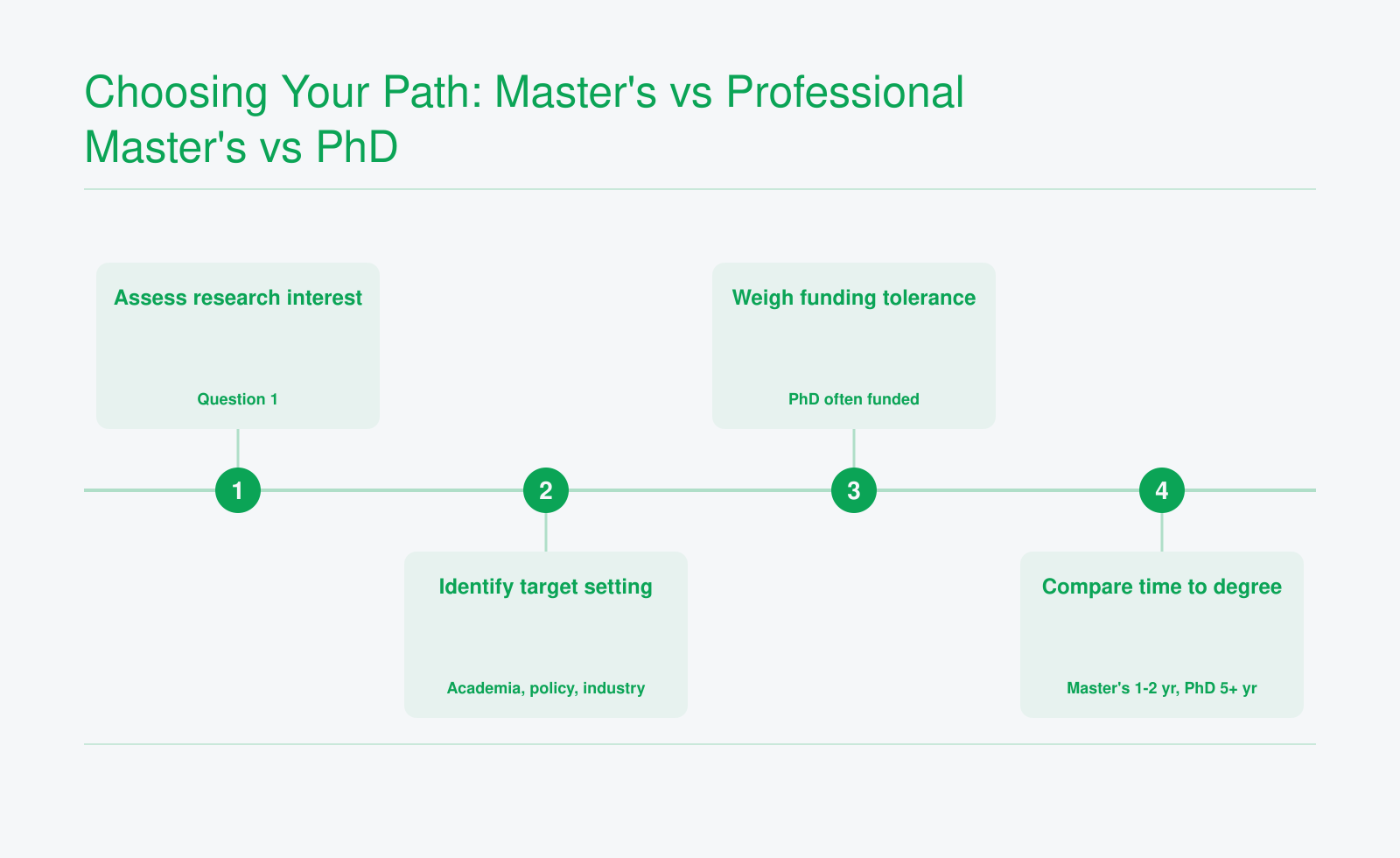
Choosing Your Path: Master's vs Professional Master's vs PhD
Start with whether you want research at the center of your career or a practice and policy setting. Then weigh funding tolerance and how many years you can invest before choosing a degree type.
What It Takes to Get in: Selectivity Benchmarks by Discipline
Admissions selectivity varies widely across social science graduate programs. Highly selective PhD programs in psychology and sociology often admit a small fraction of applicants, while professional and data-focused master's programs may set lower GPA minimums and are increasingly test-optional or test-free.
| Discipline / Program Type | Typical Acceptance Rate | Average GPA | GRE Required? |
|---|---|---|---|
| Psychology PhD programs | 12% to 48% non-clinical; 7% to 50% clinical | 3.6 overall, 3.7 in psychology courses | Typically required; first-year mean scores 158 verbal and 149 quantitative |
| Psychology master's programs | Not reported | 3.4 overall, 3.5 in psychology courses | Typically required; first-year mean scores 153 verbal and 146 quantitative |
| Sociology PhD programs | As low as 4% | Minimum typically 3.0 to 3.5 | Typically required |
| Sociology PhD, University of Minnesota | 6.44% | 3.90 | Optional |
| MS in Social Data Analytics and Research, University of Texas at Dallas | Not reported | 3.0 | Not required |
- PhD Acceptance Rates 2027: How Competitive Is Getting In?, ApplyKite
- Applicant Qualifications, Admissions Criteria, and Acceptance, University of California San Diego
- Admissions Standards and Statistics | Sociology, University of Minnesota
- Frequently Asked Questions: Department of Sociology, Northwestern University
- Admissions - Division of the Humanities and Social Sciences, California Institute of Technology
- How to Apply - MS in Data Science for Public Policy, Georgetown University McCourt School of Public Policy
- Master of Science in Social Data Analytics and Research - Academics, University of Texas at Dallas
What Applicants and Current Students Should Look For
A graduate program's website is a marketing document. The information that actually matters sits in the details: the funding letter, the course catalog, the placement record. Build your shortlist around a handful of verifiable questions rather than a reputation ranking.
The Verification Checklist
- Funding guarantee language: Get the offer in writing and read the conditions. "Guaranteed for five years" and "renewable annually subject to performance" are very different promises. Ask about teaching load, summer support, fee waivers, and health coverage.
- Required quantitative coursework: Look for named, required courses in statistics, causal inference, or computational methods, not a list of electives you may never take.
- Career services with a graduate focus: A general campus career center built around undergraduates may not know how to place an ethnographer in a policy shop. Ask who advises graduate students specifically.
- Alumni outcomes: Request placement information by cohort rather than a curated page of success stories. Where did graduates of the last three years land, inside and outside academia?
- Format fit: Residential, hybrid, and online programs differ in lab access, fieldwork funding, and advising contact. Match the format to how you actually work.
Questions to Put to Admissions
- How does the program support internships, and are placements funded or credit-bearing?
- What share of recent graduates moved into non-academic roles, and in which sectors?
- Under what conditions can funding be renewed or revoked?
- Can you connect me with students in their third year or beyond, not only first-year ambassadors?
- How many advisees does each faculty member carry?
Fit Beats Prestige
Reputation travels poorly across sectors. A well-funded department with an applied placement record can serve you better than a famous name that treats non-academic work as a fallback. Use the tables and comparisons above to shortlist on cost, funding terms, and format, then judge culture through campus visits and conversations with people a year or two ahead of you. Their experience of advising and funding is the closest preview you will get.