Key Points
- UMaine's 2023-2024 cohort had 11 students from seven departments, three colleges.
- Fall fellows chose workshops themselves; spring sessions were peer presentations.
- Strong applications pitch a specific project fit within a shared problem.
Introduction: Why Themed Fellowships Are Reshaping Graduate Training
What does a themed fellowship add that a departmental assistantship does not? The University of Maine's Center for Sustainability Solutions tested one answer during the 2023-2024 academic year, running a first-of-its-kind cohort of 11 graduate students drawn from seven departments and three colleges. Selection was competitive: written applications, interviews, a review panel.
The tension is structural. Dissertation funding usually follows one advisor's project, while sustainability problems spill across policy, economics, and community behavior. A themed fellowship asks students to spend part of their funded time learning how other disciplines frame the same problem, then to teach their own methods back to the cohort.
That design choice, more than the stipend line, decides who applies and how they pitch themselves.
What Are Themed Sustainability Graduate Fellowships?
A standard assistantship buys you time and a desk. A themed fellowship asks you to spend part of that time learning how other disciplines think, and that tradeoff is worth pricing before you accept.
A Cohort, Not Just a Check
Themed sustainability graduate fellowships are cohort-based programs organized around a real-world sustainability theme rather than a single department's research agenda. They admit a group of graduate students, often from several fields, and run them through a shared sequence of seminars, workshops, and projects. Funding may cover stipends, tuition, travel, or project costs, but the defining feature is the structured cohort experience. General fellowships and departmental assistantships usually support a student inside one lab or discipline; the themed model deliberately mixes those boundaries. The distinction matters when comparing offers: two fellowships can pay similar amounts and train very differently.
Why Team Science and Peer Teaching
Sustainability problems do not arrive sorted by department. A fellowship that asks economists, ecologists, engineers, and education researchers to work on the same question has to teach the mechanics of collaboration: how to frame a shared problem, divide work, and translate evidence across fields. That is why themed programs invest in professional development and peer teaching. Workshops on facilitation, team science, and communication are not extras; they are the curriculum that makes cross-disciplinary work possible.
The University of Maine's Center for Sustainability Solutions shows how that works in practice. Its experimental sustainability graduate fellowship cohort drew students from across the university into one program, showing how a themed structure turns disciplinary breadth into deliberate training rather than an accidental mix.
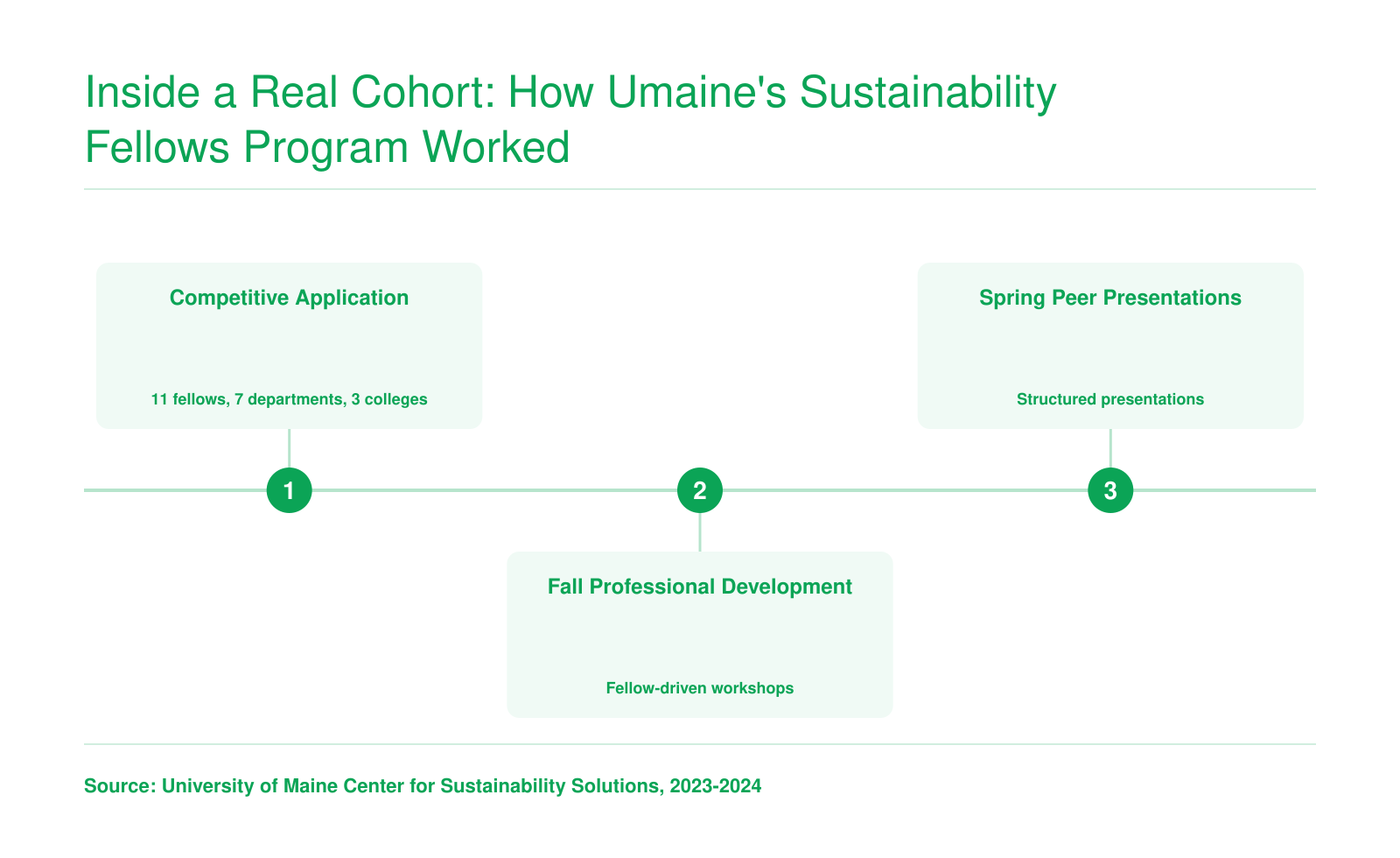
Inside a Real Cohort: How UMaine's Sustainability Fellows Program Worked
The University of Maine's Center for Sustainability Solutions ran a pilot graduate fellowship during the 2023-2024 academic year, moving from competitive selection to peer-driven training and presentations.
Did You Know?
The most transferable design element is fellow ownership: participants chose the fall workshop topics themselves, from facilitation training to team science exercises. Spring peer presentations, ranging from data visualization to nature journaling, kept the learning peer-led rather than faculty-directed.
Funding and Stipends: How Much Do Sustainability Fellowships Pay?
A stipend alone does not tell you whether an award is livable; the tuition allowance and the expense pool do. Full-tuition-plus-stipend packages leave a graduate student free to do the work. Capped tuition awards that leave fees to the department can turn a headline number into a budgeting exercise.
Full Awards vs. Partial Awards
The National Science Foundation's Graduate Research Fellowship Program is the clearest full-funding model. It pays a $37,000 stipend for each 12-month tenure period and a $16,000 cost-of-education allowance to the institution, for $53,000 per funded year1. Fellows receive three years of support over a five-year period. The institution must exempt fellows from tuition and mandatory fees normally charged to comparable students and cover required costs above the $16,000 allowance. The fellow never sees the tuition money, but the department does, and the fee bill disappears.
Partial awards shift more risk to the student and the department. EPA's Science to Achieve Results fellowship, as described in EPA program materials, provides a $27,000 stipend, $5,000 for expenses, and up to $12,000 for tuition and fees, for up to $44,000 per year.2 It supports full-time students in a two-year master's program or a three-year doctoral program.
What Named Programs Pay
- NSF GRFP: $37,000 stipend plus a $16,000 cost-of-education allowance, or $53,000 per funded year.
- EPA STAR, program materials: $27,000 stipend, $5,000 expenses, and up to $12,000 tuition and fees, or up to $44,000 per year.
- EPA STAR, separate 2026 listing: $42,000 stipend plus tuition and fees, with a December 1 deadline.4 That figure conflicts with EPA's own program document, so treat it as a distinct listing and confirm the solicitation rather than merging the two.
- University of Maine graduate benchmark: $21,000 for a master's student on a 9-month, 20-hour-per-week appointment, prorated for other lengths or workloads.3 The university states there is no specific minimum fellowship stipend.
- UMaine Mitchell Center fellowship: the center does not publish a separate stipend, tuition-coverage figure, or cost-of-living adjustment. Ask the center and the admitting department which funding combination applies.
Reading the Fine Print
Calendar length is the first trap. A 9-month academic-year stipend is not a 12-month salary, and summer support often comes from a separate appointment. Fee treatment is the second. A cost-of-education allowance is not cash in hand, and a tuition cap may not cover mandatory fees. Expense pools are the third: EPA's $5,000 allowance is the rare line item that can support travel or materials, while NSF's allowance goes to the institution.
Cost-of-living adjustments are uncommon in these programs. Compare the stipend with local rent, not with the national headline.
- Graduate Research Fellowship Program (GRFP), National Science Foundation
- Research Fellowship Opportunities, U.S. Environmental Protection Agency
- Resources for Currently Funded Students, University of Maine Graduate School
- Presidential Management Fellows (PMF) Program (2026), Granted AI
Eligibility Deep Dive: Master’s vs. Doctoral, International, and External Applicants
Eligibility varies more by host institution than by degree level. Some programs below accept master’s and doctoral students, while others are limited to doctoral candidates or students enrolled at a single university. The external-applicants column shows which awards are portable across campuses and which require current enrollment at the host institution.
| Fellowship | Master's Eligible? | Doctoral Eligible? | International Students? | External Applicants? |
|---|---|---|---|---|
| Climate Corps US Fellows (EDF + Business) | Yes | Yes | Yes, if eligible to work in the U.S. during the summer | Yes |
| National Network for Environmental Management Studies (NNEMS) Fellowship | Yes | Yes | No, unless a U.S. citizen, citizen of a U.S. territory or possession, or permanent resident | Yes |
| Global Energy, Climate, and Sustainability Fellows (NYU SPS) | Yes | Yes | Yes | No |
| Wrigley Institute Graduate Fellowship | No | Yes | Not specified | No |
| The Sustainable Stanford Fellowship | Yes | Yes | Not specified | No |
| CEI Graduate Fellowship (Clean Energy Institute) | No | Yes | Not specified | No |
| DBU Fellowship for Graduates from Central and Eastern Europe | Yes | Yes | Yes, for citizens of participating Central and Eastern European countries residing in a participating CEE country | Yes |
| OGE Fellowships (MIT) | Yes | Yes | Not specified | Not specified |
- Climate Corps US Fellows, Environmental Defense Fund (EDF) + Business
- Environmental Education FAQs, National Network for Environmental Management Studies (NNEMS), U.S. Environmental Protection Agency
- The Sustainable Stanford Fellowship, Sustainable Stanford
- CEI Graduate Fellowship, University of Washington Clean Energy Institute
The 2023-2024 sustainability fellows cohort at the University of Maine had 11 graduate students drawn from seven different departments and three UMaine colleges. That is an unusually wide disciplinary spread for a themed fellowship, according to the university's Center for Sustainability Solutions.
Application Deadlines and Required Materials: A Side-by-Side Look
The programs below show how application deadlines and required materials differ across sustainability graduate fellowships. Deadlines span from September 2026 to March 2026, and required materials range from brief cover letters and faculty nominations to full research proposals, personal essays, and video introductions. Review criteria also vary, with some programs listing explicit rubrics and others evaluating applications through committee review and interviews.
| Fellowship | Deadline | Required Materials | Selection Criteria |
|---|---|---|---|
| James G. Campbell Fellowship | November 2, 2026 | Brief cover letter explaining motivation and intended contribution; full name, Georgia Tech ID number, anticipated graduation date, and research field; current resume; separate one-page faculty nomination letter. | N/A |
| Robert and Patricia Switzer Foundation Fellowship | 11:59 p.m. Pacific Standard Time, Monday, December 14, 2026 | Personal essay limited to 7,000 characters; short-answer questions limited to 1,000 characters; letters submitted by the application deadline, along with all other application materials. | Environmental commitment; applied focus; innovative problem-solving; leadership potential; collaboration and engagement; social equity awareness and experience; communication skills. |
| NCECA Environmental Sustainability Fellowship | Wednesday, September 16, 2026, at 11:59 p.m. Eastern Time | Proposal application; recommender response; materials assembled using the Environmental Sustainability Fellowship Checklist; Fellowship Budget Template outlining expected project expenditures. | N/A |
| Smith Fellows | 11:00 p.m. Eastern Time, Wednesday, September 30, 2026 | All application materials, including letters from mentors and references, submitted through the online platform. | Strength of the proposed research and potential as future conservation leaders. |
| Global Energy, Climate, and Sustainability Fellows Program | 11:59 p.m., March 15, 2026 | Completed application form; statement of interest of no more than 500 words; unofficial academic transcript; current resume; two professional references; 3-5 minute video introduction. | Applications considered by a selection committee comprising NYU faculty and administration; finalists are required to interview via Zoom with the Selection Committee. |
| George Mason University Sustainability Summer Fellowships for Graduate Students | Friday, February 27, 2026, at 11:59 p.m. | One- to two-page statement explaining how the research opportunity or partner-organization connection fits research and professional goals; current CV or resume; letter of support from the graduate advisor. | N/A |
| IonE Interdisciplinary Doctoral Fellowship | IonE internal deadline: October 16, 2026, at 12:00 p.m. noon; Graduate School submission deadline: November 6, 2026, at 5:00 p.m. Central Time | Completed fellowship application form; research proposal including a 100-word abstract and two-page proposal; nominee's CV. | Materials reviewed for competitiveness using the Graduate School's review criteria. |
| Boston University Institute for Global Sustainability Graduate Student Summer Fellowship | 5:00 p.m., Thursday, February 26, 2026 | Application materials, including a letter of support from a Boston University faculty member familiar with the research-proposal concept and goals; the faculty member submits the letter directly to the Institute. | Applications evaluated using the program's selection rubric; Institute associate directors review applications and may interview some applicants. |
- Student Organizations and Opportunities, Georgia Tech Strategic Energy Institute
- Become a Fellow, Robert & Patricia Switzer Foundation
- Fellowships, NCECA
- Apply, Smith Fellows, Smith Fellows
- 2026 Sustainability Summer Fellowships for Graduate Students, George Mason University Institute for a Sustainable Earth
- Interdisciplinary Doctoral Fellowship, University of Minnesota Institute on the Environment
- Apply, Boston University Institute for Global Sustainability
Application Strategies from Current Fellows and Program Directors
Applying to a themed sustainability fellowship is less like competing for a scholarship than like pitching a working partnership: you ask a program to fund a project it can picture inside a shared problem, with a cohort it can picture you learning alongside. That framing shapes almost every choice below.
Build a Narrative That Crosses Disciplines
Lead with the problem, then the method. A committee reading across departments needs to see the sustainability question in the first paragraph and your social science tools (survey design, interview protocols, policy analysis, program evaluation) as the means of answering it, not as a separate interest.
Materials differ enough that you should read the call twice before drafting:
- Plain language: Washington State's Boeing fellowship asks for a three-page project description a non-specialist can follow, linking the environmental problem, objectives, methods, timeline, and how the money advances the work.
- Assembled support: George Mason's summer fellowships require a cover letter, a CV or résumé, and a brief statement of support from your faculty adviser, so line that up early.1
- Layered statements: Stanford Doerr's postdoctoral fellowship separates a research statement from a leadership and engagement statement, each capped at two pages.
- Short essays: CUNY's climate policy fellowship pairs a 250 to 500 word personal statement with a second essay of the same length. Use the full word count, and get readers from outside your field.
Time the Work Against Your Dissertation
George Mason's 2026 summer award pays $9,000, bars outside employment, and asks fellows to agree scope, schedule, and deliverables with a partner before the summer starts, with a work summary due September 1, 2026.1 That structure is a gift if you use it: the commitment occupies one defined season rather than leaking across a writing year. UMaine's program split its calendar into fall workshops and spring peer presentations, so obligations arrived in blocks. Ask directly whether fellowship research can count toward your dissertation; do not assume it will.
Expect a Panel, Not a Formula
UMaine selected its 2023-24 fellows through written applications, interviews, and a review panel, so rehearse explaining your project to someone from another department. Cohort sizes set realistic expectations: Arizona's 2025 Environment and Society fellowship made up to four awards of $5,0002, and UMaine's experimental cohort numbered 11 across seven departments.
- 2026 Sustainability Summer Fellowships for Graduate Research Partnerships, George Mason University Institute for a Sustainable Earth
- 2025 Environment & Society Graduate Fellowship Applications Now Open, University of Arizona CLIMAS
An excellent opportunity for interdisciplinary learning and professional development.
Alumni Outcomes: Where Sustainability Fellows Land After the Program
A fellowship's career payoff is easy to promise and hard to verify: few programs publish outcomes anyone can compare. Most publish alumni spotlights or plans to track graduates rather than placement tables, so read the figures that follow as indicators, not benchmarks.
What the Documented Paths Show
The National Graduate Fellowship Program reports an alumni network of more than 900.1 Its 2025-2026 report says over 85 percent of alumni found national-security-connected employment, and about 80 percent of the current class accepted continuing global-security roles. That is a placement signal, though the report does not break out publications or destinations by institution.
Alameda County's Climate Corps has served 75 fellows since 2010.3 Alumni have gone to public service, environmentally focused companies, advanced degrees, and fellowships. Named employers include PG&E, Salesforce, the Sierra Club, UCSF, and Recology, and alumni have won awards such as Fulbright and City Hall Fellows. No placement percentages accompany the list.
Yale's Environmental Fellows Program is a 12-week summer placement with a 2026 stipend of $15,000.2 Hosts include nonprofits, policy think tanks, government, and environmental media. Alumni cite networks and professional development, but fellowship effects are not separated from Yale's wider graduate outcomes.
Reading the Evidence Cautiously
Departmental data can add context but should not be credited to fellowships. NC State's marine, earth and atmospheric sciences department reports 91 to 96 percent MS and PhD placement within six months, and about 28 percent of its 2016-2025 BS graduates continued to graduate school.4
The Skills Thread
The sectors alumni enter, from government and NGOs to consulting and research institutes, reward what these programs train: facilitation, team science, and translating across disciplines. Social scientists who can show that experience have a portable credential, even when published outcome data is sparse.
- National Graduate Fellowship Program 2025–2026 Annual Report, Pacific Northwest National Laboratory
- Yale School of the Environment Environmental Fellows Program and Graduate Career Outcomes, Yale School of the Environment
- Alameda County Climate Corps Fellowships, Alameda County
- NC State Marine, Earth and Atmospheric Sciences Alumni Outcomes, NC State University