
Key Points
- Penn State's SSRI director manages an $11 million annual budget.
- 2026 applicants submit a written vision statement and letter of interest.
- Director candidates need tenure credentials and interdisciplinary social science leadership records.
Inside the Role: What Leading a Social Science Research Institute Really Entails
Penn State's Social Science Research Institute operates on roughly $11 million a year, inside a university research enterprise that exceeds $968 million annually. The director answers to the Senior Vice President for Research, chairs the institute's executive and steering committees, and is expected to hold a tenured professorship's credentials.
That combination explains why these searches are demanding. Candidates need a scholarly reputation strong enough to command faculty respect, plus the budgeting and convening skills of an administrator. Few hold both at the outset.
What directors do, how they are chosen, and how a faculty member can prepare for the post are the questions worth answering before applying. Most institute directors are hired from within academia after years of faculty and administrative service.
The Director's Core Responsibilities and Day-to-Day Work
Directors are hired as scholars of standing but spend most of the week on administrative work, and the job rarely gives both identities equal time. Postings make that tension plain.
Running the Portfolio and the Committees
At Penn State's Social Sciences Research Institute (SSRI), which operates on a budget of roughly $11 million, the director sets a university-wide vision, promotes translational research, directs seed funding, and shapes research infrastructure.1 The director also chairs the Executive and Steering Committees, which advise on institute investments, policies, and programs.1 Beyond those, the director chairs advisory committees of deans, associate research deans, and department heads. Much of the work is convening: deciding which pilot projects get internal money, which strategic areas deserve investment, and how the institute lines up with college priorities.
Operational duties sit underneath. Postings, including a University of Hawai'i position description, mention staff supervision, budgets, compliance, and proposal submission.3 Nothing in the postings shows that every director handles these personally. Many delegate to managing directors, research administrators, or grants staff.
Reporting Lines Vary by Setting
Whom the director answers to depends on the institution:
- Penn State: The director reports to the Senior Vice President for Research.1
- Duke: The Social Science Research Institute sits under the Vice Provost for Interdisciplinary Studies.
- Colorado State: The director of the Institute for Research in the Social Sciences is a twelve-month administrative professional reporting to the Associate Dean for Research in the College of Liberal Arts.2
- Government centers: Directors work inside agency hierarchies, reporting to an agency-level executive or program directorate, with accountability tied to statutory mission and budget authority.5
- Nonprofits: Executive directors answer to a board, a board chair, or a CEO, and carry mission strategy and revenue development.6
Grants and External Partnerships
Funding work is central everywhere. University postings describe identifying funding opportunities, facilitating large interdisciplinary proposals, aligning projects with sponsor priorities, and following through after an award. Duke's specification adds funder stewardship. Partnership duties depend on the setting: Virginia Tech's institute names government, industry, alumni, donors, and an advisory board, while Colorado State lists academic, nonprofit, community, industry, and school partners and expects extramural resources through grants, fundraising, and university advancement.4 Nonprofit directors add foundations, federal agencies, and philanthropy to that list.
How Time Actually Splits
No credible source supplies a standard percentage split among administration, research, and teaching, and any sector-wide figure should be treated with suspicion. Allocation is negotiated appointment by appointment. A twelve-month administrative role like Colorado State's may leave little protected research time.2 A director who keeps a faculty line may negotiate a reduced teaching load and some lab or project time. What the postings support is a qualitative picture: the work is administration-heavy, and a candidate should ask early what research and teaching commitments come with the offer.
- Penn State Director, Social Sciences Research Institute Job Posting, JBHE
- CSU Director, IRISS Job Posting, LinkedIn
- University of Hawai‘i Social Science Research Leadership Position Description, University of Hawai‘i
- Virginia Tech Executive Director, Institute for Society, Culture, and Environment Job Posting, Virginia Jobs
- DOI Science Center Director Job Posting, U.S. Department of the Interior
- Nonprofit Research Director Jobs, Indeed
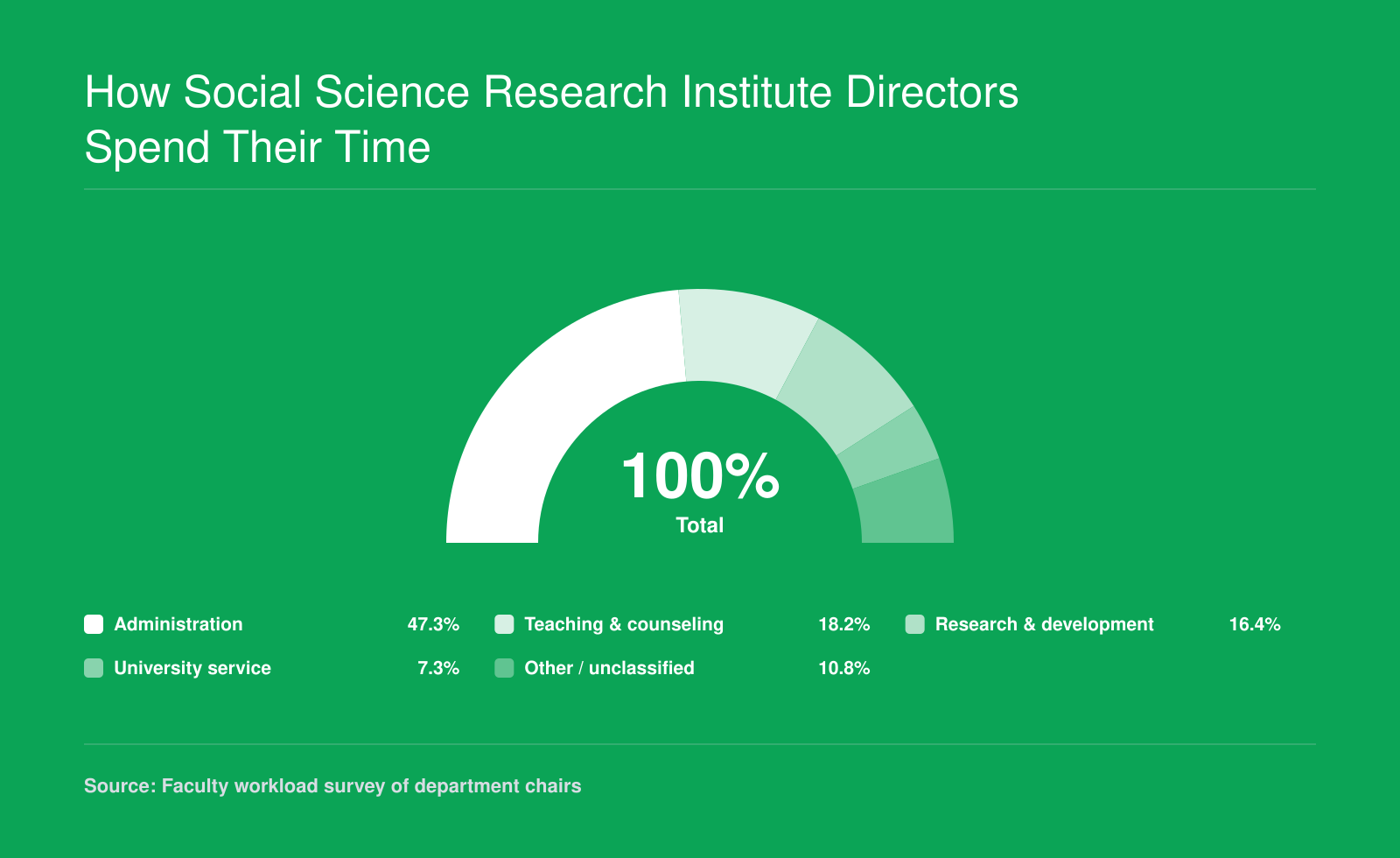
How Social Science Research Institute Directors Spend Their Time
Exact time-use data for social science research institute directors is not published, but the closest comparable evidence comes from faculty workload surveys of department leaders. Their week shows administration consuming the largest share, while research time remains a meaningful block that sustains scholarly credibility.
Qualifications and Track Record That Search Committees Look For
Two candidates can hold identical doctorates and still look nothing alike on paper: one has spent a career publishing within a single literature, while the other has convened cross-campus teams, managed a budget, and translated findings for policymakers. Search committees for social science research institute directors weigh exactly that difference.
The Credential Floor: Doctorate and Tenured Rank
Research-intensive postings commonly begin with a doctorate and a record that would support appointment as a tenured professor in a relevant social science discipline. Virginia Tech's 2026 executive director posting requires a doctoral degree, achievement at Professor rank, and active research.1 Penn State asks for credentials appropriate for a tenured professorship.2 Illinois requires full Professor standing3, and Duke seeks senior tenured faculty. Typically, this is not a role for a professional administrator who happens to work near research. Directors usually come from the faculty, and the appointment generally carries a tenured home in a department or college. The credentials are a floor, not the whole case.
Recognition Beyond a Single Field
Penn State expects an internationally recognized leader in the social, behavioral, or population health sciences with a strong interdisciplinary research record.2 The committee is not simply counting publications; it is looking for evidence that the candidate has built a research agenda others follow. A distinguished publication record matters, but so does evidence of leading work that crosses fields: multi-investigator projects, training programs, outreach, and institution-wide convening. Prior administrative experience is a common preference. Duke describes administrative success as ideal, Illinois requires management and budget experience, and Virginia Tech looks for experience leading research organizations. Fundraising and resource development appear as preferred or expected in several postings.
The Vision Test
The application itself reveals what committees value. Penn State requires a letter of interest with a detailed vision statement for advancing social sciences research, covering strategy, existing strengths, new initiatives, and societal impact.2 A credible candidate can explain how to build seed funding, research infrastructure, and external partnerships. Some institutions use different appointment models, such as a three-year renewable administrative term without an active research requirement, but those are exceptions.4 For most research institutes, the winning profile is a tenured scholar who has already shown the ability to lead beyond their own lab.
- Executive Director, Institute for Society, Culture and Environment, Virginia Tech
- Penn State Director, Social Sciences Research Institute, JBHE Jobs
- HRI Director Job Posting, University of Illinois Urbana-Champaign
- Director, Institute for Research in the Social Sciences, WICHE
How Institute Directors Differ from Department Chairs and Center Directors
A department chair runs one academic department, an institute director leads research across many departments, and a center director steers a narrower research program. All three lead academic units, but their authority and reach differ in ways that matter when you plan a career move.
The Roles Side by Side
Dimension
Institute Director
Department Chair
Center Director
Reporting line
Vice chancellor, dean or provost, depending on reach
Dean
Chair, dean or institute director
Budget authority
Manages the unit budget
Prepares, monitors and recommends
Manages the unit budget
Scope of influence
Cross-department, interdisciplinary
Single department
Defined research area
Faculty authority
Recommends appointments
Recommends appointments, promotion and tenure within university policy
Recommends appointments
Typical term
3 to 5 years
Varies by institution
3 to 5 years
Terms are not standardized. LSU describes three years during a probationary period or a term tied to a five-year review,1 while the University of the Sunshine Coast allows three years plus an optional two after a satisfactory review.2
Where the Lines Blur
Institute directors generally work across more of the university. Duke's search specification for its Social Science Research Institute, for example, gives the director responsibility for intellectual direction and initiative priorities across the university's research enterprise. A chair's authority runs deeper but only within one department, where it includes budget requests to the dean and recommendations on salaries and tenure.3
Center directors typically carry a more focused mission, though the vocabulary is inconsistent. "Center" and "institute" are not used uniformly, and some policies, including LSU's, govern both alike.1 A center may report to a chair, a dean, or an institute director, depending on where it sits.4
Institute directors also tend to recommend rather than decide on personnel. Appointment homes often remain in departments or schools, and final approval of financial agreements can rest with a central research officer. Check the governing policy at any institution you are considering, because titles alone will not tell you who holds the authority.
- LSU Research Centers and Institutes Guidelines, Louisiana State University
- Research Centres and Research Institutes Academic Policy, University of the Sunshine Coast
- University of Chicago Social Sciences 2025-26 Chairs Handbook, University of Chicago Social Sciences Division
- Centers and Institutes Guidance, Drexel University
Salary Benchmarks and Compensation for Institute Directors
Social science research institute directors are not always captured in a single federal wage category, so nearby occupational estimates offer a useful proxy. The table below uses national figures from the U.S. Bureau of Labor Statistics for postsecondary education administrators, managers, economists, and social scientists. In academic settings, a director who already holds a tenured professorship may also receive an administrative stipend, sometimes reported between about $5,000 and $60,000 per year depending on workload and institution.
Occupation
Median Annual Wage
25th Percentile
75th Percentile
Employment
Managers, All Other
$141,900
$102,880
$186,300
622,190
Economists
$124,720
$89,330
$174,720
17,790
Education Administrators, Postsecondary
$104,590
$80,870
$144,370
180,470
Social Scientists and Related Workers
$97,900
$74,860
$129,710
288,600
Miscellaneous Social Scientists and Related Workers
$96,930
$75,350
$128,610
56,490
- Boise State School of Public Service Academic Leadership Position Descriptions, Boise State University
- Health Research Institute Director Job Posting, University of Illinois
- Research Director Salary (PayScale), PayScale
- Research Director Salary in Alexandria, VA, ZipRecruiter
- Research Director Salary in Annapolis, MD, ZipRecruiter
- Top 20 Highest Paying Jobs in Education: Compensation Leadership, ExceptionalGrad
- Dean of Institutional Research and Assessment Jobs, Indeed
- Director of Institutional Research Salary in Indiana, SalaryExpert
- Occupational Employment and Wage Statistics (OEWS) (2025), U.S. Bureau of Labor Statistics
The Path to Research Institute Leadership
Leadership roles in social science research institutes are rarely entry-level hires. Search committees look for a record that runs from doctoral training and faculty research through successive administrative roles. Leadership development programs such as ACE Fellows or the HERS Institute can support faculty making that transition.
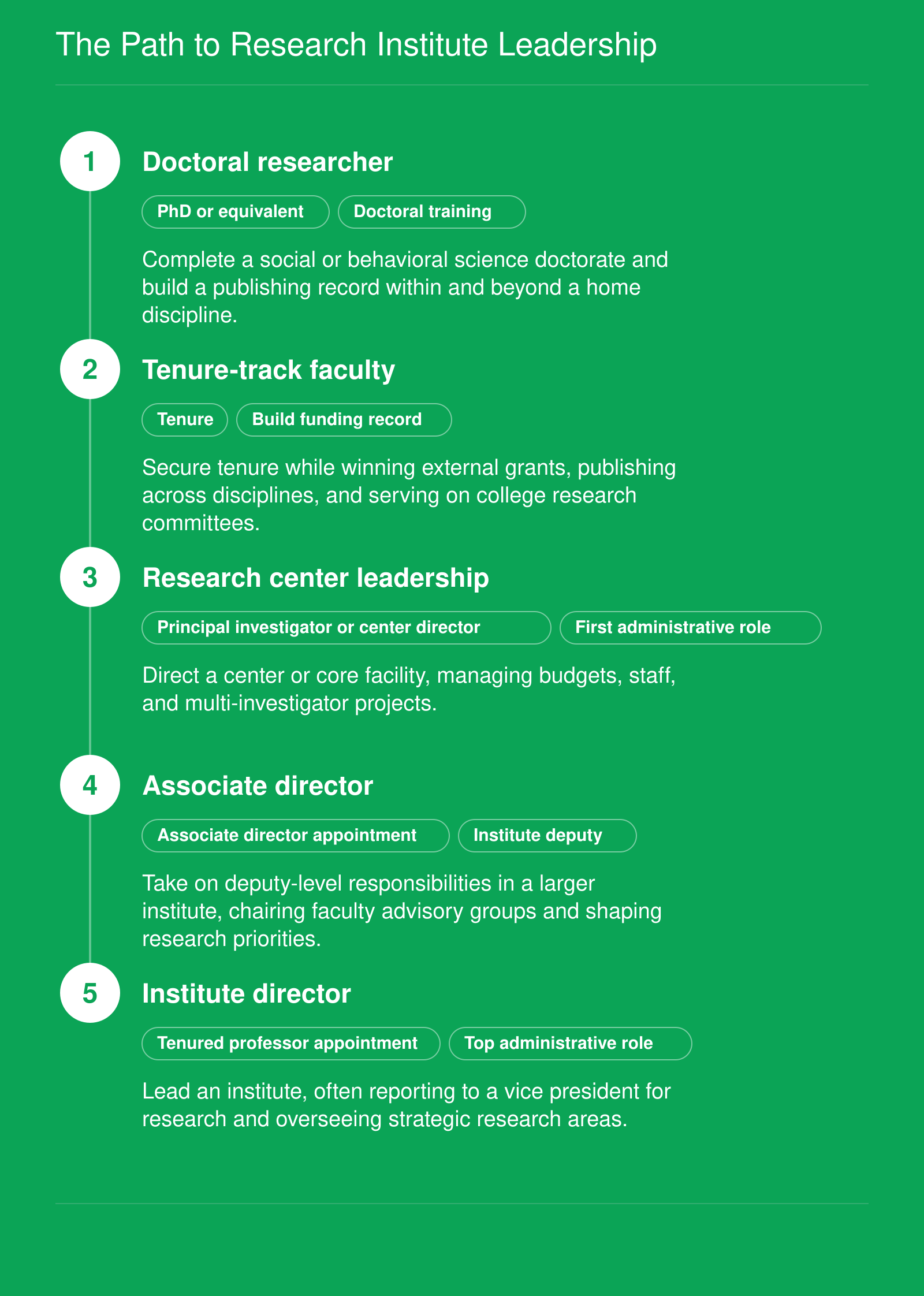
Career Pathway: From Faculty Researcher to Institute Director
Every hour a scholar spends on administration is an hour taken from their own research, yet the director's chair goes to people who have done both well. No single route is required, but most directors follow a similar sequence.
The Typical Progression
- Build an interdisciplinary research program: Search committees favor senior scholars, usually tenured professors, whose work crosses disciplines. Penn State's current search for a Social Sciences Research Institute director requires credentials for appointment as a tenured professor and an internationally recognized interdisciplinary record.
- Win large, collaborative grants: Leading multi-investigator awards shows you can coordinate teams, manage budgets, and keep sponsors satisfied.
- Take on intermediate leadership: Common stepping stones include program director, center director, associate director, department chair, associate dean, and research dean.2 Duke's 2026 description for its Social Science Research Institute director asked for prior administrative leadership, ideally in a research-intensive setting.
- Cultivate institutional networks: Directors report to senior research officers and often chair committees of deans and department heads. Those relationships, built through committee service and joint initiatives, matter long before a search opens.
The University of Sydney frames this as a move from leading early or mid-career research networks toward center and institute leadership.2 The work changes along with the title: strategy, cross-department coordination, infrastructure, and faculty oversight such as appointments, renewals, evaluations, and promotions take more of the week.
Formal Leadership Development
Structured programs can fill gaps in budgeting, governance, and campus-wide strategy. The American Council on Education's ACE Fellows Program, running since 1965, reports preparing more than 2,500 faculty, staff, and administrators for senior leadership.1 It pairs cohort retreats in August, January, and June with mentoring and a customizable host placement lasting an academic year, a semester, or a series of periodic visits. HERS runs leadership institutes for women and gender-diverse academics, and ELAM serves women faculty in academic medicine and health sciences, a closer fit for candidates eyeing population health or behavioral institutes. None of these is a formal requirement for director searches, so treat them as preparation rather than credentials.
The Vision Statement and Nonacademic Routes
Applications increasingly center on a written vision. Penn State asks for a letter of interest with a detailed vision statement for advancing social sciences research at the university. Drafting one before any search opens forces you to articulate priorities, funding strategy, and how you would serve faculty across colleges.
Some directors arrive from government agencies, think tanks, or policy research organizations, and Duke's 2026 specification accepted equivalent policy impact alongside senior tenured achievement. Because many university institutes still expect tenure-eligible credentials, candidates from these sectors usually need a solid publication record to make the move.
- ACE Names 31 Emerging Higher Education Leaders ACE Fellows Program, American Council on Education
- Career Pathways, University of Sydney
Penn State's posting for its SSRI director asks for a candidate who is "an internationally recognized leader in the social, behavioral, or population health sciences with a strong interdisciplinary research record," along with a detailed vision statement for advancing social sciences research.
Building Your Case for Research Leadership Roles
A strong CV gets you into the pool, but a strong vision gets you onto the shortlist. Search committees can see your publications and grants at a glance. What they cannot see is how you would steer an institute, and that is the part you have to write.
Write a Vision Statement That Commits to Something
Penn State's current search for a Social Sciences Research Institute director asks applicants for a letter of interest with a detailed vision statement for advancing the university's social sciences research. That is a useful template for any institute search. A competitive statement does three things:
- Priorities: Name a small set of research themes and explain why they fit the institution. Penn State's institute, for example, is organized around five strategic foci, so a credible applicant would speak to that existing architecture instead of proposing a generic agenda.
- Interdisciplinary synergy: Show where collaboration between fields produces something neither could alone, and say who needs to be in the room.
- Funding strategy: Describe how you would grow external support, seed new projects, and sustain shared infrastructure on a budget the institute does not fully control.
Document a Leadership Portfolio
Treat your record as evidence, not a list of titles. Pull together examples of committees you chaired and what they decided, grants you administered (including budgets, compliance, and team management), students and junior colleagues you mentored and where they went, and partnerships with agencies, community organizations, or industry. Outcomes persuade more than service lines on a CV.
Get Close to the Work Before You Apply
Interim and associate director roles are the most direct way to practice institute-level decisions. If none exist at your university, consider leading a methods core, a seminar series, a training grant, or a multi-investigator proposal. Each one shows you can coordinate people who do not report to you.
Build Relationships Upstream
Institute directors often report to a senior vice president or vice provost for research, so those offices matter. Introduce yourself to research officers, volunteer for university research councils, and attend meetings of research administrator associations. These settings teach you how funding, compliance, and strategy are discussed above the department level, and they put your name in front of the people who later shape searches.
Did You Know?
Test yourself against the criteria above: a fundable research record, interdisciplinary range, and experience convening faculty across departments. If one piece is missing, start building it now, whether through a center directorship, a multi-department grant, or committee leadership. Readiness is usually assembled, not awaited.
Appointment, Evaluation, and Succession Processes
Institute leadership searches have grown more formal and competitive, and the paperwork now required of candidates, beginning with a written vision for the institute, reflects that shift. Penn State's current search for its Social Sciences Research Institute director asks applicants for a letter of interest with a detailed vision statement, a curriculum vitae, and contact information, and expects credentials suited to a tenured professorship. Other institutes follow similar logic, though the mechanics differ.
How Directors Are Selected
Most university-based institutes route appointment through a dean, provost, or governing council after a formal search. The committee is usually built by senior academic authority, and its makeup varies:
- ICPSR: The committee includes two members from the ISR Policy Committee, two from Council, and one from management staff.3 Council selects, and the Director negotiates the terms.
- University of Alberta: The Vice Dean Research chairs, joined by the institute director and a faculty member.5
- McGill University: Committees have at least three members, and the process is expected to be transparent and equity-compliant.2
- University of Florida (Center for the Humanities): The committee is advisory to the Dean of CLAS, and a public presentation of the candidate's leadership vision is required.4
Duke's specification for its Social Science Research Institute invites comments, inquiries, applications, and nominations, which widens the candidate pool before any shortlist forms.6 A federal statutory institute is the outlier: the President appoints, with Senate consent.1
Terms and Reappointment
Five years is the common initial term. McGill allows renewal once, with a third term only in exceptional circumstances and with Vice Dean approval.2 ICPSR caps terms at five years, and the federal statutory position runs six.3 At Florida, the director serves at the Dean's pleasure. Many directors hold an administrative title while keeping faculty status, which is why tenure-eligible credentials matter at hiring.
Reappointment is rarely automatic. McGill starts review in the fourth year, requiring annual review reports and a cover letter from the director.2 ICPSR convenes a review about a year before the term ends, and Council then decides whether a new search is needed.3 At Alberta, an Oversight Board begins at least 12 months out and makes a recommendation, and the Dean decides.5
How Performance Is Judged
Evaluation criteria are not standardized, and the published materials set no numerical targets. Reviews generally weigh research output, external funding raised, faculty satisfaction, and institute growth. Alberta asks that inclusive criteria and competencies be stated in advance. McGill leans on annual reviews and the director's own account. Candidates should expect to document results rather than assume a common scorecard.
Transitions and Succession
Starting review a year early gives institutions room to plan. If a review points toward change, an acting or interim director can bridge the gap while a search runs. ICPSR also provides a fallback: if the chosen candidate declines, Council may consider another nominee or ask for more nominations. For aspiring directors, the practical lesson is to understand an institute's review calendar and succession habits before accepting a post.
- 20 U.S.C. § 9514 - Appointment of Director, U.S. House of Representatives
- Appointment of Directors - McGill University, McGill University
- ICPSR Memorandum of Agreement, ICPSR, University of Michigan
- Center for the Humanities and the Public Sphere Bylaws, University of Florida
- Overarching Institute Directors - University of Alberta, University of Alberta
- Duke Social Science Research Institute, Duke University