
Key Points
- Strain eases after a deadline; burnout persists once the task is done.
- Among 3,004 doctoral students, well-being dropped lowest around comprehensive exams.
- Extensions, part-time status, and formal leaves affect funding and visas differently.
Your Social Science PhD Is Stressing You Out: Recognizing Burnout and Finding Real Support
A second-semester graduate student described two courses, a full-time job, endometriosis, and feeling "genuinely drowning." The r/GradSchool post is one case from 2026, but the arithmetic is familiar in social science doctorates: coursework plus a 20-hour practicum, a qualifying exam reading list, and an advisor who answers email twice a month.
That arithmetic differs across a DSW, a PhD in social work, a human services doctorate, and sociology, public administration, or public policy programs. Failure points track program design, not character.
Strain attaches to a deadline and lifts when the draft is submitted. Burnout follows you home. That difference decides whether the fix is a week off or a change in enrollment status.
Burnout vs. Normal Dissertation Strain: How to Tell the Difference
Every doctoral student has weeks of dread before a committee meeting or a chapter deadline. That is strain. It attaches to a specific task, peaks near the deadline, and eases once the draft is submitted and you sleep for a night or two. Burnout is different in kind: it spreads across the whole of your academic life and does not lift after rest.
The Three Dimensions, Translated for Doctoral Work
The World Health Organization's ICD-11 describes burnout as an occupational phenomenon, not a medical condition, defined by three features. Each has a recognizable doctoral version.
- Exhaustion: You feel drained before the day begins, and dread opening the literature review file even when no deadline is close.
- Cynicism or mental distance: You feel contempt for your own field, your sample, or your questions, and wonder why anyone cares about this research.
- Reduced efficacy: You blank on tasks you once did easily, such as coding interviews, running a model, or writing a clean paragraph.
One bad week does not meet this bar. A pattern that persists across months does.
A Three-Domain Functional Check
If the definition feels abstract, look at how your life is functioning. Ask about three areas:
- Sleep: Are you lying awake, or sleeping heavily and still waking depleted?
- Physical health: Are you getting frequent colds, headaches, stomach trouble, or skipping medical care?
- Relationships: Are you canceling plans, snapping at people, or feeling numb around them?
If two of the three have been getting worse for more than a few weeks, that is no longer ordinary dissertation strain, whatever your cohort says is normal.
Burnout, Depression, and Anxiety
These can overlap, and only a clinician can tell them apart. As a rough guide, burnout usually tracks the work: you feel better on a vacation or when a project is handed off. Depression tends to follow you into the weekend, dimming things you used to enjoy that have nothing to do with school. Anxiety often shows up as constant worry, racing thoughts, or physical tension that does not depend on your workload. If you cannot tell which fits, book a real clinical assessment instead of guessing.
When the Body Is Part of the Picture
Chronic illness complicates all of this. The r/GradSchool poster who described drowning in a second semester while working full time named endometriosis symptoms among the burdens. Flares of pain, fatigue, and brain fog can look like burnout and can also make burnout worse. That deserves its own conversation with a doctor, separate from the one about your workload, so you treat the right problem.
Graduate Student Burnout Statistics: What the Survey Data Actually Shows
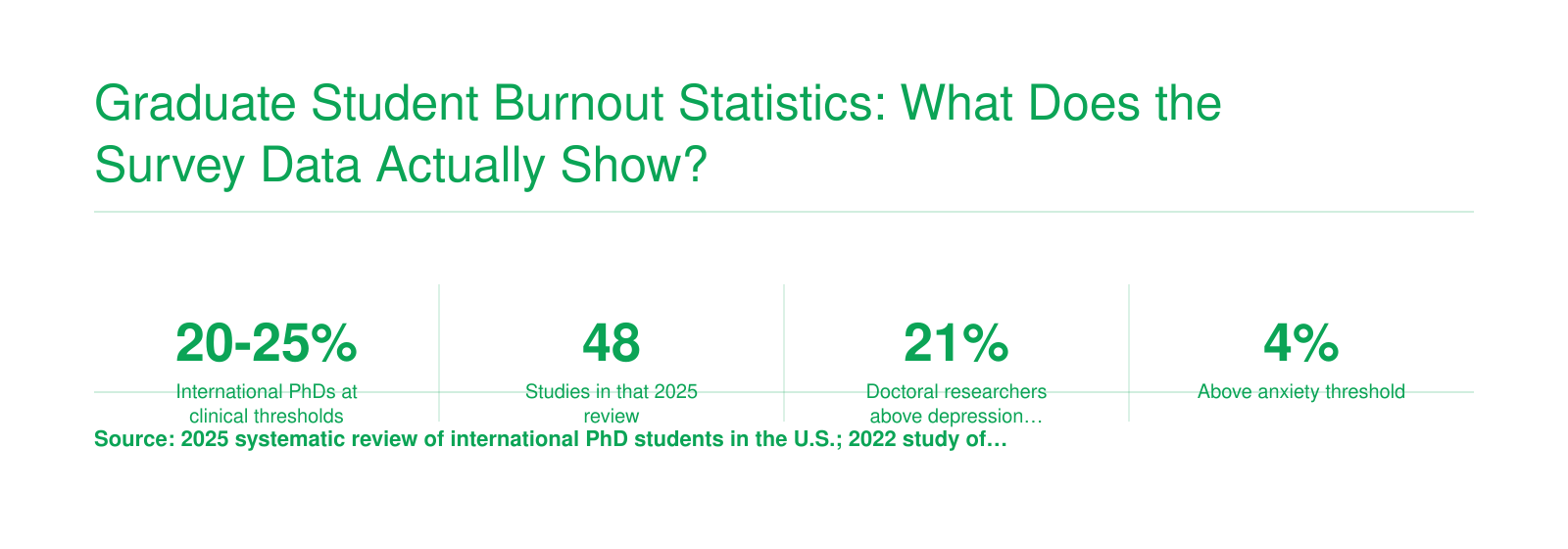
In a study of 3,004 doctoral students, well-being and motivation peaked during coursework and dropped lowest around comprehensive exams, though the study did not report burnout rates by stage. The figures below come from separate studies of doctoral and international PhD populations, not social science students alone, and no reliable PhD vs. professional-doctorate comparison exists yet. Most of this evidence rests on self-selected surveys rather than probability samples, so treat each figure as a signal, not a national rate.
The Second-Semester Squeeze: What One r/GradSchool Post Reveals—and What It Doesn't
The Second-Semester Squeeze: What One R/Gradschool Post Reveals, and What It Doesn't
The second-semester squeeze is the point, a few months into a graduate program, when the novelty wears off and coursework, paid work, and the rest of life land in the same few weeks. A short 2026 post on r/GradSchool titled "Drowning in Grad School" captures the squeeze in miniature, and shows exactly what one case can and cannot prove.
One Case, Four Loads in One Term
The poster, whose thread was cross-posted to r/ABA (suggesting a student in applied behavior analysis), describes a second semester that piled up fast:
- Coursework: two classes.
- Employment: a full-time job.
- Health: endometriosis symptoms running alongside both.
- Self-assessment: "feeling like a massive failure" and "genuinely drowning."
They ask whether others relate and whether they can finish without "completely losing myself." That is one student's account, not a trend.
The Schedule Is the Problem
Most graduate course loads assume a student with discretionary daytime hours, recovery time, and a body that cooperates on deadline. This poster has none of those to spare. When a program's default pace assumes time a student does not have, the gap feels like personal failure, but the mismatch is structural. Naming it shifts the question from "what is wrong with me" to "what about this arrangement needs to change."
"One Course at a Time" Is a Default, Not a Finding
A reply from commenter 4ftnine recommends part-time enrollment: one course per term while working full time, accepting a longer path as "more manageable." That advice is practical, and for many working students it may be the right call. It is also untested. Slowing down redistributes the load without resolving it, and it leaves open questions the comment never touches:
- Does part-time status affect eligibility for assistantships, fellowships, or financial aid?
- Do per-term fees make a slower path more expensive overall?
- Will a stretched timeline collide with the program's time-to-degree limit?
What This Case Cannot Tell Us
At capture, the thread showed zero upvotes and almost no discussion. Treat that as a sampling caveat, not a signal that the experience is rare or common. A single self-selected post tells us what one person went through. It cannot show whether attrition risk actually clusters in semester two for working students managing health conditions, and it cannot show whether decelerating improved this student's outcome. Both are researchable questions that this thread leaves unanswered.
Did You Know?
The r/GradSchool poster called themselves a "massive failure," but two courses plus a full-time job plus a chronic illness is a load most programs were never designed to accommodate. The schedule, not your character, is the variable you can actually renegotiate with your department.
Part-Time, Caregiving, First-Gen, and International: Who Carries the Extra Load
The advice to slow down assumes you are allowed to slow down, and for many doctoral students the permission is not theirs to give. Part-time study looks like the obvious fix for overload, but it is a lever only some students can pull. Before you measure your own load against a labmate's, map the constraints that actually set it.
The Remedy That Isn't Universal
International students on F-1 visas are generally required to maintain a full course of study, and any work connected to an NIH appointment needs authorization documented on the Form I-20. Dropping to one course is not a neutral scheduling choice for them; it can put legal status at risk.
Funding rules tighten the same knot. Kirschstein-NRSA fellowships require citizenship, noncitizen national status, or lawful permanent residence by the time of award1, plus full-time effort, typically about 40 hours a week across 12 person-months. Fellows may add roughly 25 percent (around 10 hours weekly) of part-time research, teaching, or clinical work, and only if it does not lengthen training.2 Less-than-full-time training can be approved case by case, in writing and in advance for each budget period, for medical conditions, disability, or pressing family obligations such as child or elder care. It cannot be approved to free up hours for another job. So "just go part-time" fails precisely for the students who most need relief.
Hidden Labor Without a Playbook
First-generation and racially minoritized students often absorb uncompensated work: decoding funding forms, learning conference norms by trial, inferring advisor expectations no one in the family can explain. A 2026 systematic review documents disparities in burnout, anxiety, depression, and dropout ideation by first-generation, racially minoritized, and international status, though it reports no group-specific U.S. prevalence figures. Treat the direction as credible and the magnitudes as unsettled.
Caregiving: Ask for Levers, Not Lectures
For students raising children or caring for elders, generic self-care advice misses the point. The usable asks are concrete: an extension on a chapter deadline, remote milestones, dependent-care funding, a documented accommodation. The same review flags childcare access as a strain for doctoral parents without quantifying it.
Finally, resist the labmate comparison. Their constraint set, visa category, funding mechanism, and caregiving load are not yours, so their pace says little about what is reasonable for you.
Talking to Your Advisor and DGS About Workload, Funding, and Timeline
What should you actually say to your advisor when you can't keep up with the workload? Bring a short, structured request instead of a general confession of overwhelm. Advising guidance recommends clarifying goals, work style, communication, expectations, and flexibility; a bounded request makes that conversation easier to have.1
A Three-Part Meeting Structure
- Facts: State what is observable: hours worked per week, health limits, deadlines missed or at risk.
- Ask: Name one specific request, such as a one-course term, a milestone extension, or a funding bridge.
- Review date: Propose a check-in, for example in six weeks, so the change reads as a trial and not an open-ended concession.
Appointment contracts, departmental policies, and funding terms control your workload.1 No universal U.S. rule caps what an advisor can request, so ask what your own documents say.
Three Short Scripts
To your advisor: "I'm working about 55 hours a week across coursework, my assistantship, and a health condition, and I've missed two draft deadlines. I'd like to take one course next term and move my prospectus date to March. Could we review it in six weeks?"
To the DGS when the advisor conversation stalls: "I raised a reduced course load and a milestone extension with my advisor on October 3 and haven't reached a plan. Could you help us settle on a decision process and a date?"
To request a written plan: "Can we put what we agreed in an email: the new deadline, who signs off, and when we revisit it?"
The Escalation Ladder
- Advisor: Can change expectations and deadlines day to day, but cannot waive program rules.
- DGS or graduate coordinator: Pittsburgh and Maryland both point students here as informal mediators. The DGS can broker a plan, though not every DGS can override funding terms.
- Department chair: A further informal option, and the next stop if the DGS is your advisor.
- College ombuds or graduate school office: Ombuds offer confidential consultation and informal options, and Cornell describes them as confidential.3 Maryland requires consulting the ombuds before a formal grievance.2 Ombuds generally do not compel action or adjudicate. Discrimination or harassment goes to the appropriate university offices, not the informal ladder.
Where retaliation or safety is a concern, none of these sources requires a direct conversation first.
Power and Paper
Your advisor usually influences funding recommendations and writes your letters, so goodwill alone is a thin safeguard. Rely on records. Northwestern recommends keeping meeting summaries and notes on resolution attempts, and it requires written materials of prior attempts for escalation to its school dean or Associate Dean.4 UNMC's grievance guidance lists names, witnesses, dates, incident summaries, ongoing status, and prior steps.5
When Agreement Stays Verbal
The most common failure is an advisor who says "of course, no problem" and never confirms it. Within a day, send a recap: "Thanks for meeting. To confirm, I'll take one course in spring, the prospectus moves to March 15, and we meet again December 12. Please correct anything I've misstated." Silence on a clear recap is useful evidence, and a correction is useful too. If the recap goes unanswered, forward it to the DGS with your request for a written milestone plan.
- Graduate School Advising Resources, University of Colorado Boulder
- Graduate Policies: School Policies, University of Maryland
- Advising Guide for Professional Students, Cornell University Graduate School
- Dealing with Student-Faculty Conflicts, Northwestern University The Graduate School
- Student Grievance Resolution Procedure, University of Nebraska Medical Center
Campus and Program Support: Counseling, Accommodations, Peer Groups, and Writing Groups
The support you need almost certainly exists on your campus; students most often lose access to it by waiting too long to ask.
Booking Counseling Before You Are in Crisis
Start at the counseling center's website, health portal, or phone line. Most centers do a brief first screening, and many offer same-day or urgent slots. National figures vary by dataset. One 2023-2024 report put the average wait for an initial evaluation at 4.3 business days, with 35% of students seen the same day and 82% within five days. Another survey, which excluded same-day models, found 6.0 days to first contact and 8 days from intake to first therapy. Those averages hide midterm and finals surges, when some students wait weeks for routine care.
Session limits are set locally. Many centers cap individual therapy at roughly 6 to 12 sessions per academic year, while others use stepped care, group options, or referral. When a center refers you out, it usually means your long-term therapy, psychiatry, or specialized care belongs with a community clinician. Ask for referral help and a warm handoff, and check your insurance before the last covered session.
Accommodations for Doctoral Work
Register with the accessibility office early, because approval generally applies going forward, not retroactively. You self-identify, submit documentation when asked, and the office reviews your request individually under Section 504 and the ADA. Request separately for coursework, qualifying exams, and dissertation milestones, since needs differ across them. Accommodations such as adjusted scheduling or extended exam time can change how requirements are met, but not the essential requirements themselves. The disability office holds your documentation, and instructors typically receive only the approved implementation details.
Writing Groups and Forgotten Program Supports
Peer writing groups work through external deadlines and social accountability, not motivation. Purdue's virtual graduate writing groups met biweekly for 90 minutes, and participants' self-rated focus rose from a mean of 2.44 to 3.03 (p =.008). To start one, recruit three or four people at your stage, set a recurring time, and begin each meeting by stating a concrete goal for the next session.
Also check these:
- Graduate school ombuds: A confidential, neutral place to talk through advisor conflict and your options.
- Office of graduate studies: Often handles leaves, timeline extensions, and emergency funds.
- Employee assistance programs: If you hold an assistantship, ask whether you qualify for free short-term counseling.
- Professional association mentoring: Offers guidance from scholars outside your department.
Book the first counseling appointment while you are merely struggling. By the time you are in crisis, the waitlist is the last thing you can afford.
When to Consider a Leave, Part-Time Plan, or Timeline Change
The three levers, ordered from least to most disruptive, are a milestone extension, reduced enrollment (part-time status), and a formal leave of absence. They are not interchangeable, and each one touches funding, visa status, and tuition liability differently.
Levers One and Two: Extension and Part-Time Status
A milestone extension keeps you enrolled full time while pushing a deadline (qualifying exams, prospectus, defense). It is usually the least expensive option: assistantships and fellowships stay intact as long as you remain a full-time student making documented progress.
Reduced enrollment is where the funding trap opens. At Georgetown's PhD in Government, students who fall below nine credits can register for a thesis research course that preserves full-time status and the benefits attached to it, visa standing included, but that arrangement is program-specific rather than a national rule.1 Elsewhere, dropping below a set credit floor can quietly end TA or RA eligibility, and stipends tied to full-time registration may be prorated or suspended. Read the appointment letter, not just the handbook: an RA paid from a faculty grant may carry different terms than a departmental teaching line.
The Completion-Time Tradeoff
Decelerating by one course per term typically adds a year or more to time to degree, and most programs cap total registered time. Georgetown limits personal leave to four semesters over a student's career and two at once, and an approved leave generally extends the degree deadline by one semester without promising continued funding.2 Before choosing a slower path, confirm the cap in the graduate handbook and ask directly whether the funding-eligibility clock restarts.
When a Leave Is the Right Call
A leave, rather than an extension, fits when functioning has collapsed across work, health, and relationships, or when a medical need cannot be met while enrolled. Weill Cornell students on leave are not eligible for aid or funding and should consult on visa impact.3 Princeton treats leave students as not enrolled and directs international students to the Davis International Center.4 Penn typically approves one to two semesters, caps leave at two years, and asks for reinstatement requests about 30 days before the term.5 Federal loan borrowers there complete exit counseling, and Direct PLUS deferment runs only six months after dropping below half-time.6 International students are usually tied to full-time enrollment, and Penn asks them to depart within 15 days of a posted leave.5
A Pre-Decision Checklist
- Graduate handbook: time-to-degree cap, leave limits, reinstatement deadlines.
- Funding office: effect on TA and RA lines, fellowships, tuition remission.
- International office: full-time enrollment rules and departure requirements.
- Financial aid: loan deferment, exit counseling, Title IV eligibility.
- Accessibility office: accommodations that might let you stay enrolled.
- One written email: confirm every term in writing before you sign anything.
- Georgetown PhD in Government Program FAQ, Georgetown University
- Georgetown University Graduate Student Leave Policies, Georgetown University
- Weill Cornell Graduate School Leave of Absence Policy, Weill Cornell Graduate School
- Princeton Graduate School Leave of Absence Policy, Princeton Graduate School
- University of Pennsylvania Doctoral Student Policies, University of Pennsylvania
- StudentAid.gov Deferment Information, Federal Student Aid
One course at a time while working full time, accepting a longer time to degree as more manageable.
A 2026 analysis of Healthy Minds Study data from 2021 to 2023 surveyed 29,944 U.S. graduate students, including 5,671 international students. Each one-unit rise in loneliness was linked to 1.60 times higher odds of suicidal ideation among domestic students and 1.63 times higher among international students.