Key Points
- UC Davis reported $953 million in external research awards for FY 2025-26.
- Federal sources supplied $496 million, a little over half the total.
- Judge seed grants by follow-on external wins within two years.
How a $953 Million Research Year Translates into Social Science Support
What does a $953 million research year mean for a sociology department or a graduate student in political science? UC Davis reported that figure in external research awards for fiscal year 2025-26, with $496 million from federal sources, and described the level as stable rather than growing.
The problem is scale. A campus-wide total says little about what reaches social scientists, survey researchers, or doctoral students, because it blends medical, engineering, and agricultural awards with everything else.
Read them knowing what the totals include, how unit and interdisciplinary breakdowns assign credit, whether internal seed money converts into outside awards, and what to track afterward. A flat headline can hide very different outcomes by department.
What a $953 Million Campus Research Total Actually Counts
A nine-figure campus research total can feel like a verdict on a department's prospects. It is closer to a ledger entry. UC Davis reported $953 million in external research awards for fiscal year 2025-26 in a release dated October 13, 2026, with $496 million from federal sources.1 That figure counts sponsored research commitments booked to a fiscal year, not cash actually spent during it, and not a measure of activity in any one discipline. Most misreading begins with that gap between what the total counts and what a social science department actually experiences.
What the Number Leaves Out
The total excludes seed and pilot funds, which campuses typically track in separate internal accounts. Seed money that later attracts external support never appears in the year it does its work. Indirect cost recovery sits on its own line rather than folding into the award figure. Gifts restricted to non-research purposes, clinical trial revenue, and instruction costs fall outside the count as well, so a department can be far more active than its share of the headline suggests.
Why One Award Can Carry a Headline
Distinguished Professor Kit S. Lam received $3.1 million for nanotechnology designed to deliver drugs directly into tumors while sparing healthy tissue.1 A handful of awards at that scale can carry a campus total, which is why a unit submitting $40,000 seed proposals can feel invisible in the same announcement. Concentration is a feature of the accounting, not evidence that small social science work lacks value.
Where Social Science Hides
The release organizes notable awards by college and school and adds a separate section for interdisciplinary research. That architecture is the clue. Work spanning units, including much social science, tends to land in the interdisciplinary bucket or be absorbed into education and health categories, so read those sections before concluding your field was absent.
- Record Research Funding for UC Davis School of Medicine, UC Davis Health
$953 Million, Split by Source: Reading the Federal Share
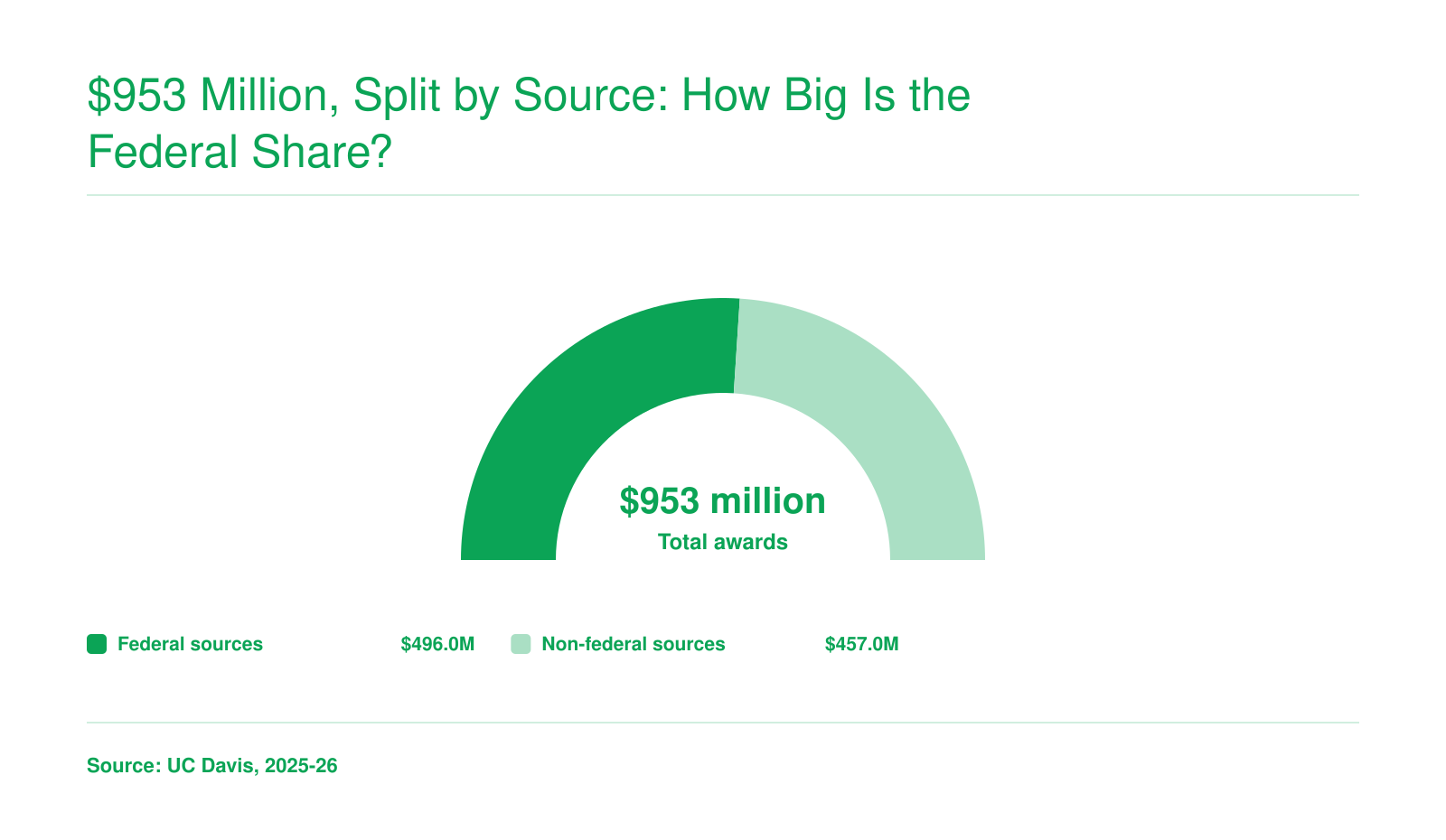
Of the $953 million in external research awards UC Davis reported for fiscal year 2025-26, $496 million came from federal sources, a little over half. The remaining $457 million came from non-federal sponsors. For social scientists benchmarking a department or grant pipeline, the federal portion matters more than the headline total because it is the part most exposed to shifting agency priorities.
Why a Flat Year at $953 Million Can Still Be a Strong Signal
The Federal Climate Behind the Number
As of early November 2026, FY2027 opened without regular appropriations for NIH, NSF, or the Institute of Education Sciences.1 Public Law 119-103 funds the government through December 11, 2026, generally at FY2026 enacted levels.1 NIH has warned that non-competing awards may come in below committed amounts while the continuing resolution lasts.2
The proposals are far harsher than the stopgap. The President's FY2027 request would cut NSF by 54% (to about $4 billion), NIH by 15.5%, and IES by 67%, the last from $789.6 million to $261.3 million.3 None of those cuts is enacted.
Flat as Defensive Strength
Against that backdrop, holding $953 million, with $496 million from federal sources, suggests steady proposal volume, disciplined resubmission, and income that does not hinge on one agency. Staying level while peers slip is a competitive result, not a stall.
Where Social Science Is Exposed
A flat campus total can hide real losses in three places:
- NSF SBE: NSF reportedly funded fewer than 100 new social-science grants in FY2026, against a historical average near 850.4 SBE reportedly spent about $95 million, more than 60% below its regular budget, and the FY2027 request omits continued SBE funding.5
- IES: Roughly $180 million in FY2025 funds faced expiration, and the FY2027 request signals minimal new research money.6
- NIH behavioral work: It sits inside institute budgets, where award levels can shift quietly.
A Habit Worth Keeping
Before concluding anything about your own field, set the institutional total beside directorate-level and discipline-level numbers. A stable $953 million tells you about the campus. Only the narrower figures tell you about your department.
- Apportionment of the Continuing Resolutions for Fiscal Year 2027, The White House
- NIH Fiscal Policy Notice NOT-OD-26-131, NIH
- President's FY 2027 Budget Request Proposes Deep Cuts to Education Research, AERA
- Periodic Update on Federal Science, Substack (J. Widder)
- How NSF Gutted Its Social Sciences Research, Science
- Periodic Update on Federal Science, Substack (J. Widder)
Reading the Breakdown: Colleges, Centers, and the Interdisciplinary Slice
A campus total tells you almost nothing about social science until you read the breakdown beneath it, and the breakdown has its own traps.
Scan in Two Passes
Announcements like the UC Davis release for fiscal year 2025-26 list notable awards by college and school, then add a separate section for interdisciplinary awards. Read your own college's list first to see who is leading projects and at what scale. Then go straight to the interdisciplinary section. Social scientists often appear there as co-investigators on large team awards rather than as lead principal investigators, so the work is real even when the name is not at the top.
Put the Campus in National Context
One institution's year is a thin basis for benchmarking. NCSES higher education R&D data put social sciences at about $3.9 billion in FY 20241, roughly 3.3% of the $118 billion spent nationally on academic R&D.2 That is up from about $2.3 billion in FY 2015, a rise of 68.9%, and up 32.5% from FY 2020.1 The path was not smooth: spending dipped in FY 2021 before recovering. Growth has been real, but the field's share remains small. Federal obligations are harder to track, because agencies stopped reporting them by science and engineering field after FY 1996.3 That means no clean federal series exists for social science alone.
Know What the Accounting Hides
In many institutional reports, a center-led award is credited to the lead college, even when half the intellectual labor is survey design, qualitative coding, or program evaluation. Practices vary by institution, and the national survey documentation does not settle how such awards are assigned4, so ask your research office how your campus counts them. Your department's visible share may understate its actual contribution.
Do Not Mistake a Bucket for New Money
An interdisciplinary line is usually a reporting category, not an addition. Dollars that appear there could often have been counted under a college or center instead. Before you treat it as growth, check whether the college totals shrank by a similar amount, and ask which awards were moved between buckets from one year to the next.
- Higher Education R&D Expenditures by Field: Table 2, NCSES/NSF
- Higher Education R&D Expenditures: FY 2024, NCSES/NSF
- Federal Support Survey 2024, NCSES/NSF
- HERD Survey 2024, NCSES/NSF
Did You Know?
A $25,000 seed award and a $50,000 one are nearly indistinguishable in value. What separates a real pipeline from a rounding error is whether recipients submit and win external funding within two years. Faculty should ask for the follow-on rate before competing, and administrators should publish it.
A campus research total records what an institution won in a given year, not which departments, graduate students, or social scientists were supported along the way.
Outcomes Worth Tracking After the Headline
A campus total like UC Davis's $953 million in fiscal year 2025-26 sets the context, but it does not show whether social science units shared in that support. The metrics below help social scientists, graduate students, and research administrators connect institutional announcements to their own department's grant pipeline and funding outlook.
| Metric | What It Signals | Where to Find It |
|---|---|---|
| Total external research awards, year over year | Overall institutional stability. UC Davis described its $953 million as stable despite a competitive and shifting landscape. | Campus annual research funding announcement |
| Federal share of total awards | Exposure to shifting federal priorities. At UC Davis, $496 million of $953 million (about 52 percent) came from federal sources. | Campus announcement or office of research summary reports |
| Awards attributed to social science colleges and schools | Whether social science units share in campus-wide funding or sit outside the headline | College-by-college award listings in institutional announcements |
| Social science participation in interdisciplinary awards | Whether social scientists are named investigators on cross-campus projects or only contributors | Interdisciplinary award sections of announcements and center project rosters |
| Conversion of internal seed grants to external awards | Whether internal investment programs help social science projects win outside funding | Internal grant program records and sponsored programs office data |
| Indirect cost recovery returned to departments | How much of grant overhead flows back to social science research infrastructure | Campus budget office and departmental budget reports |
| Graduate research appointments funded by grants | The graduate funding outlook tied to the department's active grant pipeline | Graduate division and department appointment records |