Key Points
- SICSS-Stanford 2026 drew 23 participants from 19 institutions.
- All seven 2026 SICSS-Stanford teams built AI into their research workflows.
- Pick your dissertation project before day one, not during the bootcamp.
Why Researchers Are Paying for Methods Bootcamps in 2026
Two weeks in August is not much time to add a method to your toolkit, yet researchers keep spending it that way. The 2026 SICSS-Stanford institute drew 23 participants from 19 institutions and about 15 disciplines for ten program days centered on AI as both a research subject and a working tool.
The tradeoff is concrete: tuition, travel, and time away from fieldwork or teaching, weighed against skills most doctoral programs still do not require. SICSS institutes have run since 2017, so the format itself is settled; what changed in 2026 is the content, with generative models now sitting inside the daily workflow rather than beside it. That shift is reshaping what a department expects an early-career scholar to already know.
Why Methods Bootcamps Are Being Rebuilt Around AI: Inside SICSS-Stanford 2026
What does a methods bootcamp teach once AI sits inside nearly every research workflow? The second annual Summer Institute in Computational Social Science at Stanford (SICSS-Stanford), held August 10 to 21, 2026, offers a useful answer. Hosted by Stanford's Tech Impact and Policy Center, it brought together 23 participants from 19 institutions in the US and abroad, including Northeastern, Maryland, UC Berkeley, CU Boulder, Rutgers, and the Chinese University of Hong Kong, plus universities in Germany, Poland, and Austria. They spanned roughly 15 disciplines, from sociology and political science to law, education, and engineering.
AI as Subject and AI as Instrument
The 2026 program treated AI in two ways at once. As a research topic, sessions covered integrating human values into AI development, large language models as fact checkers, and AI sycophancy. As a workflow tool, sessions covered LLM-based social simulations, video data analysis, and qualitative annotation. Every project team experimented with AI in its own research process.
This was not a one-year experiment. The 2025 cohort followed a similar focus, which suggests a direction for methods training rather than a passing trend. Researchers choosing a bootcamp can reasonably ask whether a program teaches them to study these systems, to use them responsibly, or both.
What Practitioners Add
Twelve guest speakers came from academia, industry, law, and policy. They included platform and AI researchers, an engineer at a social media company, and a legal scholar focused on AI governance. A single-department seminar rarely offers that range. Practitioners can describe how platform data is actually produced, what constraints shape deployment, and how regulation frames the questions a study can responsibly ask. For a doctoral student, that context can sharpen a research design before any code is written.
Design Elements Worth Copying
The format matters as much as the topics. Several features are easy to replicate in a department workshop or a funded training series:
- Team projects: Participants formed seven teams, working on questions such as a public-facing media bias indicator, multilingual disinformation on Telegram, and defendant descriptions in criminal trials.
- Mixed days: Lectures and hands-on workshops were combined, so concepts were applied soon after they were introduced.
- Mixed disciplines: Teams drew on different training, which pushed members to explain methods rather than assume them.
- Continuity: Teams from both the 2025 and 2026 cohorts kept working on their projects after the program ended.1
That last point is the strongest signal of quality. A bootcamp that produces only a certificate has done less than one that leaves behind a working team and a project with momentum.
What Comes Next
SICSS-Stanford is scheduled to return in summer 2027, and organizers have invited inquiries from people interested in getting involved. Details are in the original announcement at https://fsi.stanford.edu/news/two-weeks-computational-social-science-stanford.
- 2026 SICSS Fosters Collaboration, Florida Atlantic University
What 'Intensive' Really Means: Contact Hours, Daily Structure, and Real Weekly Workload
Bootcamp marketing sells transformation; the calendar tells you what you are actually buying. A two-week institute usually has about 10 program days. Days often mix lectures, labs, and workshops for roughly six to eight scheduled hours before teams break off for project work. That looks manageable until you add reading, debugging, team meetings, and slide revisions.
The Real Weekly Load
Plan for a full-time commitment, often 40 to 50 hours a week once project work is included. Treat it as a short-term job. This is not a course to stack on top of teaching or a full research load. Residential institutes concentrate the work because you are there in person, eating meals with your team and carrying conversations into the evening. Part-time online cohorts spread the same material over more weeks, which lowers the weekly peak but stretches the deadline pressure.
Formats Are Not Interchangeable
Residential two-week institutes front-load contact time. Multi-week summer schools with modular one-week courses let you choose one or two modules, so the weekly load depends on how many you take. Part-time online cohorts usually run in shorter weekly blocks, but they demand more self-direction between sessions. Ask for the daily schedule before you pay, not after. Three questions matter: how many contact hours per day, how many project team meetings per week, and what deliverable is due after the final session.
What 2027 Planning Looks Like
The 60th Essex Summer School runs 28 June to 13 August 2027, with a pre-sessional week from 28 June to 2 July and three two-week sessions after that. Courses will be in person and online, with online teaching via Zoom. The application deadline is in early 2027, and applying early is wise because courses can fill by May. ICPSR expects to publish 2027 scholarship information in December 2026. SICSS host-site applications were open in August 2026, and SICSS-Stanford is scheduled to return in summer 2027. Use those dates as planning anchors and confirm details with each program.
Before and After the Program
Expect pre-arrival software setup and reading, plus a final presentation or write-up that often lands after the last day. Budget those hours too.
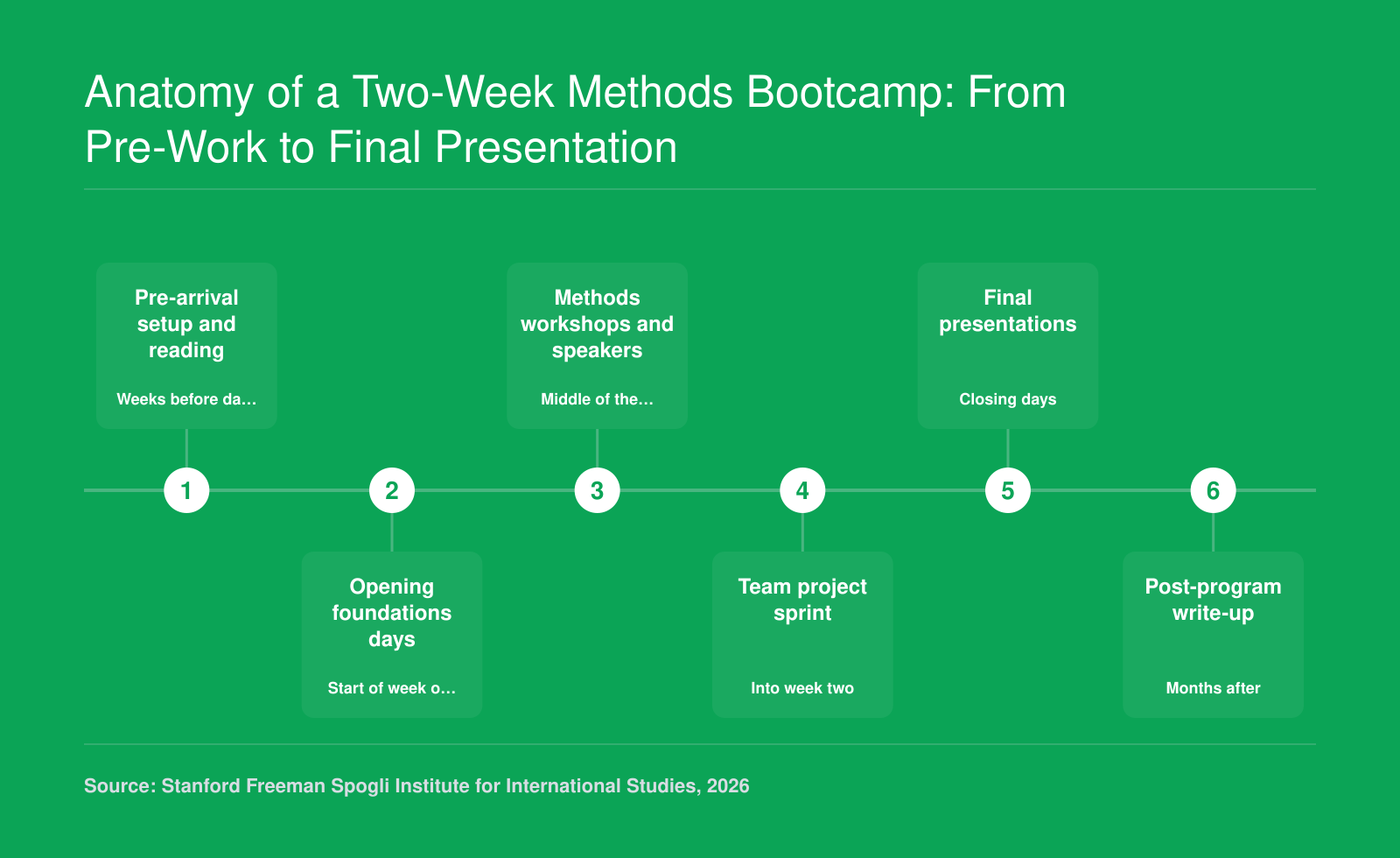
Anatomy of a Two-Week Methods Bootcamp: From Pre-Work to Final Presentation
This sequence follows the arc of SICSS-Stanford 2026, which ran August 10-21 and used mixed lecture and workshop days to feed seven team projects. Each stage depends on the one before it.
How to Evaluate Curriculum and Instructors Before You Enroll
Methods training has moved from a supporting role in doctoral education to a factor applicants weigh when choosing a program. At SICSS-Stanford in 2026, hosted by Stanford's Tech Impact and Policy Center and running August 10 to 21, 23 participants from 19 institutions and about 15 disciplines spent two weeks moving between lectures, workshops, and seven team projects, with twelve guest speakers drawn from academia, industry, law, and policy. That structure is worth studying before you pay for anything similar.
Read the Syllabus, Not the Landing Page
Ask for the day-by-day schedule and check the sequencing. Foundations-first programs build toward something; samplers string together unrelated techniques so that nothing compounds. Then count hours: how much is lecture, how much is supervised lab time, how much is open work with an instructor nearby. A program advertising four methods in two weeks is often advertising exposure rather than fluency.
Instructor mix matters as much as instructor quality. Tenure-track methodologists teach you why an estimator is defensible. Applied researchers teach you what breaks in real data. Practitioners from industry, law, or policy teach you what a collaborator outside the academy will ask for. Programs strong on one type are frequently thin on another, and the imbalance rarely shows up on the marketing page.
The Project Test
Ask what participants actually produce. A real team project means an assigned dataset, a defined deliverable, and a final presentation in front of the cohort. In-class exercises are not a substitute, because they end when the session ends. At SICSS-Stanford, all seven 2026 teams experimented with AI in their research workflow, and many teams from the 2025 and 2026 cohorts kept their projects moving afterward. That continuity is the outcome to ask about directly.
Also ask about cohort size and staffing. Twenty to thirty participants with dedicated teaching assistants is a different experience from a large lecture hall where questions get triaged.
Red Flags Worth Walking Away From
- Demo-only software: tools shown on a projector but never used on your own data.
- No pre-work: no reading, setup instructions, or environment check before day one.
- Nothing retained: no materials, code, or repository access once the program ends.
- Thin instructor bios: no methods publications and no applied portfolio to point to.
What Methods Bootcamps Cost: Tuition, Fees, and Scholarships at Major Institutes
Methods bootcamp pricing runs from free to several thousand dollars, and funding often decides which end of that range you land on. Published figures shift from year to year, so treat the numbers below as a starting point and confirm current tuition and deadlines on each program's own page before you apply.
Program-by-Program Costs
- ICPSR Summer Program (Ann Arbor, Michigan): Tuition for the current cycle is $2,725, for a four-week program1. This is the full-price benchmark here. Funding: ICPSR reports more than $300,000 per year in scholarships and reduced fees4, and it runs a separate Opportunity Scholarship.3
- Summer Institute in Computational Social Science (SICSS): No tuition is required. Locations vary, and some cover travel, accommodation, and meals. Funding: the free tuition is the main draw, so the question is which site covers living costs.
- University of Chicago MACSS Computing Fundamentals Boot Camp: In person in Chicago, August 24 to September 11, 20265. No fee figure was confirmed, so check the program page. Funding: no fee waiver information was confirmed.
- University of Oregon sponsorship for the ICPSR Summer Program: This is a department funding route rather than a separate bootcamp. It offers up to $5,000, covering tuition and lodging first, with any remainder applied toward travel and meals6. The 2026 window ran June 8 to July 2.
Reading the Range
The gap between SICSS and ICPSR is large, but the two are not interchangeable. SICSS is a two-week institute built around team projects for graduate students, postdocs, and early-career faculty. ICPSR is a longer, course-based program where you choose among methods workshops2. Paying $2,725 may be reasonable if you need a month of structured statistics training, while a free institute may fit better if you want collaborative computational work.
Sticker price also understates what some programs ask of you. A free institute that does not cover lodging can cost more out of pocket than a funded tuition seat, so check what each site pays for before you compare.
Where to Look for Money
Start with your own department. The Oregon example shows that a graduate program can budget for summer methods training, and it is worth asking whether yours does. Then check the program's scholarship pages, since ICPSR publishes separate scholarship information. Apply early, because aid decisions often come before the registration window closes. Keep your written funding offers, since they spell out whether the money covers tuition, lodging, or travel.
- Summer Program Registration & Fees, ICPSR, University of Michigan
- The ICPSR Summer Program, ICPSR, University of Michigan
- Opportunity Scholarship, ICPSR, University of Michigan
- Summer Program Scholarships, ICPSR, University of Michigan
- Summer Boot Camps & Placement Exams, ICPSR, University of Michigan
- Funding and Research Support, Political Science, University of Oregon
Software Reality Check: R, Stata, Python, SPSS, and NVivo by Program Type
Match a program to the software and analysis your own dissertation actually requires, not to whatever a syllabus happens to feature, because learning a tool you will never use in your own project is the most common way bootcamp time gets wasted. The 2026 listings below show that introductory ICPSR courses ask for no prior statistics, while R, regression, and health-data workshops expect working knowledge of a package or of core inference concepts. None of these listings names a dedicated qualitative package such as NVivo or MAXQDA, so researchers doing interview or text-based work should confirm qualitative software coverage directly with a program before enrolling.
| Program / Program Type | Primary Software Taught | Qualitative Tools | Math/Stats Prerequisite | Beginner-Friendly? |
|---|---|---|---|---|
| ICPSR General Session: introductory statistics course | Examples shown in R and Stata; no software required, and code is shared with participants | Not specified in course listing | None; assumes no prior knowledge of statistics | Yes; introductory level, open to every discipline and career stage |
| ICPSR General Session: statistical software course | SAS, SPSS, and Stata/MP | Not specified in course listing | None | Yes; Beginner/Intermediate, especially useful for those with limited software experience |
| ICPSR General Session: Introduction to the R Statistical Computing Environment | R | Not specified in course listing | Basic familiarity with R plus prior knowledge of probability distributions, statistical inference, estimation, and hypothesis testing | Beginner/Intermediate |
| ICPSR General Session: regression course | R, RStudio/Posit Cloud, and Stata/MP | Not specified in course listing | Regression 1 and a basic understanding of ordinary least squares regression | N/A |
| ICPSR General Session: SPSS examples course | Examples in SPSS; students may use any software package | Not specified in course listing | None; participants must choose which software they will use for the lab portion | N/A |
| ICPSR Topical Workshops (overall) | Varies by workshop; examples include R, Python, Stata, and other research tools | Not specified in course listing | Varies; review each course's prerequisites and recommended preparation | Varies, from introductory overviews to intensive advanced training |
| ICPSR workshops at the University of Houston Hobby School | R and RStudio; some workshops allow Stata or R by student preference | Not specified in course listing | Varies: basic or elementary statistics for most; one workshop has none for motivated students, though introductory statistics or linear regression helps | Some are open to motivated beginners; others expect basic statistics |
| SICSS-Penn (computational social science institute) | Python recommended for applicants with less coding experience | Not specified in application | No specific math or statistics prerequisite stated; applicants with less social science research experience complete extra readings | Coding beginners may apply but are encouraged to learn Python basics first |
| ICPSR PCODR health-research workshop | SPSS, Stata, SAS, or R; working knowledge of at least one is required | Not specified in course listing | No explicit math prerequisite; requires familiarity with health datasets, codebook experience, and skill operationalizing research questions | Not for software beginners |
- 2026 ICPSR Summer Program Registration, ICPSR, University of Michigan
- Explore ICPSR Summer Program Courses and Workshops, ICPSR, University of Michigan
- ICPSR Summer Workshops, University of Houston Hobby School of Public Affairs
- Overview and Data Analysis Examples of the CODA Randomized Clinical Trial Summer Program Workshop, ICPSR, University of Michigan
Preparing with Coding Foundations Before Day One
Arriving underprepared wastes bootcamp days, but over-preparing can burn the weeks you need for your own research. The goal is narrow: be able to read a short script, edit it, and write a basic one without panic. You are not trying to become a programmer.
A Realistic Pre-Work Plan
Budget roughly 10 to 15 hours spread over two to three weeks. Short, frequent sessions stick better than one marathon weekend. Free starting points are plentiful:
- R users: the data import and data wrangling chapters of R for Data Science, which is free online.
- Python users: the introductory pandas tutorials in the official pandas documentation.
- Either language: Software Carpentry-style lessons on the command line, version control, and scripting basics.
Pick one language, ideally the one your program teaches, and stay with it. Switching midstream is the surest way to finish with scattered half-skills.
Test Your Setup Early
Installation trouble is the biggest day-one time sink at residential institutes. Install your language, an editor such as RStudio or VS Code, and any packages on the syllabus at least a week ahead. If the program uses Stata, SPSS, or NVivo, confirm that your license works on the laptop you are bringing, and ask whether the host provides a temporary one. Run a short script from start to finish, including loading a file and saving output. Fix errors now, while forums and colleagues are easy to reach.
Refresh Only the Statistics You Will Use
Skip proofs. Review descriptive statistics, the logic of regression, and, above all, how to read a coefficient table: what the estimate, standard error, and confidence interval say, and what they do not. That is enough to follow most sessions and to question your own output.
Arrive with a Real Project
Bring a dataset you have permission to use and a question you actually care about. Check that the data are cleaned enough to open and that any restrictions on sharing are clear. Teams and exercises tend to reward participants who show up with something concrete, and a bootcamp project built on your own material can feed straight into a dissertation chapter instead of ending as a practice exercise.
From Bootcamp Project to Dissertation Chapter — And the Cohort That Keeps It Moving
From Bootcamp Project to Dissertation Chapter, and the Cohort That Keeps It Moving
Can a two-week team project really turn into a dissertation chapter? Yes, but only if you choose the project before you arrive and treat the final presentation as a starting draft rather than a finished deliverable.
Pick the Project That Is Already Your Problem
Choose a team topic one step away from your dissertation question, not the most exciting topic in the room. At SICSS-Stanford 2026, the seven project teams worked on a public-facing media bias indicator index, simulated conversations testing a "bridge-building voice" against polarizing ones, multilingual disinformation on Telegram, online norm-violation judgment, defendant descriptions in criminal trials, and whether public predictions are self-fulfilling. Each of those is a chapter-shaped problem with a data source attached. Structure your final presentation as a gap, a dataset, a method, one preliminary result, and the next three steps. That is an outline your committee can react to.
The Feedback Loop: Daily Work, Mixed Critics
Two weeks of daily team work came with peer critique built into the schedule and twelve guest speakers drawn from academia, industry, law, and policy. Industry and legal readers ask what academic audiences often skip: who is accountable for the output, who maintains the code after the grant ends, what deployment would cost. Write those questions down during the session. They become the limitations section you would otherwise write badly six months later.
Why the Cross-Disciplinary Team Speeds You Up
The twenty-three participants came from nineteen institutions and about fifteen disciplines, including communication, sociology, political science, engineering, law, social psychology, and education. An engineer on your team pushes on compute and reproducibility; a legal scholar pushes on consent and data provenance. You absorb methods vocabulary from adjacent fields in days rather than through a semester of reading.
Cohort Continuity Is the Real Asset
Shared code and shared workflows are what carry a project past the last day. Many teams from both the 2025 and 2026 cohorts kept working after the institute ended, and one participant said shared workflows "increased the productivity" of their work. That continuity is where co-authored papers, preprints, and follow-on grant applications come from.
The First 48 Hours Decide Everything
Settle authorship order, data-sharing rules, and repository hygiene in the first two days, not the last. One repository, a README that runs, file-naming conventions, and a named owner for access credentials. Teams that defer this conversation spend the second week negotiating instead of analyzing, and the project stalls the week after.
Since 2018, institutions worldwide have hosted two-week SICSS institutes for graduate students, postdocs, and early-career faculty. The 2026 Stanford cohort alone drew 23 participants from 19 institutions and roughly 15 disciplines, from communication and sociology to engineering, law, and education. Source: FSI Stanford, https://fsi.stanford.edu/news/two-weeks-computational-social-science-stanford
Do Bootcamp Certificates Actually Count with Universities and Employers?
No universal rule governs how a methods certificate or summer institute credential is counted, and the evidence points to one dividing line: transcripted credit versus a completion certificate.
What the Published Policies Show
Harvard Summer School says acceptance at most colleges and universities is up to the home institution1, and UCLA Summer Sessions says credit appears on a UCLA transcript3 while the receiving school makes the transfer decision2. Campus rules then diverge. USC sets a minimum grade of C-4, Duke requires at least 4 weeks and 17 class meetings5, Georgetown caps outside summer courses at four6, and Cornell requires regional accreditation7. Duke's 2026 transfer deadline was May 1.5 These policies cover transcripted courses. They do not show that a noncredit certificate transfers, or that employers treat it as a qualification.
Scripts and Steps to Verify
- Registrar: "Can a certificate from [program] be evaluated for credit toward my degree, and what documentation do you need before I enroll?"
- Prior learning assessment: Ask whether the department offers it, then submit the syllabus, contact hours, and written learning outcomes.
- Career services: "How should I list a two-week institute on my CV?" A common answer is a training or professional development section, with the topics and software named.
- Hiring managers and associations: Ask people in your field whether they recognize the credential in practice. Read current job postings and HR pages for stated requirements, and check BLS.gov and the Occupational Outlook Handbook for occupational context.
How to Compare Programs
Weigh accreditation of the host institution, instructor qualifications, published learning outcomes, total cost, and documented alumni outcomes such as publications or placements. Ask the program for those outcomes directly. Treat marketing phrases like "recognized by leading employers" as claims to confirm with the institution or employer, in writing if possible, before you pay.
- Transfer Credit and Accreditation, Harvard Summer School
- Summer Pathways for Transfers, UCLA Summer Sessions
- Frequently Asked Questions, UCLA Summer Sessions
- Transfer Credit Services, USC Academic Records and Registrar
- Transfer Credit, Duke University Trinity College of Arts & Sciences
- Summer School, Georgetown University College of Arts & Sciences
- Transfer Credit Policy, Cornell University
The institute was incredibly inspiring and useful, and definitely one of the best experiences I've had throughout my PhD.