Key Points
- Rowan's Ric Edelman College hosted its first career fair since its merger.
- In NACE's 2014 survey, 97.3% of employers used on-campus recruiting channels.
- The sponsoring office predicts a fair's employer roster better than its marketing.
Introduction: The Career Fair as Post-Merger Infrastructure
A newly merged college's first career fair is a stress test of the merger itself. At Rowan University, the Ric Edelman College of Communication, Humanities and Social Sciences held its first fair since consolidating, and the booths were the first student-facing proof that the new structure could build one employer network out of several.
The stakes reach beyond one campus. When administrators combine units, career services is often rebuilt too, and that quietly changes how humanities and social science graduates meet employers, which recruiters hear about them, and who owns the relationship.
For graduate students, advisors, and program leaders, the practical question is whether a fair signals a working pipeline or only a well-staffed afternoon.
Why Merged Colleges Are Betting on Career Fairs
When humanities and social science units are folded together, career services is often where the new college first tries to prove the arrangement works.
The Institutional Chain
Enrollment pressure on humanities and social science majors pushes administrators toward consolidation: shared budgets, combined advising and staff, one dean's office where several stood before. A single college-level career office then inherits the job of justifying that structure. A fair is the most visible deliverable available. Employers fill a room, students attend, and leaders can point to the result.
What Recent Cases Show
Seattle University launched its College of Humanities, Education and Social Sciences in Fall 2026, joining the College of Arts and Sciences with the School of Education.2 Public materials describe the formation and its units, but not a new fair tied to it.
Northeastern's College of Social Sciences and Humanities in New York completed its merger with Marymount Manhattan College in summer 2026.3 Its Co-op Poster Expo, set for October 7, 2026, was redesigned as a mixer where returning students discuss placements with organizations ranging from local nonprofits to global employers.3 The dean's newsletter does not say the expo exists because of the merger.
Two other colleges are better read as engagement models than as merger evidence: their sources give no recent merger date.
- Michigan State College of Social Science: An Employer Advisory Board, conceived in summer 2024 and first convened July 24, 2025 at TechSmith in East Lansing, supports internships, job shadowing, site visits and mentoring. Undergraduates must complete three credits of experiential learning.
- University of Denver CAHSS: The 4D Fridays program weaves coursework, internships, mentorship and research into the academic week.4
Structure Versus Student Experience
The pressures are structural: shared budgets, consolidated staff, and efficiency targets from the provost's office. The student-facing outcome looks different. Department-level job talks, each with its own alumni and contacts, give way to one college-wide event.
The Question to Ask
Does a merged fair widen employer networks or narrow them to the biggest departments in the new college? Program leaders should ask who builds the invitation list, and whether smaller departments' employer contacts survive consolidation or quietly drop out.
- College of Humanities, Education and Social Sciences, Seattle University
- A New Chapter Begins, Seattle University Newsroom
- CSSH Dean's Newsletter Fall 2026, Northeastern University College of Social Sciences and Humanities
- Dean's Desk June 2026, University of Denver College of Arts, Humanities and Social Sciences
In NACE's 2014 Recruiting Benchmarks Survey, 97.3% of employer respondents reported using on-campus recruiting channels such as career fairs and on-campus interviews. The survey covered the 2013-2014 recruiting year and drew 274 participants, about 26.3% of NACE's employer members, so it reflects members, not all employers.
Rowan University's Ric Edelman College: The First Fair After the Merger
A department-run fair introduces students to a handful of employers a single faculty member already knows. A college-wide fair asks a much larger question: who is hiring across communication, humanities, and social science at once? Rowan University's Ric Edelman College of Communication, Humanities and Social Sciences is a useful case of the second approach.
What the Reporting Establishes
Rowan announced the college in February 20251, and the realignment took effect Aug. 1, 2025,2 under Dean Nawal Ammar. It combined the former Ric Edelman College of Communication & Creative Arts with the College of Humanities & Social Sciences.1 The Whit, Rowan's student newspaper, reported that the college hosted its first career fair since the merger. Rowan's own pages place the Career and Internship Fair on Thursday, Nov. 5, 2026, in the Chamberlain Student Center's Eynon Ballroom,3 aimed at students in those three fields.4
What It Does Not Establish
No available source names the participating employers, counts them, or reports student attendance. One external listing gives a 10 AM to 12 PM window,5 while Rowan's pages say 10 AM to 2 PM. This matters because a fair's value depends on roster composition and turnout. Without them, an inaugural event is a signal of intent, not proof of outcomes.
The Transferable Model
The merger required a common approach to career readiness, so Rowan's Center for Professional Success developed Career Learning Outcomes for all Ric Edelman majors and supports embedding career content in coursework.6 A first college-wide fair suggests employer-network building has moved from the department to the college level.
A Watchlist for Faculty and Program Leaders
- Roster composition: Look for a mix of employers, government agencies, and graduate schools, not a single sector.
- Alumni participation: Alumni at the tables show whether the college is drawing on its own graduates.
- Follow-up tracking: Check whether the college records interviews, internships, and hires after the event, or treats the fair as a one-day effort.
- Rethink, Reimagine, Realign, Rowan University
- 6.18.25 Board of Trustees Audience Copies, Rowan University
- Career Fairs, Rowan University Hire Rowan
- Career Fairs Prep, Rowan University
- 2026 Rowan Ric Edelman College Career and Internship Fair, University of Pennsylvania School of Social Policy & Practice
- Career Learning Outcomes, Rowan University Ric Edelman College Center for Professional Success
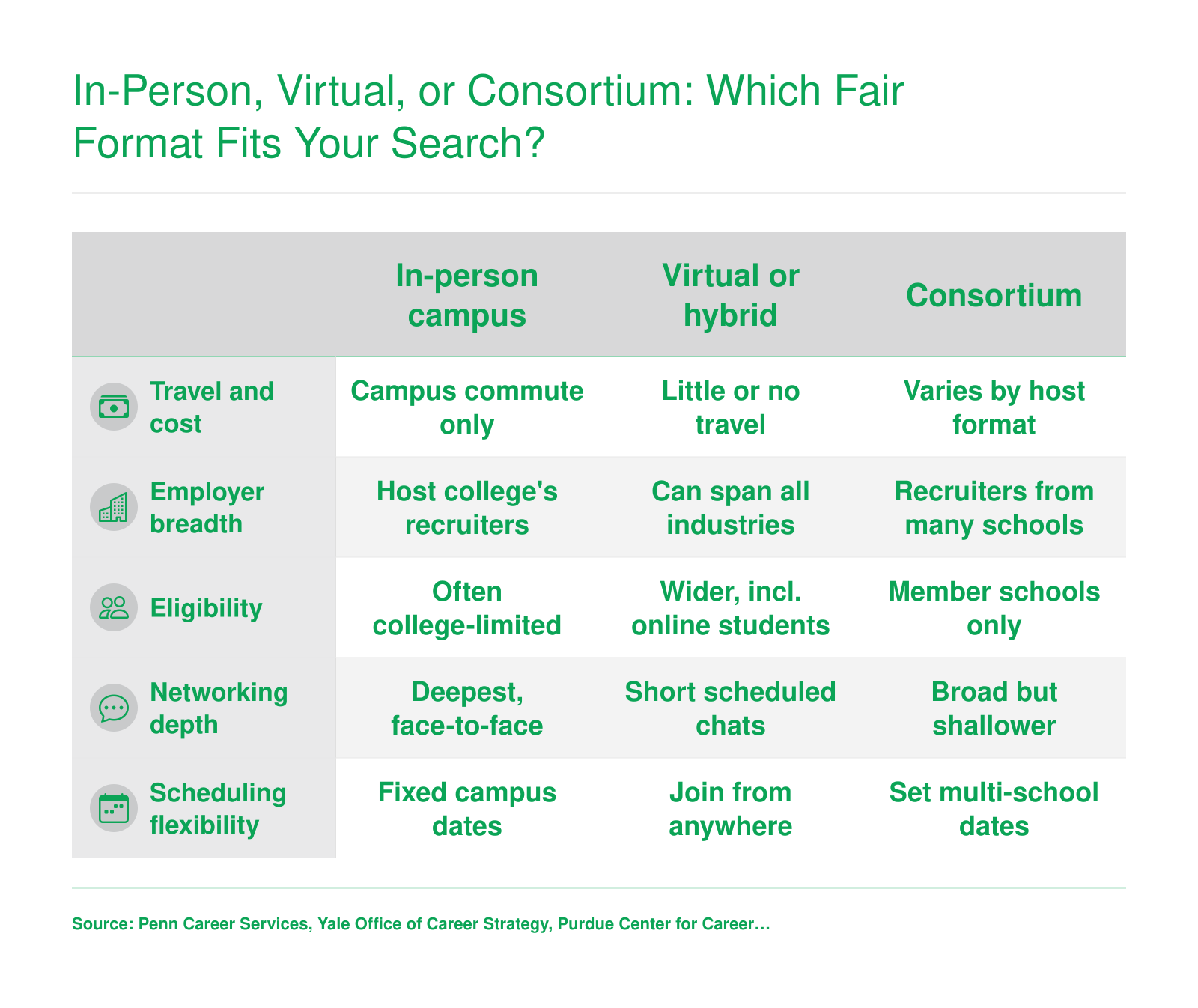
In-Person, Virtual, or Consortium: Comparing the Three Fair Formats
Virtual fairs, which spread widely after 2020, opened recruiting to students who cannot travel; Penn, for example, lets online-degree students attend all of its virtual fairs, and its 2026-27 calendar includes a virtual spring fair on February 25, 2027. Some events now blend both modes, such as Purdue's hybrid expo on February 2-3, 2027. The core trade-off is plain: consortium fairs buy employer breadth at the cost of intimacy and follow-up.
- University of San Diego Career Fairs, Employer Pricing, University of San Diego
- Yale OCS, Career Fairs & Networking Events, Yale Office of Career Strategy
- Purdue CCO, Spring Career Fairs, Purdue University Center for Career Opportunities
- NC State CHASS Career Fair, NC State University Career Development Center
Did You Know?
Who runs a fair predicts the employer roster more reliably than the fair's own marketing does. Central career services, a disciplinary association, and a vendor-run virtual platform each attract different recruiters, so confirm the sponsoring office and the eligibility rules before you register, not after you have booked travel and taken a day off.
How Graduate Students Should Prepare Before the Fair
A hundred printed resumes with no research behind them, or eight names you can speak about intelligently: the second approach is the one that produces callbacks. Graduate students often arrive at career fairs over-prepared in volume and under-prepared in focus. The fix starts a week or two before the doors open.
Build a Short, Researched Target List
Pull the published employer roster as soon as it appears and circle 8 to 12 organizations worth your time. For each, know what the firm or agency actually does, who in the room you want to meet, and one specific question you can ask that a website cannot answer. A short list outperforms a thick stack of paper every time, because it lets you open with substance instead of a handshake and a generic pitch.
Match the Materials to the Audience
Different tables want different documents.
- Research employers: institutes, think tanks, and research centers expect a CV framed around methods, publications, and fieldwork.
- Applied employers: consulting firms, agencies, and policy shops respond better to a one-page resume that leads with analysis, data work, and results.
- Your 30-second framing: rehearse a plain-language account of the degree's transferable methods, such as survey design, causal inference, or qualitative coding, without assuming the recruiter knows what a dissertation is.
Sort Out Logistics and the Overqualification Question
Ask the sponsoring office whether the fair runs separate master's and doctoral programming, and whether alumni or online students can register. Confirm what to bring (printed resumes, a card, a notebook) and whether the venue collects them electronically. Expect at least one recruiter to ask why someone with a graduate degree wants an entry-level role. Answer with the specific work you want to do and the skills you would use on day one, not with a defense of your credentials.
Script the Follow-Up Before You Go
Decide in advance that every real conversation gets a note within 48 hours, referencing something specific that was said. Log each contact in a simple tracking sheet with three columns: employer, name, next step. That sheet becomes your pipeline, and it is the part of the fair most students skip.
Ten minutes with a short list of employers you actually want to work for beats two hours handing resumes to every booth in the room.
Connecting the Fair to Non-Academic Career Pathways
A career fair offers quick, face-to-face access to employers, yet no published study shows that attending one improves hiring outcomes for humanities and social science graduates. Treat the fair as a way to start a pipeline, not as the pipeline itself.
Three Pipelines Worth Mapping
- Employer contact to entry-level role: A booth conversation can lead to an internship or fellowship, which in turn can lead to an offer.
- Research assistantship to program evaluation: Skills in survey design, statistics, and qualitative analysis carry into evaluation and research roles at nonprofits, foundations, and consulting firms. Ask recruiters which of those roles they staff.
- Campus recruiting to public-sector work: Government agencies often use campus events to explain application steps and timelines, which can run long.
For descriptions of the roles themselves, see the site's existing coverage of non-academic career paths. How a fair connects to them is the narrower question.
What the Evidence Shows
The strongest data concern internships, not fairs. NACE's 2026 Internship & Co-op Survey, drawing on 284 organizations, reports a 63.1% internship-to-full-time conversion rate for 2024-25 interns.1 The previous survey, with 247 organizations, found conversion below 51% for 2023-24 interns and an average offer rate of 62%.2 The samples differ, so read the year-to-year gap cautiously. NACE also reports that more than three-quarters of former interns who were hired stayed with the employer for a year, and more than half for five.3
Those figures are employer-reported and cover all majors. They do not isolate social science graduates. NACE calls career fairs "relatively effective" at turning student connections into jobs, based on its 2024 Student Survey, but publishes no conversion rate and no breakdown by field. On whether fair participation raises hiring odds for these graduates, the evidence is thin.
Fair Contacts vs. Portal Applications
A job-board submission competes as a document, often screened by software before a person reads it. A fair contact gives a recruiter a face and a specific conversation to recall. That plausibly changes how your application is read, though it is a reasonable inference and not a measured effect. Follow up within days, name what you discussed, and still apply through the official portal, since many employers require it.
How to Judge Your Program's Career Support
A career fair is an event. Career support is a system. Before you credit a merged college for its fair, ask questions that separate the two.
Ask for the Roster and the Trend
"We host a fair" is not a metric. A named employer roster is. Ask for this year's list and last year's, then look for repeat employers. Companies and agencies that return are signaling that earlier hires or interviews were worth the trip. A roster that turns over completely every year suggests a one-off outreach push, not a pipeline.
Request Attendance and Outcome Data
Ask how many graduate students attended, how many employer contacts were logged, and whether the college traces first destinations back to the event. Offices that track follow-up conversations, interviews, and offers can tell you something concrete. Offices that count only foot traffic cannot.
Also ask who is eligible and who gets counted:
- Alumni: Can recent graduates attend, and are they tallied separately?
- Online-degree students: Is there a virtual track, or is participation limited to the campus?
- International students: Does anyone advise on work authorization, and which employers will actually hire them?
Check the Advising Behind It
Find out whether the merged college staffs dedicated social science career advisors or leans on generalist counselors who mostly serve business students. An advisor who understands how a sociology or political science master's translates into research, policy, or program-evaluation roles is worth more than a longer employer list.
Red Flags
- No published roster before the event.
- No follow-up mechanism, such as a post-fair debrief, employer introductions, or outcome survey.
- Employers who recruit only accounting and marketing majors.
- Vague answers about whether the fair predates the merger or was simply rebranded.
None of these alone settles the matter. Together, they tell you whether the college has built a pipeline for your discipline or only a calendar entry.