Key Points
- FAS Metascience Fellows start at $120,000 for a 12-month federal agency term.
- Applicants need U.S. citizenship and an advanced degree or equivalent experience.
- In 300-word prompts, show evaluation methods translating into implementable funding policy.
What Is a Metascience Fellowship? A Salaried Route into Research-on-Research
A metascience fellowship pays a researcher to study how research itself is funded, reviewed, and evaluated. The Federation of American Scientists is recruiting three full-time Metascience Fellows at $120,000 to work inside federal agencies such as NSF or DOE for 12 months. Applications closed November 9, 2026.
Research-on-research applies empirical methods to the scientific enterprise, which suits economists, STS and policy scholars, and graduate students weighing non-faculty paths. The trade-offs are concrete: the pay is strong, but the post is in-person in the DC area and limited to U.S. citizens who are not current federal employees.
Windows are short, so preparation has to start before a call opens.
What Is a Metascience Fellowship — And Why It Is a Job, Not a Grant
What Is a Metascience Fellowship, and Why It Is a Job, Not a Grant
A grant buys time for a project you proposed; a fellowship of this kind hires you onto a payroll to work on problems an agency has already decided matter. That distinction trips up a lot of applicants who read "fellowship" and picture a dissertation-year stipend.
The Field, Defined
Metascience, also called research-on-research or the science of science, is the empirical study of the research enterprise itself: how work gets funded, how proposals are reviewed, how findings are published, whether results replicate, and how scientific labor is recruited, trained, and retained. The object of study is not a social phenomenon out in the world but the institutional machinery that produces knowledge. Peer review panels, grant portfolios, authorship patterns, and funding mechanisms are the data.
Salaried Appointment, Not a Stipend
In its current federal form, a metascience fellowship is a full-time, term-limited job with a salary, benefits, and a supervisor. You are not reimbursed for a project budget. You are not funded to finish your own book. You report somewhere, you have deliverables, and the term ends on a fixed date unless it is renewed.
The Federation of American Scientists program illustrates the structure plainly. FAS is recruiting three full-time Metascience Fellows. Each begins with a pre-service residency at FAS, then moves into a 12-month placement embedded inside a federal research agency such as the National Science Foundation or the Department of Energy. The term may be extended, contingent on funding and performance. Those structural details come from the FAS program page at https://fas.org/career/metascience-fellowship/.
Why These Roles Exist Right Now
The clearest signal is on the agency side. NSF and NIH have each recently stood up metascience units charged with testing and evaluating research funding mechanisms, which means someone inside those buildings now has a mandate to ask whether a given review process or award design actually works. That mandate creates demand for people who can design an evaluation, read an administrative dataset, and write up a defensible answer under deadline.
If you have been treating non-faculty work as a fallback, note what is being purchased here: methods capacity, applied to the research system itself.
Fellowship Structures: Embedded Agency, University Postdoc, and Policy Placement
Three structures dominate this space, and they differ most in who hosts you and who supervises your work. The Federation of American Scientists (FAS) Metascience Fellowship is a salaried, in-person job embedded in a federal agency. University postdocs vary by posting, and policy placements pay across a wide range. Compare the structure before you compare the paycheck.
| Feature | FAS Embedded Agency Fellowship | University-Hosted Metascience Postdoc | Policy Placement Fellowships |
|---|---|---|---|
| Program type | Embedded fellowship with a pre-service residency at FAS | Postdoctoral appointment | Policy fellowship with a yearlong assignment |
| Host and supervision | FAS first, then a federal agency such as NSF or DOE | A university department, center, lab, or principal investigator, supervised through academic structure | A policy institution, such as Congress, the State Department, or a state government, assigns the placement |
| Location | Washington, DC, primarily in person at agency offices | Wherever the university is based; varies by posting | Depends on the placement; AIP lists Congressional and State Department assignments, Maryland and California programs serve state government |
| Term | 12 months after the residency, extendable depending on funding and performance; start by January 4, 2027 | Set by each posting and institution | AAAS Pathways to Policy runs 12 months; others vary |
| Pay | $120,000 starting salary, plus $1,500 for travel and $1,500 for professional development | Varies by posting and institution | AAAS minimum $85,000 by locality; AIP $91,000; California CCST $68,640; Maryland $56,000 |
| Benefits | Standard benefits are not detailed in the call | Varies by institution | AAAS lists health insurance, paid time off, and relocation; Maryland lists health insurance and retirement; CCST lists health, dental, vision, and paid time off |
| Placement process | Finalists go through a mutual fellow-agency match before selection is finalized | Hiring through the host university, often tied to a specific project or grant | Assignment through the program's own placement process |
| Eligibility | U.S. citizenship required; current federal employees ineligible | Set by the host university and funder | Set by each program |
- AAAS Pathways to Policy Fellowship, American Association for the Advancement of Science
- AIP Congressional Science Policy Fellowships, American Institute of Physics
- AIP State Department Science Policy Fellowships, American Institute of Physics
- Maryland State Science Policy Fellowship, Maryland Sea Grant / University of Maryland
- CCST Science and Technology Policy Fellowship, California Council on Science and Technology
Stipends, Benefits, and What the Money Actually Covers
The Federation of American Scientists Metascience Fellowship lists compensation starting at $120,000 per year1, and it is the clearest salary figure among the programs compared here. The Alfred P. Sloan Foundation's postdoctoral fellowship offers grants of up to $250,000. The two numbers are not interchangeable, and putting them side by side without context misleads.
Salary Versus Grant
The FAS posting describes pay going to the fellow. It lists a pre-service residency at FAS, then a 12-month placement at a federal agency such as NSF or DOE.1 Compensation is a salary1, so ordinary employment questions apply: health coverage, retirement contributions, and leave. The available listing text does not detail those benefits, so confirm them with FAS before you accept an offer.
The Sloan postdoctoral notice describes grants of up to $250,000 over a term of up to two years, not extending beyond Summer 2027. The available text does not say whether the money goes to the fellow or to the host institution. That matters. A grant of that size usually has to cover more than one person's pay, but the details are the host's to confirm.
Conditions That Shape the Real Value
Sloan expects most postdoctoral fellows to spend 100% of their working time on the fellowship. Faculty mentor time cannot be charged to the grant, so the host institution must supply it. In practice, a department that will not commit mentor hours is a weak host, whatever the headline figure.
The Sloan Research Fellowship is a different kind of award. It pays $75,000 over two years and begins on September 15 of the award year. It is a fellowship rather than a metascience program, and the published text does not say who receives the funds. Treat it as adjacent, not as a direct comparison.
Questions to Ask Before You Compare
- Who is the payee? Salary to you, or a grant to your institution.
- What does the figure cover? Pay alone, or pay plus research costs and overhead.
- How long does it last? Twelve months, two years, or an extension that depends on funding and performance.
- Is there a mentor? Supplied by the host, or left for you to arrange.
A $120,000 salary and a $250,000 grant answer different questions. Read the payee, the term, and the conditions first, then compare.
- Metascience Fellowship - Job, Federation of American Scientists / Idealist
$120,000: What an Embedded Federal Metascience Fellowship Actually Pays
For anyone weighing this path against a postdoc or adjunct line, the starting salary is the fastest reality check.
$120,000Starting salary for an FAS Metascience Fellow embedded in a federal research agency
The role is full-time and primarily in-person at agency offices in the Washington, DC, metro area. It runs a 12-month term that may be extended, depending on funding and performance.
Source: Federation of American Scientists, 2027 fellowship cycle · 2026-11
Which Metascience Fellowships Are Open Now? A 2026 Directory
Metascience has moved from a niche academic interest into the structure of federal agencies, yet named fellowships for research-on-research remain scarce and their windows are short. Here is where the most relevant calls stand as of November 10, 2026.
FAS Metascience Fellowship 2027: Just Closed
The Federation of American Scientists ran the clearest U.S. opportunity this year. Its window shut at 11:59 PM Eastern Time on November 9, 2026, and FAS states that late applications will not be reviewed. If you missed it, treat this cycle as preparation for the next one.
- Term: A pre-service residency at FAS, then 12 months at a federal agency such as NSF or DOE, with extension possible depending on funding and performance
- Location: Washington, DC area, primarily in person at agency offices
- Eligibility: U.S. citizens at mid- to senior-career level with an advanced degree or equivalent experience in a scientific, engineering, or public policy field; current federal employees cannot apply
- Application: A CV plus prompt responses of 300 words or fewer each, submitted through the FAS application platform, with no application fee reported
- Start date: Selected fellows begin at FAS no later than January 4, 2027
Finalists go through a mutual placement process with host agencies, so selection is final only once both sides agree on a match.
ESRC Postdoctoral Fellowships: Open, but a Comparator
The UK's Economic and Social Research Council opened its Postdoctoral Fellowships call on November 10, 2026, closing at 11:59 PM UK time on March 23, 2027. Proposals route through the relevant Doctoral Training Partnership, and the award must be held at a research organization within an ESRC partnership. This is a general social science postdoc focused on publications, networks, and professional skills, not a dedicated metascience track. For U.S. readers it is mainly a model of how a social science funder structures early-career support; confirm eligibility directly with ESRC before planning around it.
NIH and NSF: New Units, No Standalone Fellowship Yet
Both NIH and NSF have recently created metascience units to test and evaluate research funding mechanisms. That shift is what makes embedded placements like the FAS fellowship possible. Neither agency had a separately announced metascience fellowship with a confirmed deadline at the time of writing, so the FAS placement remains the most direct route into that work.
How to Track the Next Openings
- Follow FAS career announcements so the next cycle does not arrive with only weeks of notice.
- Watch NIH and NSF metascience unit pages for pilot calls or evaluation projects.
- Check private funders directly; we could not confirm an open Sloan Foundation metascience call for this cycle.
- Draft a CV and several 300-word responses now, since tight prompts reward early revision.
Eligibility, Citizenship, and International Applicant Rules
Eligibility language is where strong applicants most often rule themselves out, and it is also the part that varies most from sponsor to sponsor. Read the noun carefully, then verify it against the live posting.
The Doctorate Is One Route, Not the Only One
FAS asks for mid- to senior-career professionals with an advanced degree or equivalent experience in a scientific, engineering, or public policy field. That "or" carries real weight. A master's degree plus several years of applied research, evaluation, or policy work can read as equivalent experience, which means a practitioner running program evaluations at an agency or a nonprofit is not automatically outside the pool. The bar is demonstrated capability, not a credential checklist.
The Two Hard Barriers at FAS
Two requirements are not negotiable in the current cycle. Fellows must be U.S. citizens, and current federal employees are ineligible to apply. The posting does not establish eligibility for permanent residents, DACA recipients, refugees or asylees, or other work-authorized noncitizens, and it does not describe visa sponsorship. Treat citizenship as a genuine gate here until a program officer tells you otherwise. The role is also primarily in person at agency offices in the DC metro area, with in-person activities required.
The Wider Landscape Is More Varied
Adjacent programs draw their lines in different places:
- NEH fellowships: U.S. citizens, or at least three years of established U.S. residency before the deadline. The 2026 competition is limited to American history and culture and Western civilization.
- Switzer Fellowship: U.S. citizens, permanent residents, DACA recipients, and refugees or asylees, with international students ineligible; enrollment must be at an accredited U.S. graduate institution, and online programs are excluded.
- CFR International Affairs Fellowships and Fulbright U.S. Scholar grants: U.S. citizenship.
- Zuckerman STEM postdoctoral scholarships: U.S. or Canadian citizens, or applicants holding a U.S. study or work visa.1
Sponsor listings themselves sort requests into U.S. citizen, citizen or permanent resident, and non-U.S. citizen categories, which tells you the answer is program-specific rather than field-wide.2
Distinguish Citizenship from Work Authorization
The common trap is treating the two as synonyms. A call open to citizens and permanent residents is open to a green card holder; one limited to citizens is not. Because these rules shift cycle to cycle, confirm the current wording on citizenship, work authorization, and in-person attendance on the live call page before you draft a single prompt response.
- FAS Postdoc Opportunities, Harvard FAS Research Administration
- FAS Research Administration U.S. Citizen Listings, Harvard FAS Research Administration
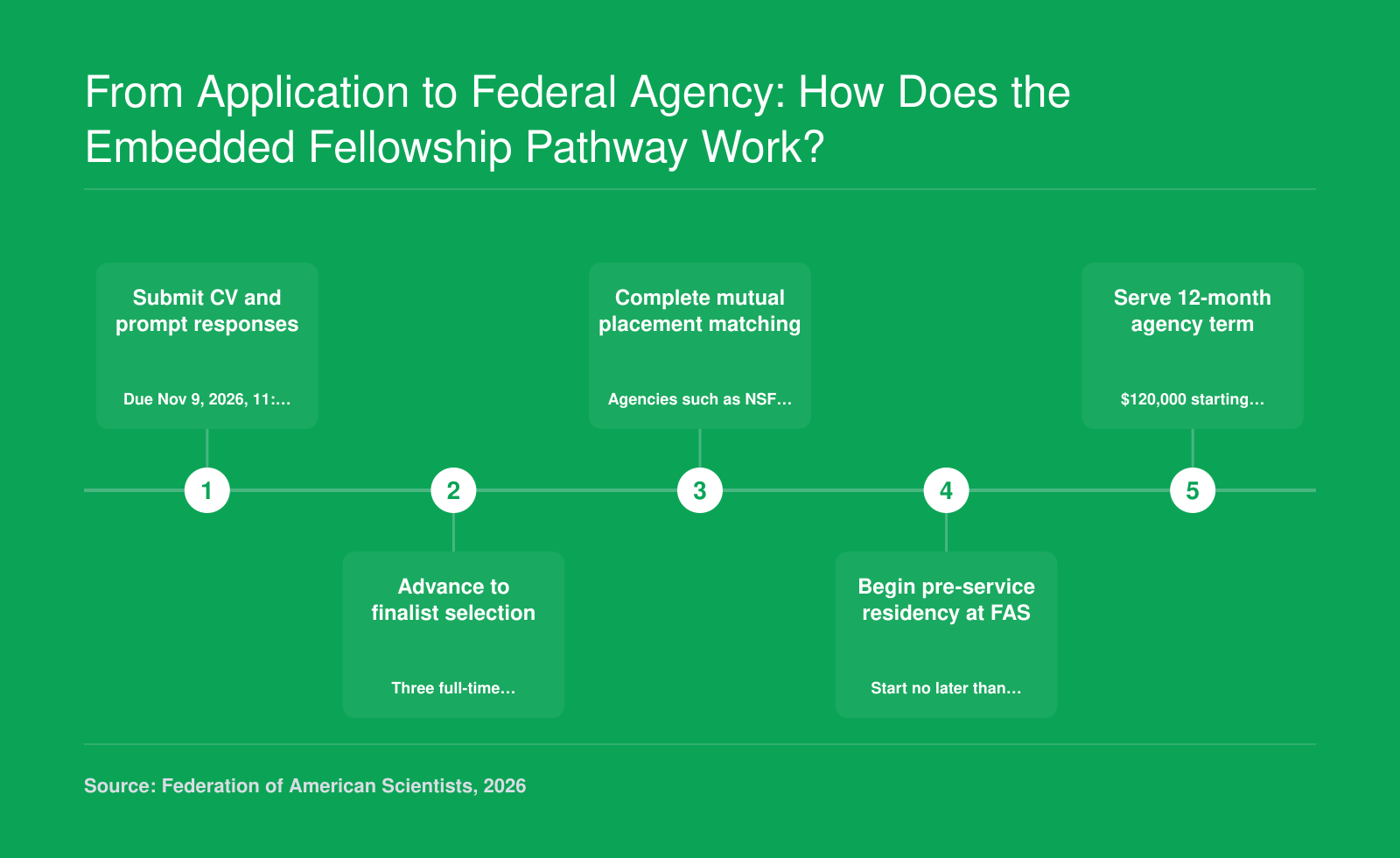
From Application to Federal Agency: The Embedded Fellowship Pathway
The FAS Metascience Fellowship moves through a fixed sequence, from a short written application to a year inside a federal research agency. For the current cycle, applications closed at 11:59 PM Eastern Time on November 9, 2026, and late applications are not reviewed.
How to Frame Your Methods and Evaluation Skills in a 300-Word Prompt
Federal agencies are now building their own units to test how science gets funded, and NSF and NIH have each recently created metascience offices to evaluate funding mechanisms. The FAS call asks applicants for a CV plus responses to prompts of 300 words or fewer, and that cap rewards people who can think like an evaluator, not a dissertation committee.
Build Each Response Around Three Moves
A tight answer has one problem, one method, one decision. Name a specific problem in how research is funded or reviewed. Describe the method you would use to test it. Then state what an agency could do differently depending on what you find. If a sentence does not serve one of those three moves, cut it.
Translate Academic Language into Action
Dissertation prose describes contributions to a literature. A program officer needs to know what to change on Monday. Swap "I examine heterogeneity in reviewer scoring" for "I would test whether panel scores predict later outcomes, so the agency can decide whether to reweight review criteria." Lead with the finding or the decision, and leave theory-building for the footnotes you do not have room for.
Show You Have Been Inside the Process
Reviewers can tell whether you have served on a panel, written a review, or administered a competition. One concrete line is enough: the panel you sat on, the number of proposals you scored, or the rubric you helped revise. That experience signals you understand how the machinery actually behaves.
Name a Real Mechanism
Avoid describing metascience in the abstract. Point to something an agency actually controls:
- Proposal triage: Does desk screening filter out strong, unconventional ideas?
- Review criteria: Do the stated criteria drive the scores reviewers give?
- Award size or duration: Would smaller, shorter awards produce more per dollar?
Treat Ambiguity as a Qualification
Policy-facing work rarely comes with clean data. Say what you would do when administrative records are incomplete: document what is missing, test whether the gaps are random, run bounded estimates, and report what the agency can safely conclude now versus what needs another year of data. Saying so plainly shows the judgment this kind of embedded role requires.
Non-AI Metascience Topics That Actually Get Funded
UKRI reported that its 2025 distributed peer review pilot, in which applicants assess one another's proposals, cut the time from deadline to decision by 53% to 65%, and the model is being expanded across research councils. That is a metascience result produced by survey design, incentive analysis, and process evaluation, not by a language model. It is also a fair picture of where most research-on-research money actually goes.
The Funded Clusters
- Peer review and reviewer behavior: reviewer supply and quality is a named priority of the UK Metascience Unit, and NSF's metascience office exists partly to test how communities respond to novel review and funding mechanisms.
- Reproducibility and research integrity: NIH's 2026 strategy emphasizes robust, reproducible results, support for replication, and publication of negative findings.
- Research workforce and training pipelines: NIH names the research workforce a strategic objective; NSF's NextGen Workforce effort targets interdisciplinary graduate training, including accelerated six-year bachelor's-to-doctoral pathways.
- Evaluation of funding mechanisms: UKRI and ESRC analyze how different funding modes perform, and the UK Metascience Unit administers multi-million-pound competitive grants to grow the field.
- Open science and data sharing: UKRI's 2026 to 2031 strategy strengthens open research policy; ESRC-backed work evaluates preregistration, open data, and reproducible code, including one funded project building code-quality indicators.
Why the Quiet Areas Dominate
AI-and-science panels fill conference programs because the technology is new and the claims are large. Funder documents read differently. The recurring questions are administrative and behavioral: who reviews, what gets rewarded, whether published findings hold up, and who stays in the field. Those are social science questions with existing literatures.
Questions Your Discipline Already Asks
A sociologist of science can ask whether reviewer training reduces score variability across panels. A labor economist can ask how award duration shapes early-career publication and attrition. A higher education researcher can ask what assessment systems do to institutional hiring behavior. Scholars in STS, sociology, economics, and higher education rarely need a new agenda to apply; they need to restate the agenda they have in the vocabulary of research culture, peer review, and funding design.
Did You Know?
Many social scientists rule themselves out over degree field or the "not a scientist" label before reading the criteria. The FAS call accepts an advanced degree or equivalent experience in a scientific, engineering, or public policy field. Finalists also go through mutual placement with federal agencies, so agency fit is negotiated, not predetermined. Read the call first.
Where Metascience Fellows Work After the Fellowship
Where do metascience fellows actually go once the 12 months end? The realistic destinations are federal staff or analyst roles, funder program-officer jobs, university research-on-research centers, and a return to faculty with policy credibility. The strongest evidence comes from older science policy fellowships, because the FAS Metascience Fellowship recruits only three fellows and its public materials describe placement, not completed-cohort outcomes.
What Alumni Data from Comparable Programs Shows
The AAAS Science & Technology Policy Fellowships are the best-documented comparison. The program places more than 250 fellows a year and counts roughly 4,000 alumni.1 AAAS reports that about half of fellows stay in policy at the end of the fellowship, about a quarter return to their prior field, and about a quarter move into new territory.1 An independent evaluation found that 42 percent took government jobs immediately afterward.2 Those figures do not separate funders, university centers, and faculty posts, so treat them as a general pattern.
Smaller programs report less. The National Academies' Gulf Research Program says its science policy fellowship has more than 90 alumni working in government, nonprofits, and academia, including tenure-track professorships, but gives no percentages.3 The State Department's science adviser fellowship places tenured professors in one-year roles, with a possible consultant arrangement after they return.4
A Complement to a Disciplinary Career
For social scientists, the better framing is addition, not exit. A year inside an agency such as NSF or DOE shows how funding mechanisms are designed, tested, and evaluated. That access can generate research questions about peer review, program design, and evidence use that are hard to get from outside. Alumni of the AAAS program reported later-career activity such as writing science-policy papers (54 percent) and taking organizational leadership roles (49 percent)2, which suggests the experience carries into scholarship and service.
A Bridge, Not Tenure
The FAS term is 12 months. It may be extended, but only contingent on funding and performance, so plan for both outcomes. NSF and NIH have each created metascience units, which suggests demand for this expertise inside agencies, but openings depend on budgets. Before applying, line up a faculty or research affiliation to return to, keep a publication pipeline running, and ask the program directly where its earlier fellows landed.
The shift is institutional, not just individual. As the Federation of American Scientists notes, NSF and NIH have each recently created dedicated metascience units to test and evaluate research funding mechanisms, so fellows step into infrastructure that barely existed a few years ago.