Lowest In-State Tuition for a Bachelor’s
University of the District of Columbia
$5,662 in annual undergraduate tuition and required fees for state residents (2024–25), the lowest among the 8 bachelor’s programs shown here.
Program Rankings
Ranked lists for every field and degree level, scored within that field and level.
All Program RankingsDegrees for Working Adults
Most Affordable Degrees
Online Degrees
Careers
What the work involves, what it pays, and the education each job usually asks for.
All Career GuidesBachelor’s Entry Routes
Graduate Study Routes
Compare Majors
Courses, research methods, and career routes, side by side before you choose a major.
Compare All MajorsHead-to-Head Comparisons
Latest Reading
Explore a Field
Browse by State
State lists by subject and degree level, ordered by the national comparison score.
Browse All StatesPrograms by State
A bachelor’s from the University of the District of Columbia costs residents $5,662, while Georgetown University, George Washington University, American University and The Catholic University of America cost $58,378 up to $68,089. Howard University tops the list with 170 degrees. Howard and Georgetown are the only Washington schools with a ranked doctorate, and Georgetown tops the eight on schoolwide completion at 95%.

By Taylor Rupe, Editor
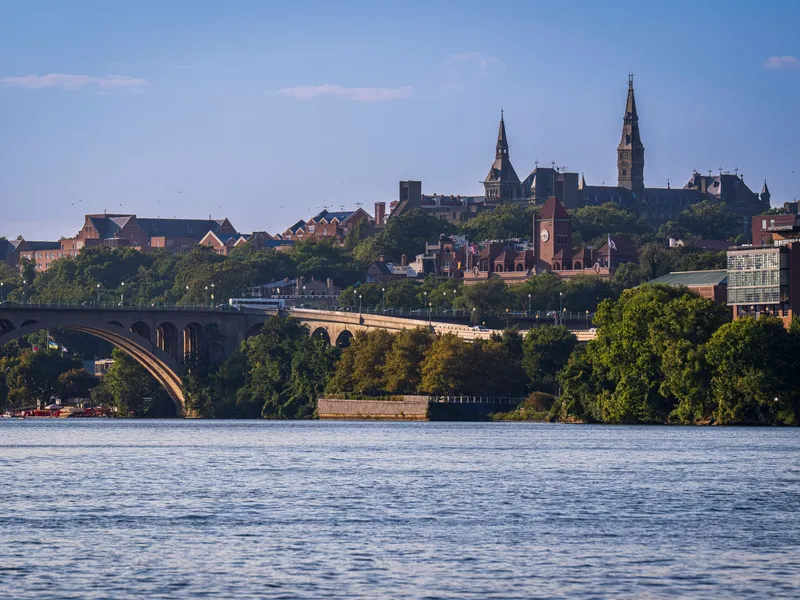
8 schools in Washington, DC awarded psychology bachelor’s degrees in 2023–24, scored against 1,212 bachelor’s programs nationwide.
Psychology BS
Howard sets a high bar early: Foundations of Psychological Science, Research Design and Analysis, and Statistics I with its lab each need a B at minimum, and Statistics II follows. You then pick four of six core domain courses, covering abnormal, cognitive, developmental, neuropsychology, social and personality psychology, with no grade under a C. Electives come from clusters, with at least one required from a cluster on the Black experience, cross-cultural psychology, gender, or race and racism, and one from areas like clinical, health or educational psychology. Practicum, internship and independent research are optional, and a capstone senior seminar and a new-student orientation complete the program.
Program Sources: Howard University Undergraduate Catalog 2025-2026
Psychology Major
The psychology major at Georgetown is 31 credits, and you start by attending a declaration session where the director of undergraduate studies explains requirements and advises you one-on-one. The department points to a strong research methods and statistics background, built around PSYC 2000, for anyone eyeing graduate school, and encourages pairing the major with a minor such as biology, philosophy, cognitive science or computer science. Students can seek research assistantships in faculty labs. Majors holding a 3.5 GPA plus a faculty mentor can apply to the honors program, a senior-year thesis and poster symposium that is recorded on the transcript as Honors Psychology Major Complete.
Program Sources: Undergraduate Program | Department of Psychology | Georgetown UniversityHonors Program | Department of Psychology | Georgetown University
Psychological and Brain Sciences BA and BS
At GW, psychology is called Psychological and Brain Sciences and comes as a BA or a STEM-based BS. Both require Research Methods and a statistics course, and both end with an advanced research lab you choose from sensation and perception, cognitive neuroscience, clinical/community, applied social or developmental psychology. The BA adds survey courses in abnormal, social, developmental, cognitive and biological psychology with room for four free electives. The BS swaps in introductory biology, biostatistics, a Python programming course and two gateway courses, aimed at students headed for medical school, law school or a PhD. Declare with an advisor who works in your interest area.
Program Sources: BS in Psychological & Brain Sciences | Department of Psychological & Brain Sciences | Columbian College of Arts & SciencesBA in Psychological & Brain Sciences | Department of Psychological & Brain Sciences | Columbian College of Arts & Sciences
Psychology BA
Formal admission to the major takes departmental approval, and then it's 41 credit hours, each graded C or above, with 18 or more at the 300 level. Quantitative Methods and the introductory course are required, along with four credits of statistics and a research methods course. After that you take one course per area across five areas, including biopsychology, learning and cognition, society and psychology, and health and development. A capstone can be an internship capstone, a controversial issues seminar or an honors capstone, and you add two experiential credits, such as community service-learning or an internship. Strong students can apply in spring of sophomore year to the Honors in Psychology program.
Program Sources: Program: Psychology (BA) - American UniversityProgram: Honors in Psychology - American University
Psychology BA and Psychological and Brain Sciences BS
Catholic University offers a BA in psychology and a BS in Psychological and Brain Sciences, and the BS is the research-heavy one: 13 psychology courses, General Research Methods and Introductory Statistics with labs as prerequisites to Senior Seminar, three credits of research, and three cognitive or brain courses at the 300 level. Research apprenticeship (PSY 493) puts you in a faculty lab for four to five hours a week, and seniors at 3.70 or higher can write a year-long thesis. Off-campus placements include NIH, Children's National Medical Center, the Washington VA and the FBI. Third-year students at a 3.5 GPA or higher can apply for the five-year BA or BS plus MA in general psychology.
Program Sources: Psychological and Brain Sciences BS - Department of Psychology - Catholic University of America, Washington, DC | CUAResearch and Internship Opportunities - Department of Psychology - Catholic University of America, Washington, DC | CUA
Psychology BS
UDC keeps psychology classes to about 25 to 30 students and builds the last year around your own research. The 120-credit degree includes 43 credits in the major, and seniors join experimental activities and a capstone seminar that requires an independent research project. Outside class, the program runs psychology clinics, five-minute elevator speech practices, research forums and senior thesis defenses prepared for possible conferences. You can join the Psi Chi chapter for independent research under faculty direction and conference travel, or the student circle of the Association of Black Psychologists. Over half of recent graduates have gone on to counseling, rehabilitation, social work, developmental or clinical psychology programs.
Program Sources: Bachelor of Science in Psychology | UDC | University of the District of ColumbiaBachelor of Science in Psychology | UDC | University of the District of Columbia
Psychology BA
At Trinity you choose a cluster as well as a major: after 30 credits of required courses, you complete 15 credits in a general, developmental or forensic psychology cluster. The required courses include two research methods courses, Experimental Psychology and Applied Psychology, plus two statistics courses (Introduction to Statistics and Statistical Inference), an ethics course, a biology course, plus Senior Seminar. The forensic cluster pairs Forensic Psychology with Introduction to Criminal Justice, while the developmental cluster centers child psychology and adolescence or aging. Psychology majors can also apply to the dual degree that starts a master's in counseling while you finish the bachelor's.
Program Sources: Psychology (B.A.) – CAS | 2026-2027 Academic Catalog
Psychology BA
To declare psychology at Gallaudet you need a 2.5 GPA and at least a C in the introductory course, and you hold a 2.5 in major courses afterward. The required core mixes Human Biology, Lifespan Development, Psychology and Deaf People, Abnormal Psychology, Cognition or Social Psychology, and a two-part Research Design and Analysis sequence. Then comes a Pre-Internship Seminar, an Internship, and a Senior Capstone on current issues. Fifteen more credits of electives let you add areas such as health, sport, school or multicultural psychology, neuropsychology or psycholinguistics. Honors students complete honors projects, a senior seminar and an independent research project.
Program Sources: 2026-2027 Undergraduate Academic Catalog | Gallaudet University
2 schools in Washington, DC awarded research doctorates in psychology in 2023–24. Doctoral scores leave out tuition because funding offers, not sticker price, decide the real cost.
Psychology PhD, Clinical, Neuropsychology, Social, Developmental and Personality Specializations
Howard's Graduate School houses its psychology doctorates as specializations, so the first choice is your area: clinical (adult or child track), neuropsychology, social, developmental or personality. Each page describes an APA-accredited PhD. Clinical students begin with a school-based assessment placement, add psychotherapy practicum in year two, and complete externships in years three and four, focused on social determinants of health in underserved communities. Neuropsychology has strengths in brain and physical health related to racial and ethnic health disparities. Applicants name faculty they want to work with in their statement, and the Nov. 15 early deadline is needed to be considered for Competitive Assistantships.
Program Sources: Clinical Psychology (Ph.D.) | Howard University ProgramsNeuropsychology (Ph.D.) | Howard University Programs
Psychology PhD
Georgetown's psychology PhD is a fully funded, five-year, full-time research program with two concentrations: Human Development and Public Policy, or Lifespan Cognitive Neuroscience. Public policy students take core courses at the McCourt School of Public Policy, while neuroscience students take them in the Interdisciplinary Program in Neuroscience at the School of Medicine, and both groups also take psychology department courses. You choose a primary mentor on entry and work toward rigorous research milestones. Dual degrees are offered with the Master of Public Policy and with Cognitive Science. The department doesn't offer clinical or counseling psychology degrees, and there's no separate master's program.
Program Sources: Ph.D. Program | Department of Psychology | Georgetown University
Each program gets the same comparison score it earns in our national psychology model, calculated against the nationwide group that meets the numeric and directory criteria. We then order Washington, DC’s eligible programs by that score within each degree level. We feature up to 10 programs, taking the next highest-ranked program from each degree-level list in turn. Scores are compared only within the same degree level. Bachelor’s lists weigh graduation rate (20%), published tuition (20%), graduate earnings (20%), program reputation (25%), and degrees awarded (15%). Doctoral lists weigh research activity (35%), program reputation (35%), and doctoral degrees awarded (30%). See the full ranking method.
These picks compare only the programs featured in the lists above.
University of the District of Columbia
$5,662 in annual undergraduate tuition and required fees for state residents (2024–25), the lowest among the 8 bachelor’s programs shown here.
170 psychology bachelor’s degrees awarded in 2023–24, the most of any school on this list.
95% of first-time, full-time students at the school finished a bachelor’s within six years. This is a schoolwide rate, not a psychology-only rate.
University of the District of Columbia
The highest-scoring public school on the bachelor’s list (No. 6 overall), with a comparison score of 45.2.
Carries the Carnegie 2025 Research 1 designation for very high research spending and doctorate production.
9 research doctorates awarded in 2023–24; ranked first of 2 doctoral programs shown here.
Howard University leads the bachelor’s list and awarded 170 psychology degrees in 2023–24, the most in the District. Cost separates them far more than score does. The public university charged District residents $5,662 in 2024–25 tuition and required fees, and nonresidents $12,514. Georgetown charged $68,089 and George Washington $67,710. On schoolwide graduation rates, Georgetown reports 95% and the public university 44%.
Georgetown University joins Howard on the research doctorate list, with 3 doctorates awarded.
The District of Columbia Board of Psychology licenses psychologists in Washington, DC. A bachelor’s or master’s degree in psychology does not by itself qualify you to practice as a psychologist.
D.C. Law 25-191 (effective July 19, 2024) created a health services psychology license, a general applied psychology license, a school psychology registration, and a psychology associate registration. DC joined PSYPACT effective March 16, 2021.
Requirements summarized from the board’s official pages. Confirm the current rules with the board before you choose a graduate program.
These are BLS median annual wages for Washington, DC and the United States from the May 2025 Occupational Employment and Wage Statistics survey. A median is the midpoint among workers in the occupation, from new hires to senior staff, so it is not a starting salary for a new graduate. The 10th–90th percentile range shows what the middle 80% of workers earn in the state.
| Occupation | Washington, DC Median | Washington, DC 10th–90th Percentile | U.S. Median | Washington, DC Jobs |
|---|---|---|---|---|
| Psychologist Wages in Washington, DC BLS: Clinical and Counseling Psychologists | $107,000 | $70,400–$324,950 | $100,580 | 220 |
| Psychologist Salary in Washington, DC BLS: School Psychologists | $107,500 | $83,470–$164,380 | $95,990 | 250 |
| Psychologist Wages in Washington, DC BLS: Psychologists, All Other | $125,110 | $59,880–$169,170 | $110,840 | 230 |
Source: BLS Occupational Employment and Wage Statistics, May 2025. Wage data does not enter the program scores.
8 schools in Washington, DC appear in the lists shown here (8 bachelor’s, 2 research doctorate programs). A school can appear at more than one degree level. The degree counts come from federal IPEDS completions for 2023–24.
University of the District of Columbia lists $5,662 in annual undergraduate tuition and required fees for state residents in 2024–25, the lowest among the bachelor’s programs shown here. That is a schoolwide figure before aid, so check the program’s own costs and any fees for fieldwork or labs.
The federal IPEDS completions file records psychology research doctorates awarded in 2023–24 at Georgetown University (3 degrees), Howard University (9 degrees). These are historical award counts. Check current admissions, advisor availability, and funding directly with each department.
The University of the District of Columbia, the only public school on the list, charged District residents $5,662 in 2024–25 tuition and required fees and nonresidents $12,514. Among the private schools, Gallaudet University had the lowest figure at $19,654. These are schoolwide charges, not program prices, and the public university ranks sixth on the bachelor’s list.
Howard University ranks first among 2 psychology research doctorate programs on the District of Columbia list. It reported 9 research doctorates in 2023–24. Georgetown University also appears on the list. Read the doctoral program’s research areas and advisor information before you apply. Degree awards describe past graduates, not the size of the next entering cohort.