Key Points
- A Ph.D. by the deadline disqualifies you from the Student Program.
- Reviewers score feasibility: a confirmed host affiliation beats multi-country ambition.
- Campus Fulbright deadlines typically fall four to six weeks before national ones.
Why Fulbright Still Sets the Benchmark for International Social Science Research
The Fulbright Program turns 80 in 2026, the same year as America's 250th anniversary, and it still draws participants from more than 160 countries. The milestone matters less than what the program does at department level: Florida Atlantic University's 2026-27 cohort alone places six faculty awards across India, Ireland, Poland, Spain, Guatemala, and France.
For most social scientists, two questions decide the outcome: how an award is actually won, and what it produces afterward. Neither is settled by credentials alone. The mechanics run through pathway choice, a project scoped to the data you can reach, a Statement of Grant Purpose written as a feasibility argument, and campus deadlines that land weeks before the national one.
How Hard Is It to Get a Fulbright? What the Selection Numbers Actually Show
The most reliable Fulbright selection figures come from cycle-specific, award-type sources rather than a single acceptance rate repeated online. The U.S. Student statistics page breaks out numbers by country for the 2025-2026 through 2027-2028 award years and labels them projected estimates that may change. To find usable figures, compare several cycles across Study/Research grants, English Teaching Assistant awards, U.S. Scholar awards, and Specialist awards. Start with the Fulbright U.S. Student Program and Fulbright Scholar Program websites, their country and award-type pages, and IIE and Fulbright annual reports. Then ask your campus Fulbright Program Advisor or fellowship office for historical applicant and award counts, and check discipline associations for field-level patterns. Treat the application year and the award year as separate cycles. Use BLS.gov only for occupational context, not award counts. If figures are missing for your award type, request program-office data before drawing conclusions about your odds.
Which Awards Fit Political Science, Sociology, Economics, and Public Policy
A Fulbright award is a funded stay abroad built around a specific project, and the award family you apply to decides what that project can look like. That the social sciences are eligible says little about where to apply. What matters is which family fits your method and your career stage.
The Award Families Worth Knowing
- Fulbright U.S. Scholar: Open to faculty and professionals, it funds teaching, research, or a combination abroad. Political scientists use it for comparative fieldwork, sociologists for ethnography, and economists and policy analysts for data collaboration with a host institution.
- Fulbright Specialist: Short-term project placements, usually a few weeks. This suits a policy analyst or methodologist asked to consult on curriculum, survey design, or institutional capacity, not someone starting a long study.
- Fulbright-Hays Doctoral Dissertation Research Abroad: Aimed at doctoral candidates who need extended fieldwork, which fits dissertation archives, interviews, and village or neighborhood studies. Eligibility rules differ from the main Fulbright programs, so read them separately.
- Fulbright-Nehru: A U.S.-India award. Florida Atlantic University's 2026-27 cohort includes an engineer who received one, which shows the family reaches well beyond the humanities.
- Distinguished Chair awards: Senior appointments that combine lecturing and research at a host university, generally expected of scholars with an established record.
Country Awards Versus Institutional or Distinguished Awards
Country awards are tied to a host nation, and that nation's priorities shape the call. A proposal for one should show why this country, this host institution, and this question belong together, and should echo the priorities stated in the listing. Institutional and distinguished awards are usually organized around a university's needs or a senior appointment. There the argument shifts toward what you will teach, whom you will mentor, and what lasting link you will leave behind.
Check the Current Catalog
Award names, countries, and availability change every year. Some listings are added, others lapse or shift in scope. Treat the current Fulbright catalog and your campus Fulbright adviser as the only reliable list, not a summary written for an earlier cycle.
The Fulbright Program was established in 1946, so 2026 marks its 80th year, the same year America celebrates its 250th anniversary. Florida Atlantic University's 2026 announcement notes that participants come from more than 160 countries and locations. Source: https://www.fau.edu/news/2026/fulbright-scholars-2026/index.php
How Fulbright Funding Works: Stipends, Allowances, and Cost-of-Living Adjustments
A Fulbright award is a bundle of separate benefits, and each host country sets its own mix. For example, the Fulbright U.S. Student stipend runs from $1,300 a month in Slovakia to $4,325 a month in Kuwait, and some countries add research, language, or housing support on top of the base stipend. The examples below come from Fulbright U.S. Student country pages. U.S. Scholar and Fulbright-Nehru awards publish their own terms on each award listing in the catalog, so treat that listing, and the grant document issued after selection, as the authoritative figure.
| Funding Element | Which Award | How the Amount Is Set | Typical Range or Note |
|---|---|---|---|
| Monthly stipend | Fulbright U.S. Student grants | Broadly based on the cost of living in the host country; the country page lists an estimate subject to change | Final financial terms are confirmed in the grant document issued after selection |
| Monthly stipend, Kuwait | Fulbright U.S. Student Open Study/Research Award | Set on the Kuwait country award page | $4,325 per month (2026-27) |
| Monthly stipend, United Arab Emirates | Fulbright U.S. Student Open Study/Research Award | Set on the UAE country award page | $4,202 to $6,650 per month (2026-27) |
| Monthly stipend, Romania | Fulbright U.S. Student Open Study/Research Award | Set on the Romania country award page | $2,150 per month (2027-28) |
| Monthly stipend, Slovakia | Fulbright U.S. Student Open Study/Research Award | Set on the Slovak Republic country award page | $1,300 per month (2027-28) |
| Monthly stipend, Taiwan | Fulbright U.S. Student award in Taiwan | Built from separate base, living, housing, and incidental allowances | NT$50,000 total per month: NT$22,000 base, NT$15,000 living, NT$10,000 partial housing, NT$3,000 incidental (2027-28) |
| Housing component, Taiwan | Fulbright U.S. Student award in Taiwan | Partial housing allowance listed separately from the other allowances | NT$10,000 per month; the Foundation for Scholarly Exchange makes housing arrangements (2027-28) |
| Travel allowance, Romania | Fulbright U.S. Student Open Study/Research Award | Set on the country award page | $3,500 travel and relocation allowance (2027-28) |
| Travel allowance, Slovakia | Fulbright U.S. Student Open Study/Research Award | Set on the country award page as a round-trip allowance | $1,500 round-trip air travel allowance (2027-28) |
| Research and book allowance, Romania | Fulbright U.S. Student Open Study/Research Award | Country-specific add-on listed on the award page | $500 (2027-28) |
| Professional allowance, Slovakia | Fulbright U.S. Student Open Study/Research Award | Intended to cover visa-related expenses | $100 to $800, depending on permanent residency (2027-28) |
| Community integration allowance, Romania | Fulbright U.S. Student Open Study/Research Award | Country-specific add-on listed on the award page | $800 for Romanian-language learning and specialized counseling (2027-28) |
| Dependent maintenance allowance | Fulbright U.S. Student grants | A small allowance may be provided in some countries; the grantee covers remaining dependent costs | No universal amount is published; an accompanying dependent must spend at least 80% of the grant period abroad with the grantee |
Host Affiliation and Language Proficiency: What Countries Actually Require
A generic welcome letter and a working affiliation letter can look identical on letterhead, but reviewers read them differently. One says a visitor is welcome. The other shows that a named host has agreed to support a specific project.
What the Affiliation Letter Has to Prove
Every Fulbright academic applicant lists a proposed host. Affiliation is expected even when a project involves no enrollment.1 A strong letter confirms three things:
- Access: the archives, data, or field sites the project depends on.
- Engagement: a supervisor who knows your work and intends to engage with it.
- Timeline: a schedule the host considers realistic.
Generic praise of your CV does none of that. Letters must be in English, on official letterhead, and signed. Electronic signatures are accepted.1
The Timing Problem
For many awards, these documents are due with the application, not before departure. Where a letter is required at the national deadline, a missing one can make the application ineligible, and late letters are not accepted.1
- France: Independent study or research requires the letter at the application deadline.2 Degree programs do not require acceptance at application, but the award depends on acceptance before arrival.2
- South Korea: Applicants need a formal letter signed by the host supervisor by December 31, 2026. The commission may request it at the semifinalist stage, but the requirement stands.
Rules vary by country and award, so check each award summary.
Language Expectations by Country
- France: About one year of French study or the equivalent is expected.3 English-taught programs set no particular level.4 French-language research needs at least intermediate French.4
- South Korea: Interview-based projects need at least intermediate Korean, with advanced preferred. The bar can rise with the project.
- English-speaking hosts: Countries where English is the national language are exempt from language evaluation.1
Documenting Proficiency Credibly
Where language is required, applicants submit a Language Self-Evaluation plus a professional Foreign Language Evaluation.1 Native speakers must submit both as well.1 If your level cannot sustain unscripted interviews, adjust the design before applying. You can lean on documents and administrative data, budget for interpretation, or work with a host-side research assistant. Explain that choice in the proposal.
- MSU Fulbright Study/Research Programs, Michigan State University
- Fulbright France Study/Research Grants, Fulbright France
- Fulbright Visiting Scholar Program: Applying, U.S. Department of State
- 2026-2027 Fulbright Visiting Scholar Program Application, U.S. Embassy in Croatia
Did You Know?
Reviewers score feasibility, not ambition. A narrowly scoped study with a confirmed host affiliation, named archives or agencies, and a realistic timeline will outrank a sweeping multi-country comparison with no documented path to the data. The remedy is simple: before you write, secure written confirmation of access, then size the project to what that access and the grant period can actually deliver.
What Makes a Successful Statement of Grant Purpose — And What Reviewers Reject
What Makes a Successful Statement of Grant Purpose, and What Reviewers Reject
A strong Statement of Grant Purpose is a feasibility argument, not a topic announcement. It is capped at 6,000 characters including spaces, allows no bibliography, and requires no citations.2 Reviewers are full-time faculty with discipline-specific and region-specific experience1, so vague claims about the field or the host country get noticed.
Map Each Criterion to a Paragraph
- Feasibility: Open with the who, what, when, where, why, and how: the question, design, site, and timeline.3
- Preparation: Show the coursework, prior research, area knowledge, and language study that make you the right person for this project.
- Cross-cultural fit: Explain why this country and not another, what your host affiliation contributes, and what data and contacts you can reach.
- Ambassadorial potential: Describe how you will engage the host community and share results with local scholars, not only U.S. audiences.
Write the Methodology for an Outsider
The statement must work without the research proposal attached. Name the unit of analysis, how participants or documents will be located, what kind of data you expect, and how you will analyze it. No sample size or method is mandated, so justify the choices you make. A policy concern is not a research question.
Four Weaknesses Reviewers Keep Flagging
- Vague methodology: Phrases like "I will explore" with no sampling, recruitment, or analysis plan.
- Implausible scope: Too many sites, an overly broad question, or archival and interview work that cannot fit the award period.
- Thin language preparation: Fieldwork in a language you cannot yet use, with no improvement plan, interpreter, or collaborator.
- Missing or generic affiliation: A named adviser with no explanation of access, resources, or why the host country is not interchangeable.
A Weak Aim and a Feasible One
Weak: "I will study how migration policy affects communities in my host country."
Feasible: "Over the grant period, I will conduct semi-structured interviews with municipal officials and nonprofit staff in two cities to compare how local implementation departs from national policy. My host-university adviser has agreed to make introductions, and I will hold interviews in the local language, which I am studying now. I will present preliminary findings to host-country scholars before departure."
The second version states a design, a comparison, a language plan, and a reciprocal outcome in a few sentences.
Revision Checklist
- Can a non-specialist state your question, method, and site after one read?
- Does the timeline include preparation, fieldwork, analysis, and dissemination?
- Is the scope realistic for the award length?
- Is each host contact tied to a specific contribution?
- Does your language plan match what the fieldwork demands?
- Does the project give something back to the host community?
- Does the draft stay under 6,000 characters without leaning on the proposal?
- 34 CFR § 662.21 - Selection criteria, Electronic Code of Federal Regulations
- Columbia University Fulbright U.S. Student Program, Teachers College, Columbia University
- 34 CFR § 664.31 - Selection criteria, Electronic Code of Federal Regulations
Campus Fulbright Advising and the Internal Deadlines Nobody Mentions
For the 2027-28 U.S. Student cycle, the national deadline was October 6, 2026 at 5 p.m. ET. Institution-based applicants, though, answered to a campus deadline that Fulbright Program Advisers typically set four to six weeks earlier, which points to roughly August 25 through September 8. Each institution picks its own date.
The Calendar Math
Campus dates often run even earlier. Ohio State set its campus application deadline in August, with committee consultation in September. UC Santa Barbara's was August 17, 2026, open to current graduate students only, with interviews September 1 to 18. A plan begun in November for the following cycle can therefore be behind by September: the real submission date is the campus one.
What the Committee Does
The Fulbright Program Adviser coordinates campus review, and many campuses add a faculty panel and an interview. Fulbright encourages this review but does not describe it as universal, so ask whether your school requires it. Committees generally give feedback on the statement of grant purpose, the feasibility of the plan, and the fit between applicant and host. Some also complete the Campus Committee Endorsement form that accompanies the application. You can revise after the interview and before the national submission.
Using Advisers Well
Arrive with a draft statement and a named host contact, not a topic idea. A draft lets the adviser critique argument and method. A named contact lets the committee judge whether the project can actually happen. A topic alone invites a conversation about interests, and that is the one conversation the calendar cannot afford.
Who Answers What
- Ask your campus: internal deadline, interview format, committee composition, who is eligible locally (UCSB, for example, limits its process to graduate students), and how to get faculty feedback.
- Ask the national program: the application platform, the October 6 national deadline, at-large submission (applicants without an affiliated campus submit directly), and award requirements.
U.S. Scholar applicants follow a separate national process. The 2027-28 deadline was September 15, 2026 at 5 p.m. EDT, with two recommendations required and no late submissions accepted. International Education Administrator awards carry their own deadlines. Published guidance does not set a standard campus committee calendar for Scholars, so ask your research office what local support exists and how early it wants to see drafts.
Reviewers rarely fund the boldest idea in the pile. They fund the one that shows a scholar can reach the archive, the host institution, and the data within a single grant year.
What a Fulbright Award Signals: Alumni Outcomes and Research Capacity
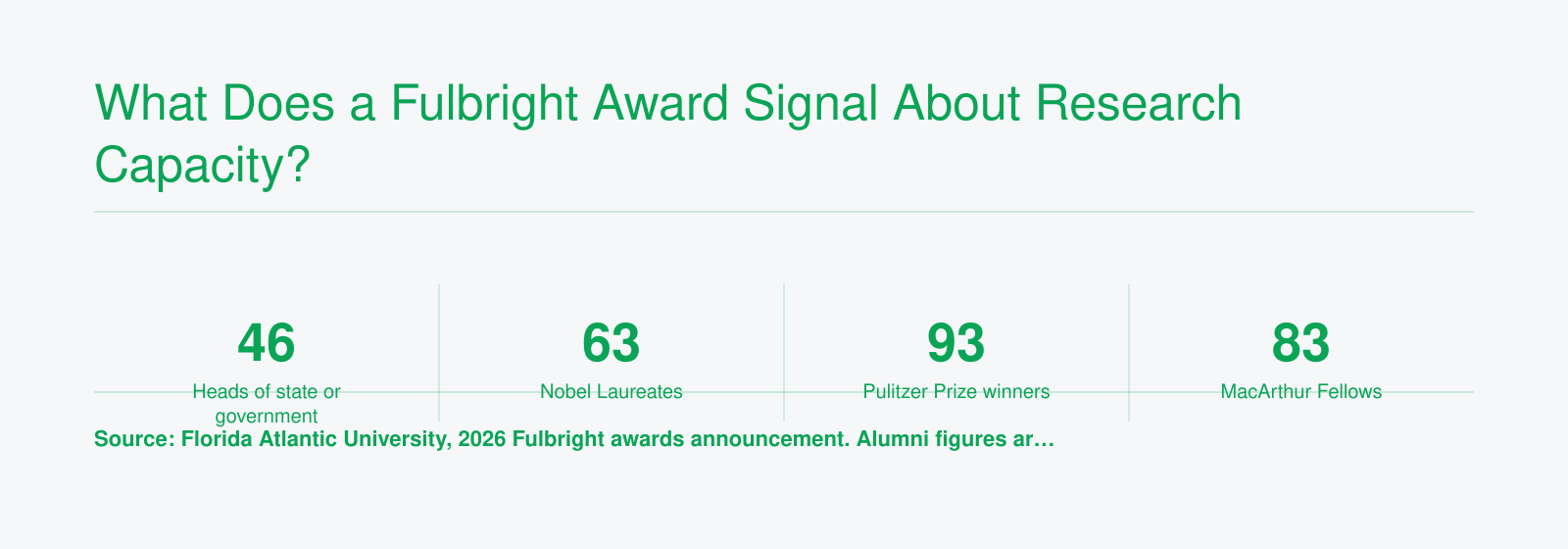
Fulbright's alumni record is useful evidence in faculty development and funding-strategy conversations because it shows the company an award places a scholar in. These are program-wide associations across every field and every year since 1946. They do not predict any individual's later funding, tenure or promotion, and published tallies vary slightly by source and reporting year.
What One University's Six-Award Cohort Reveals About Research Infrastructure
A Fulbright goes to one person, but its value to a university depends on the institution treating it as shared infrastructure. Florida Atlantic University's 2026-27 cohort shows why. According to the university's announcement, six faculty and staff members will work in India, Ireland, Poland, Spain, Guatemala, and France, across fields that include engineering, music, history, digital marketing, education administration, and climate-driven migration.1
A Cohort as Distributed Infrastructure
Each placement creates a host-institution relationship, local colleagues, and archives or field sites that a campus did not have before. Nick Underwood will teach a graduate Jewish Studies course and work in archives at the University of Warsaw.2 Stacie Lee Rossow's Ireland project, built with the Irish Institute of Music and Song and Maynooth University, documents sean-nós singing as a tool for revitalizing Irish.2 Other awardees' announced project areas include climate-driven migration in Guatemala and digital-marketing education in Spain.3 Taken together, these are channels for data access, co-supervision, and student exchange that can outlast any single grant period.
Methods Migration: The IIT Madras Example
Madasamy Arockiasamy's Fulbright-Nehru award is a useful template. He is scheduled to spend January through May 2027 at the Indian Institute of Technology Madras, where his research component centers on a geo-artificial intelligence dashboard. It would combine satellite imagery, geographic information systems, and machine learning to address landslides, coastal erosion, and water stress, with applications in disaster-risk reduction, coastal monitoring, and Blue Economy planning.4
The engineering is not the social science, but the questions downstream are. Who is exposed to coastal hazards, how do agencies act on risk maps, and how do governance choices shape adaptation? Public sources describe the project's aims but not its final datasets, architecture, or deployment, so treat it as a model of design, not a proven result.
The Selection Lesson
Fulbright U.S. Scholars are chosen for academic and professional achievement and for the potential impact of the proposed project abroad. That makes the award a portfolio argument, not a proposal-only contest. Arockiasamy's record of decades of sponsored research and professional practice sits behind the project description.
What Administrators Can Do with This
Award counts are best read as capacity signals, not trophies. A campus with several active Fulbrighters can point to:
- Graduate mentorship abroad: host contacts who can co-advise or receive visiting students.
- Partnership building: relationships that make later joint proposals more credible.
- Follow-on funding: pilot work and local knowledge that strengthen subsequent sponsored research.
The practical step is to track what each awardee builds, then route those contacts to colleagues and students while the relationships are still fresh.
- FAU Newsdesk: Fulbright Scholars 2026, Florida Atlantic University
- FAU Engineering News: Fulbright Scholars 2026, Florida Atlantic University
- FAU Research Daily: Fulbright Scholars 2026, Florida Atlantic University
- FAU Global Fulbright Scholar Program Available Awards, Florida Atlantic University